A temporary email generator for DSPM software free trials helps you verify signups, collect onboarding messages, and compare vendors without pushing every data-security sales sequence into your main work inbox.
Use it during the first pass of a DSPM evaluation, then switch to a permanent team address only after a platform proves it belongs on the shortlist.
That sounds simple, but it solves a real problem. Data security posture management vendors often gate free trials, guided demos, sandbox access, or proof-of-value programs behind email verification. The moment you register, the follow-up usually begins: activation emails, setup checklists, data-source onboarding guidance, analyst reports, webinar invites, and repeated outreach from sales teams. If you are comparing several tools at the same time, that noise builds fast.
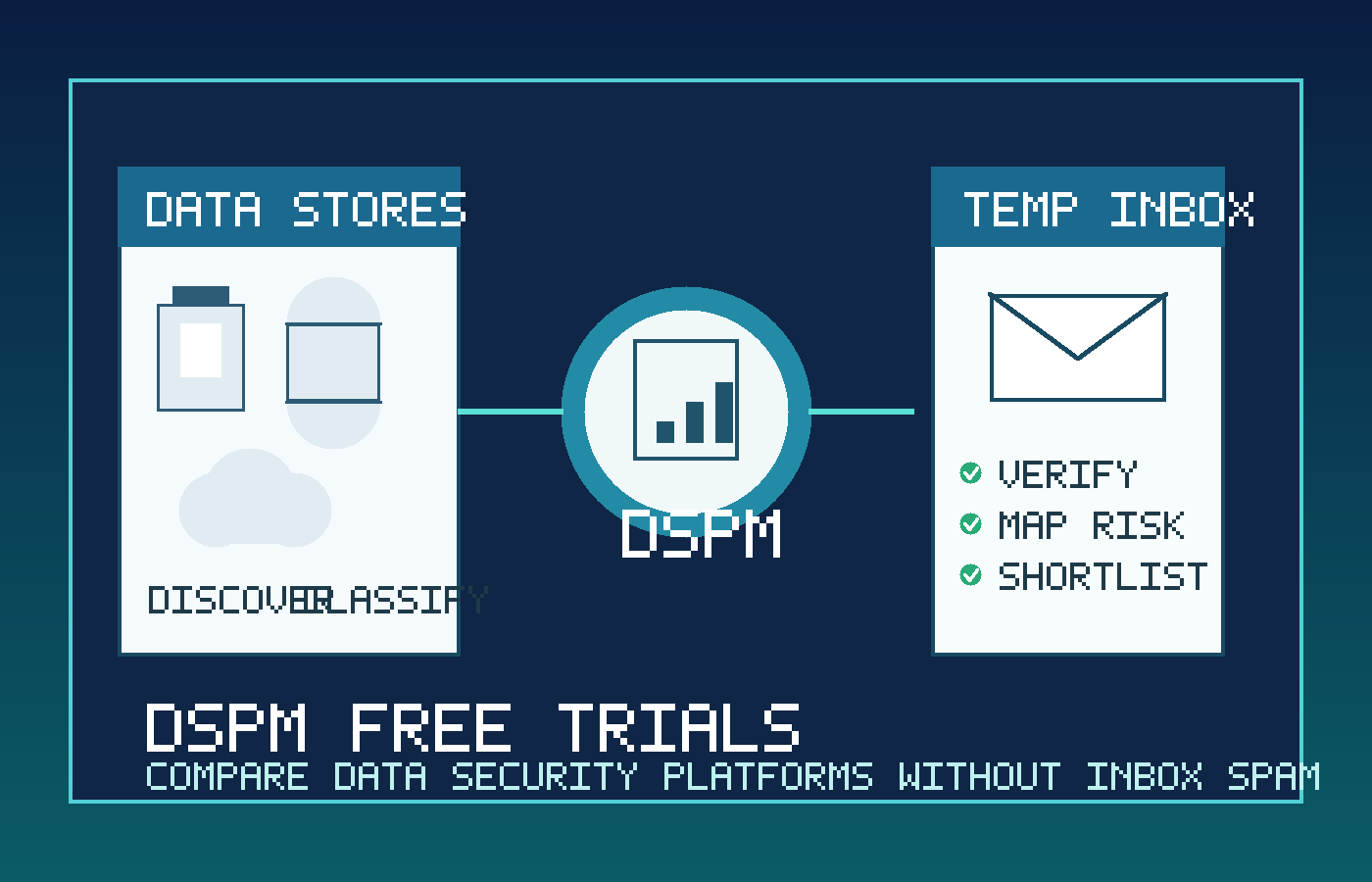
A temporary inbox gives you breathing room. You still receive the confirmation link and the first-day instructions you need, but you keep your long-term mailbox reserved for the few vendors that actually earn deeper evaluation. For security teams, privacy teams, and data-governance leads, that makes early research cleaner and less distracting.
Why DSPM is a good fit for this workflow
DSPM stands for data security posture management. These platforms help teams discover where sensitive data lives, understand exposure risk, map access paths, and prioritize remediation across cloud data stores, SaaS applications, and other modern environments. In practice, a DSPM evaluation often starts before you are ready for a long vendor relationship. You may simply want to answer a few urgent questions:
- Can this tool actually find sensitive data in the environments we care about?
- Does it show risky access clearly enough to act on?
- Will it create useful remediation work, or just another pile of alerts?
- Is it meaningfully different from our DLP, SSPM, CSPM, or broader cloud-security stack?
Those are practical evaluation questions, not buying-committee questions. That is exactly why a temporary inbox makes sense. You can get through verification, onboarding, and the first test cycle without turning a quick comparison into months of vendor follow-up.
Why DSPM trials generate so much email
DSPM is a consultative category. Vendors know buyers are often trying to solve complex visibility problems across cloud storage, analytics stacks, SaaS apps, and identity relationships. Because of that, trials rarely come with just one email. You may quickly receive:
- account activation and console login messages
- data-source connection instructions
- sample policy or classification guidance
- remediation playbook suggestions
- benchmark or maturity reports
- requests to schedule a walkthrough before you have even finished setup
- follow-up from multiple vendor contacts at once
If you are comparing two or three DSPM options side by side, your inbox can become part of the problem. Temporary email keeps the sign-up phase compartmentalized so your regular security or IT mailbox stays focused on actual work.
When to use a temporary email generator for DSPM software free trials
This approach is most helpful during the early evaluation stage, when you are still testing basic fit.
- You are building an initial shortlist. Maybe you want to compare discovery depth, data-mapping quality, and exposure reporting across several DSPM vendors before talking pricing.
- You need to verify access quickly. The immediate goal may be a trial login, a sandbox invite, or a setup checklist—not a full procurement conversation.
- You want to separate research from long-term communications. A temporary inbox lets you test tools first and commit later.
- You are reviewing adjacent categories too. DSPM often sits next to DLP, SSPM, CSPM, CNAPP, and identity tooling in broader security programs.
- You want less pressure while evaluating. It is easier to judge a platform honestly when every minor action does not trigger a new wave of outreach.
This is where Anonibox fits naturally. It gives you a quick inbox for the first phase, so you can gather the messages that matter, ignore the noise that does not, and keep your permanent address out of the loop until you decide a tool deserves it.
How to use a temporary inbox during a DSPM evaluation
1. Create the inbox before you start registration
Do not wait until after you have already signed up with your regular address. The benefit comes from isolating the vendor relationship from the start. If you begin with your normal mailbox, the follow-up sequences may keep going even if the tool is eliminated on day one.
2. Use it for verification and early onboarding
This is the ideal use case. You receive the confirmation email, the welcome note, and the first setup instructions. That is usually enough to decide whether the trial experience is promising or overly burdensome.
3. Save the messages you may need later
Temporary inboxes are good for access, not archival. Capture the information that matters early:
- activation links
- trial expiration dates
- setup instructions for data connectors
- notes on sample environments or sandbox limits
- support contact details in case you continue the evaluation
4. Test the product against real buying questions
A strong DSPM evaluation is not about admiring dashboard colors. It is about whether the platform gives your team better visibility and better decisions. Use the free trial to answer that, not just to consume the vendor’s nurture sequence.
5. Move finalists to a permanent team-controlled address
Once a platform becomes serious, change the contact path. Procurement, legal review, implementation planning, and long-term ownership belong under a durable mailbox your team controls.
What to evaluate inside a DSPM free trial
A temporary email strategy only helps if the trial itself is useful. Here are the questions worth focusing on while you have access.
Data discovery depth
Can the platform find sensitive data in the places you actually care about? That may include cloud object storage, data warehouses, managed databases, collaboration platforms, or SaaS apps. Some tools look broad in marketing but shallow in practice. Even a limited trial can reveal whether discovery feels real or superficial.
Classification quality
Discovery without context is not enough. Look at whether the platform distinguishes regulated, confidential, and business-critical data clearly. If the system labels everything important, then nothing is truly prioritized.
Exposure mapping
DSPM becomes valuable when it connects the dots between data, identities, permissions, public exposure, misconfigurations, and risky access patterns. A good trial should show you more than a list of assets. It should help you understand why a data exposure matters.
Remediation guidance
Does the product merely announce problems, or does it help teams act? Useful remediation guidance should make it clearer what to fix first, who probably owns the issue, and how risk can be reduced without endless manual interpretation.
Signal-to-noise ratio
Some platforms surface every possible condition and call it insight. Others do a better job of ranking truly meaningful exposures. During the trial, pay attention to whether the alerts feel actionable or exhausting.
Coverage across environments
If your team cares about cloud storage, SaaS apps, analytics tools, or hybrid data paths, the trial should show at least enough breadth to prove the product matches your environment. A narrow trial may still be fine, but only if it aligns with the risk you are trying to solve.
Operational usability
Security tools are easy to praise in theory and harder to live with in practice. Can analysts, governance teams, and engineering stakeholders all understand the interface? Can findings be shared cleanly? Does the workflow support collaboration instead of turning every review into a translation problem?
How DSPM differs from nearby categories
One reason this keyword is useful is that buyers often compare DSPM with several adjacent tools at once. The categories overlap, but they are not interchangeable.
- DLP focuses more on controlling and preventing data movement and policy violations.
- CSPM focuses on cloud misconfiguration and cloud posture at the infrastructure level.
- SSPM focuses on posture inside SaaS applications.
- CNAPP rolls together multiple cloud-security capabilities and may include DSPM features, but the experience is not always the same as a dedicated DSPM product.
If you are unsure which direction to take, using separate temporary inboxes for each category can make the comparison much easier. You can keep trial messages organized by product type instead of letting everything blend into one overloaded mailbox.
A practical example
Imagine a team investigating whether sensitive customer data is too broadly exposed across cloud storage and analytics environments. They shortlist three DSPM vendors. Each one requires email verification before access to the trial or guided evaluation environment. If the team uses its permanent shared security mailbox for all three signups, the next week may bring overlapping sales sequences, benchmark offers, architecture decks, follow-up reminders, and scheduling requests from each vendor.
If the team uses a temporary inbox for the first phase, the process is calmer. They verify access, review the onboarding flow, connect sample data sources, inspect discovery results, compare exposure mapping, and decide which vendor actually deserves a deeper proof of value. Only the finalists get the permanent team address. That keeps the trial focused on product quality instead of inbox management.
Mistakes to avoid
- Do not keep a disposable inbox attached once the evaluation becomes serious. Finalists should move to a team-owned email address.
- Do not forget to save setup details. Connector instructions and trial timelines matter more than vendor marketing emails.
- Do not treat temporary email as a security guarantee. It reduces clutter and early exposure, but it does not magically make every vendor interaction risk-free.
- Do not confuse adjacent categories. A platform with some DSPM features is not automatically the same as a DSPM-first product.
- Do not let urgency replace evaluation. A fast sales follow-up is not proof of product fit.
When to switch to your permanent email
Once a vendor reaches the stage where you are discussing production rollout, formal proof-of-concept scope, pricing, procurement, or long-term account ownership, it is time to stop using the temporary inbox. At that point the relationship should move to a durable mailbox your organization can retain and audit.
A simple rule works well: use temporary email for trial activation and first-pass comparison, then use your real team address when the product has earned continued attention.
Final takeaway
A temporary email generator for DSPM software free trials is a practical way to compare data security posture management platforms without letting every early-stage signup spill into your long-term work inbox. You still get the verification messages and onboarding steps you need, but you stay in control of when vendors gain access to your permanent contact channel.
If you are evaluating DSPM tools this year, use a temporary inbox for the first pass, judge vendors on discovery depth, classification quality, exposure mapping, and remediation workflow, and only move finalists to your main work email after they prove they deserve it.