Should you put your bank details on job applications? Usually no — most employers do not need your bank account or direct-deposit information at the first application stage.
If a legitimate employer needs payment details later, the safer move is to wait until you have verified the company, reached a real hiring or onboarding step, and can use a secure payroll or HR process instead of a random form, email, or text thread.
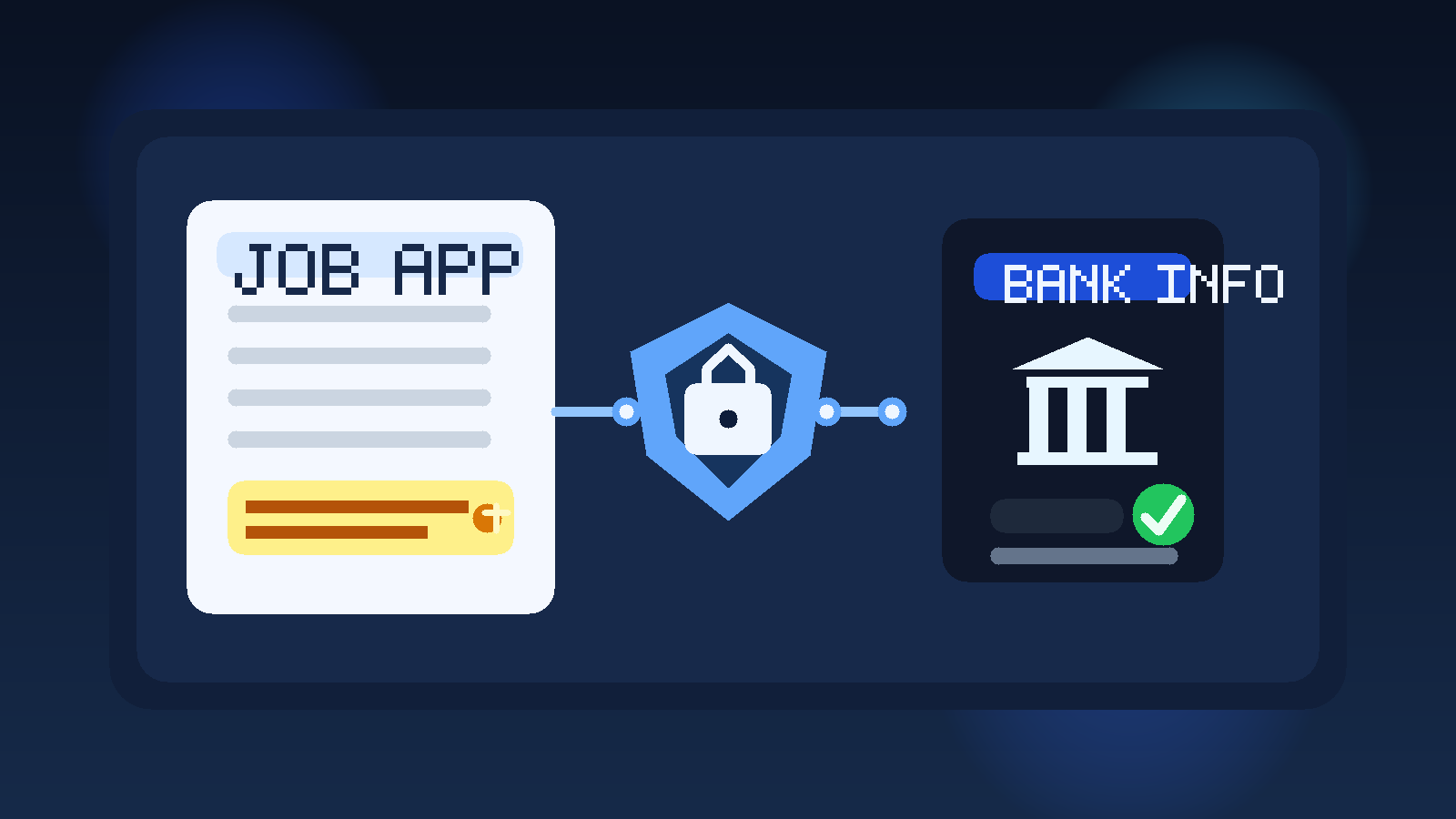
Bank details are not ordinary contact information. Your name, email address, and work history are one thing. Your routing number, account number, debit details, and direct-deposit instructions are much more sensitive. Once you share them, you have far less control over where they go, how they are stored, and who can use them.
That is why this question matters so much for job seekers. Real employers sometimes need payment information eventually, especially after an offer is accepted or when payroll setup begins. But scammers also know that people looking for work are often under pressure, eager to respond quickly, and willing to fill out forms that seem official. A fake job can turn into a bank-details scam fast if you hand over financial information before the hiring process is clearly legitimate.
So the practical answer is not just “never” or “always.” It is to understand when payment details make sense, why an employer is asking, and how you should provide them if the request is real.
Short answer: do not share bank details on an initial application unless there is a verified, job-specific reason and a clearly secure process
Most hiring teams can review your qualifications, schedule interviews, and decide whether to move forward without any bank information at all. For normal salaried, hourly, and professional roles, bank details usually belong much later in the process — after an offer, during onboarding, or inside a dedicated payroll system.
If an application asks for them immediately, caution is warranted. A legitimate explanation may exist in rare cases, but you should assume the burden is on the employer to explain why that information is needed now instead of later.
Why some employers might eventually need bank details
There are legitimate situations where a company needs payment information. The key word is eventually.
- Payroll setup after hire: once you accept a job, direct deposit details are commonly collected so you can be paid.
- Contractor or freelancer onboarding: some companies need payment details before they can issue invoices or pay approved work.
- Expense reimbursement: a company may later need a bank account if it reimburses travel or out-of-pocket expenses electronically.
- Staffing or temporary-work administration: agencies sometimes collect payment information during a formal onboarding stage after placing or activating candidates.
Those are real use cases. But notice what they have in common: they happen after the process has moved beyond a basic “submit your application” step. A normal employer does not need your bank account merely to decide whether your resume is worth an interview.
Why sharing bank details too early is risky
1. Direct financial exposure
Unlike a simple contact field, bank details can be tied directly to money movement, billing fraud, account-verification scams, or identity abuse. Even if one piece of information is not enough to drain an account on its own, it still increases your exposure.
2. Job scams are built around urgency
Many fake-job schemes try to create a fast emotional sequence: congratulations, you are hired, we need your information today, complete this payroll form now, use this link, reply before the role is reassigned. People who are excited or stressed can move too fast. That is exactly what scammers want.
3. Weak storage and bad processes
Even when the employer is real, the process may not be ideal. A recruiter asking you to email a voided check, text a screenshot of your banking app, or upload payment details through a sloppy third-party form may be creating unnecessary risk. Poor handling is not always malicious, but it is still a problem.
4. Data can spread farther than you expect
Application data may pass through job boards, applicant-tracking systems, staffing vendors, payroll platforms, and internal HR teams. The earlier you provide sensitive financial information, the more systems may end up touching it.
When a bank-details request is a red flag
Some requests should make you slow down immediately.
- You have not interviewed yet, but they already want payment details.
- The job offer arrived unusually fast or without a real evaluation process.
- The employer is pressuring you to fill out payroll forms before you have verified the company.
- You are being asked to send bank details by email, text message, WhatsApp, or Telegram.
- The company domain, forms, or recruiter identity do not match what the business publicly uses.
- The role includes other scam markers: vague responsibilities, unusually high pay, poor grammar, mystery clients, or a demand to move off-platform immediately.
In those situations, the bank-details request is not just a privacy issue. It may be one part of a broader fraud pattern.
What about direct-deposit forms sent before your first day?
Sometimes a legitimate employer sends onboarding paperwork between offer acceptance and your first day. That can include tax forms, identity verification, benefit enrollment, and direct-deposit setup. In other words, a pre-start request is not automatically suspicious.
What matters is context:
- Did you actually interview with the company?
- Do you have a written offer from a verifiable domain?
- Can you confirm the HR contact independently?
- Are you entering the information into an official HR or payroll portal rather than replying to an informal message?
If the answer to those questions is yes, then a payment request may be normal. If the answer is no, slow down.
How to respond if an application asks for bank details too early
1. Verify the employer first
Do not judge legitimacy only by the message you received. Check the company website, careers page, LinkedIn presence, and public contact details. If a recruiter is involved, verify that person through the company’s official channels.
2. Ask why the information is needed now
A simple question can tell you a lot: “Can you explain why bank details are required at the application stage rather than during onboarding?” A real employer should be able to answer clearly. A scammer often becomes vague, pushy, or defensive.
3. Look for a safer alternative
If the request is legitimate but premature, ask whether you can provide the information after an offer is made or inside a secure payroll portal later. In most cases, that is the more sensible workflow anyway.
4. Do not send sensitive details through casual channels
Even if the company is real, avoid sending routing numbers, account numbers, or images of banking documents over ordinary email or chat unless the employer has a clearly secure process and a strong reason to use it.
5. Trust the stage of the process
Applications are for evaluation. Onboarding is for administrative setup. Mixing those stages is where many problems start.
When it may be reasonable to provide bank details
There are situations where the answer changes from “no” to “yes, with care.”
- You accepted a verified offer and the employer is completing normal payroll onboarding.
- You are joining through a legitimate staffing firm and have confirmed the placement and pay process.
- You are a contractor or freelancer and need an approved payment method on file before work begins.
- You are using an established HR platform tied to a company you have independently verified.
Even then, “reasonable” does not mean “careless.” You should still confirm the portal, review the sender domain, and make sure you understand exactly what you are providing and why.
Common scam patterns to watch for
Fake payroll setup before a real offer
This is one of the cleanest warning signs. If someone is acting like you are already an employee before a real interview process has even happened, treat that as suspicious.
Overpayment or reimbursement scams
Some scammers say they need your banking information so they can “send equipment funds,” “advance your stipend,” or “set up a reimbursement.” That often leads to fake-check or payment-reversal schemes.
Impersonated HR portals
A link can look professional while still being fake. Check the real domain carefully. Scammers rely on people noticing the brand name but not the web address.
Pressure to act immediately
Urgency is one of the oldest scam tools. A legitimate employer may have deadlines, but they can usually explain them calmly and professionally. Fraudsters tend to push first and explain later.
A privacy-first workflow for job seekers
A good rule is to share information in layers instead of all at once.
- Application stage: resume, contact details, work history, and only the essentials needed to be evaluated.
- Interview stage: scheduling details, portfolio links, references if appropriate, and role-specific documentation when requested by a verified employer.
- Offer and onboarding stage: tax forms, identity verification, payroll setup, and other truly sensitive administrative data.
This layered approach gives you more control. It also makes it easier to spot requests that are coming too early.
Email privacy fits into this same strategy. Many job seekers already use a separate inbox for applications, recruiter outreach, and job-board signups so their main address does not get buried in alerts and follow-up campaigns. A tool like Anonibox can help keep that early-stage communication organized while you decide which opportunities are real and worth deeper engagement. The same mindset applies to financial data: keep sensitive information out of the first round until trust is established.
What if the field is required?
If a form makes bank details mandatory at the application stage, pause before you comply automatically.
- Confirm the employer and the platform are real.
- Check whether the field is truly required or just looks required because of bad form design.
- Contact the employer directly through a published channel and ask whether that field is normal for applicants.
- Decide whether the privacy trade-off is acceptable.
If the employer cannot explain the requirement clearly, skipping the application may be safer than forcing yourself through a risky process.
A quick decision checklist
Before sharing any bank information, ask yourself:
- Have I verified the employer independently?
- Have I actually reached the onboarding or payment setup stage?
- Is there a clear business reason for this request right now?
- Am I using a secure, official portal rather than a casual message thread?
- Does anything else about the job seem rushed, vague, or inconsistent?
If several answers are uncertain, do not share the information yet.
Final answer: should you put your bank details on job applications?
Usually no. For most roles, bank details are not needed to evaluate your candidacy, schedule interviews, or make an offer. They belong much later in the process, once the employer is verified and payroll or contractor onboarding is actually underway.
The safest approach is to treat financial information as a last-stage administrative detail, not a first-stage application field. If a real employer needs it later, they should be able to explain why and collect it through a secure, professional process. Until then, protect your privacy, verify the opportunity carefully, and do not let urgency push you into giving away more than the application truly needs.