Should you put marital status on job applications? Usually no – unless the employer has a specific, legitimate reason to ask and you understand why that field is there.
For most job applications, marital status is not needed to judge whether you can do the job, and sharing it too early can create unnecessary privacy and bias risk.
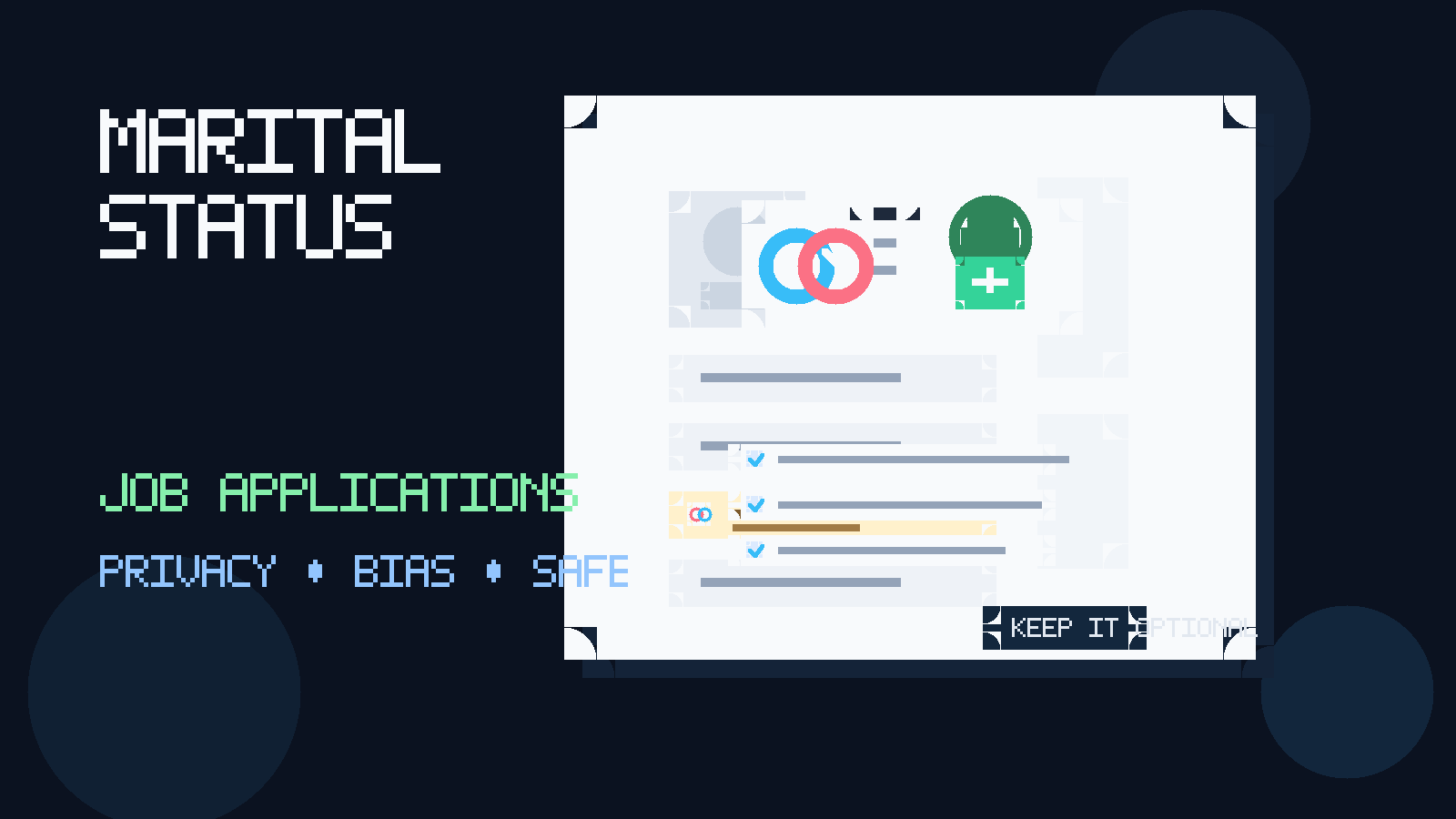
That does not mean every mention of marital status is automatically suspicious. In some countries, industries, or older HR workflows, the question still appears. But a field appearing on a form is not the same thing as the information being necessary at the first stage of hiring.
The practical rule is simple: give employers what they need to evaluate your experience, skills, availability, and right to work, but be cautious about volunteering personal details that do not improve your candidacy. Marital status usually belongs in that second category.
Short answer: most job seekers should leave it off unless there is a clear reason to provide it
If the field is optional, leaving it blank is usually the safest move. If it is required, slow down and verify the employer, the application channel, and the reason the information is being requested before you continue.
For most roles, an employer can decide whether to interview you without knowing whether you are single, married, divorced, widowed, or in another family situation. That is why many job seekers treat marital status as information to protect unless there is a real need later in the process.
Why this question comes up in the first place
Job seekers usually ask this because application forms are not always designed with modern privacy norms in mind. Some are built from old templates. Some are adapted from international hiring workflows. Some collect far more information than the recruiter reading the application actually needs.
That is also why job-application advice is a little different from resume advice. On a resume, the answer is normally very clear: keep irrelevant personal details off. That is the logic behind Should You Put Marital Status on Your Resume?. On an application form, the employer controls the fields, so your decision becomes less about formatting and more about privacy judgment.
Why sharing marital status too early can be a bad idea
1. It is usually irrelevant to the role
Most employers do not need marital status to assess whether you can do the work. It does not tell them whether you can sell, code, write, manage projects, answer support tickets, or operate equipment. If a detail is not helping them evaluate your fit, there is rarely a strong reason to hand it over during the first screen.
2. It can introduce bias signals
Marital status can trigger assumptions that have nothing to do with your ability. A hiring team might speculate about family obligations, relocation flexibility, schedule stability, or future plans even when they should be focused on your qualifications. Whether that bias is conscious or not, there is no real upside to supplying the signal early if the employer does not truly need it.
3. It expands your personal data footprint
Every application can pass through several systems: job boards, applicant tracking systems, staffing agencies, outsourced screeners, internal HR tools, and background-check vendors. The more personal data you add at the start, the more widely it can spread before you even know whether the opportunity is serious.
4. Some forms are simply outdated or overly invasive
Not every form field exists because it is important. Sometimes it exists because nobody removed it. A field being available does not automatically make it appropriate, just as a form asking for your date of birth or photo does not always make those details necessary. That same caution is worth applying here.
When an employer might ask later
There are situations where family or household information can come up later in a legitimate process, but that is very different from asking for marital status on the first application page.
- Benefits enrollment: if you receive an offer, HR may eventually need family-related information for insurance or other benefits.
- Relocation or immigration workflows: some employers gather family details later when moving or visa support is relevant.
- Country-specific paperwork: hiring norms vary internationally, and some systems ask for more personal data than others.
- Formal onboarding records: internal HR or payroll paperwork may collect details that are not needed during initial screening.
The key distinction is timing. Later administrative paperwork is different from early-stage applicant evaluation. A legitimate employer may eventually need more information, but that does not mean they need it before deciding whether to talk to you.
If the field is optional, what should you do?
If the field is optional, the best default is to leave it blank. That is especially true when you are applying through a job board, working with a recruiter you have not verified yet, or submitting an application to a company you have not researched carefully.
Leaving it blank does not make you difficult. It simply means you are limiting irrelevant personal disclosure. If the employer later has a valid reason to ask, they can do so at a more appropriate stage.
If the field is required, slow down before you answer
A required field changes the decision. You may have to choose between sharing the information, contacting the employer for clarification, or skipping the application. Before choosing, take a few practical steps.
Verify the employer independently
Do not rely only on the job board posting. Visit the employer’s official website, confirm the role exists there, and make sure the branding, contact details, and application path are consistent.
Look at the full context of the request
Is the marital-status field the only unusual question, or is the form also asking for other unnecessary personal information early? A single legacy field might point to an old HR system. A cluster of invasive questions can be a stronger reason for caution.
Check whether there is a neutral option
Some systems offer choices such as “prefer not to say” or let you continue without completing the field properly even when it appears required. If that option exists, it is often the cleanest compromise.
Ask HR if appropriate
If the company looks legitimate and you care about the role, you can ask whether the information is required at the application stage or can be provided later if needed. A real HR team may not change the form, but they should be able to explain why the field is there.
Decide whether the privacy trade-off is worth it
Sometimes the honest answer is no. Even if the employer is real, you are not obligated to be comfortable with every data-collection practice. You can decide that a process asking for too much too early is not one you want to continue with.
Red flags that should make you more cautious
- The company is hard to verify or barely has a web presence.
- The recruiter uses a generic email account and pushes urgency.
- The form asks for marital status alongside highly sensitive details such as bank information or identity numbers before any interview.
- The job description is vague, badly copied, or inconsistent across platforms.
- The process quickly shifts from a normal careers page to text, WhatsApp, or Telegram.
- The application page looks broken, off-brand, or unrelated to the employer.
Marital status alone may not prove a scam, but it can be part of a broader pattern of poor data handling. When several warning signs stack up, protecting your information matters more than finishing the form quickly.
How this relates to other job-application privacy questions
Marital status sits in the same general bucket as other personal details that often appear earlier than they should. If you are already thinking carefully about date of birth on job applications or whether you should include a photo on job applications, the same principle applies here: if it is not necessary for first-stage evaluation, keep it out unless there is a clear reason.
The goal is not to be secretive. The goal is to separate information that genuinely helps an employer assess your fit from information that only increases your exposure.
Safer privacy habits during a job search
Marital status is only one part of the bigger job-search privacy picture. A few habits make the whole process safer:
- Use a professional email address that you check consistently.
- Be selective about where you share your phone number.
- Verify unfamiliar employers before sending extra personal information.
- Keep sensitive documents and identity details for later stages unless the employer is clearly legitimate.
- Track where you applied so unexpected outreach is easier to recognize.
If you are trying to keep early-stage applications, job-board signups, and recruiter traffic out of your main inbox, a separate workflow with a service like Anonibox can help reduce clutter and limit spam exposure. That is useful for email hygiene, especially when you are exploring lower-trust job boards or signing up for alerts. But it does not make an invasive marital-status question automatically safe. You still need to judge the employer and the reason for the request.
A quick decision checklist
Before you answer a marital-status field, ask yourself:
- Is this a verified employer and a real role?
- Is the field optional or required?
- Does the employer have any clear reason to need this now?
- Are there other privacy red flags in the form?
- Would I be comfortable with this information being stored across multiple hiring systems?
If the answers do not inspire confidence, caution is the better default.
Final answer
Should you put marital status on job applications? Usually no. For most job seekers and most roles, it is not relevant to first-stage screening, and sharing it early creates more privacy and bias risk than benefit.
If the field is optional, leave it blank. If it is required, verify the employer, look for a neutral option, and decide whether the opportunity is worth the disclosure. A careful job search is not just about finding the right role. It is also about keeping control over personal information that does not need to be everywhere from day one.