Usually only if a legitimate employer clearly asks through an optional self-identification field and you are comfortable answering — most job seekers do not need to volunteer their gender in the main body of a job application.
If the field is optional, leaving it blank is often fine. If it is required, pause, verify that the employer and application system are legitimate, and decide whether the opportunity is worth the privacy trade-off.
This question comes up because job applications are messy. Some forms ask for demographic details as part of optional self-ID or equal opportunity reporting. Some older or poorly designed systems mix those questions into the same page as your contact details and work history. Some recruiters ask for more information than they really need. That makes it easy to feel unsure about what is normal, what is optional, and what you should protect.
The practical answer is not “always yes” or “always no.” It depends on where the question appears, why it is being asked, and how much trust you have in the employer and the application process.
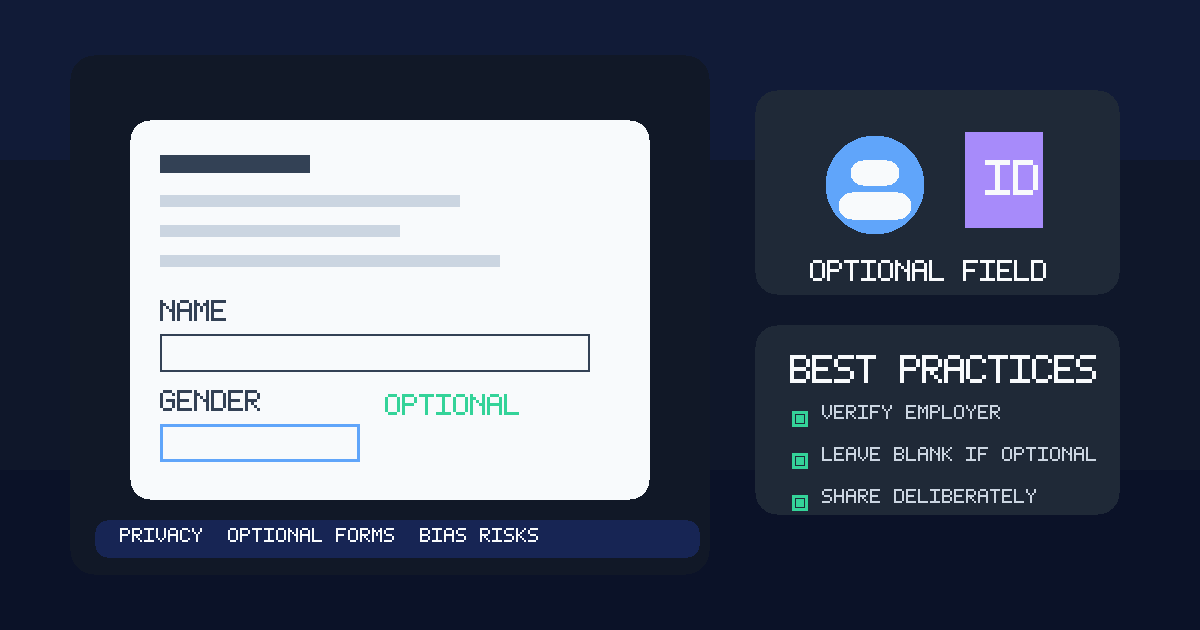
Short answer: usually optional, not core application information
For most roles, your qualifications do not depend on listing your gender. Employers mainly need your name, contact details, work history, relevant skills, availability, and any role-specific legal or operational requirements. Gender usually sits outside that core group.
That is why many employers treat gender questions as optional self-identification rather than required hiring information. If a form asks for it but also gives you options like “Prefer not to say” or leaves it clearly optional, that is a strong clue that you are not expected to provide it in order to be considered.
Why job applications ask for gender in the first place
There are a few common reasons this question appears:
- Equal opportunity reporting: some employers collect demographic information for internal reporting, compliance workflows, or diversity tracking.
- Standardized HR software fields: some applicant tracking systems include demographic sections by default, even when the hiring team does not need that information for screening.
- Regional norms: application practices vary by country, industry, and employer. Some markets ask for more personal information than others.
- Poor form design: sometimes a field appears simply because a template included it, not because it is necessary.
The existence of the field does not automatically make the employer shady. But it also does not mean you must answer without thinking. A lot depends on whether the question is clearly optional and whether the employer handles it professionally.
Important distinction: optional self-ID form vs. main application field
This is the part many job seekers miss. There is a big difference between:
- an optional self-identification form meant for HR reporting or aggregate data, and
- a visible required application field mixed into your personal profile, résumé upload, or screening form.
If the employer clearly separates the demographic section, labels it optional, and offers a “Prefer not to say” choice, that is usually a more normal and lower-friction situation. If the application demands gender as a required field with no explanation and no opt-out, the privacy trade-off is more serious.
That distinction matters because a well-designed optional self-ID flow gives you a real choice. A mandatory unlabeled field often does not.
When it can be reasonable to answer
There are situations where including your gender is probably fine if you feel comfortable doing it:
- You are applying directly through a legitimate company careers page.
- The question is in a clearly marked optional self-identification section.
- The form offers a “Prefer not to say” option, showing the employer understands it is sensitive information.
- You have already researched the employer and trust the application process.
- You personally do not mind sharing that information in this context.
In those cases, the risk may be low enough that the field does not deserve much energy. Plenty of applicants fill optional demographic sections without any issue. The important part is that it feels voluntary, transparent, and tied to a real employer.
When it makes sense to leave it blank or decline
You should be more cautious when:
- the application is on a low-trust job board or a thin landing page you cannot verify,
- the field is required without explanation,
- there is no “Prefer not to say” option,
- the employer or recruiter already seems careless with personal data, or
- the role itself looks suspicious, rushed, or inconsistent.
If the field is optional, leaving it blank is often the cleanest move. If the field is required and the role feels questionable, that can be a sign to stop and reassess the opportunity instead of forcing your way through the form.
What are the privacy and bias risks?
Gender may feel less sensitive than a Social Security number or bank details, but it is still personal information. Sharing it too freely can create risks you do not need to take.
1. More personal data exposure than necessary
Every extra field you fill out gives another system, recruiter, vendor, or employer more data about you. That may not sound dramatic, but privacy problems usually come from accumulation rather than one huge mistake.
2. Bias concerns
Many job seekers worry that gender information could affect how they are perceived. Even where employers try to separate demographic tracking from candidate review, not every process is perfect. If the field is optional and you would rather not disclose it early, that is a reasonable privacy choice.
3. Low-quality recruiter databases and spam
Some third-party forms collect more profile information than they really need. That can lead to your data sitting in systems you would not have chosen intentionally.
4. Identity-footprint expansion
Your job search already spreads your name, email, career history, and sometimes phone number across many platforms. Adding more profile data to every application increases that footprint.
What if the field is required?
If a legitimate application will not let you move forward without answering, you have to make a practical decision. Start with three quick questions:
- Is this clearly a real employer?
- Is the role genuinely worth pursuing?
- Am I comfortable with this privacy trade-off?
If the answer to all three is yes, you may decide the opportunity is worth completing as-is. If the employer is real but the field still bothers you, look for a “Prefer not to say” option, FAQ note, privacy policy, or alternate application route.
If the employer is hard to verify, the form feels sloppy, or the request seems excessive compared with the stage of the process, walking away is often the smarter move.
How to handle gender questions professionally
If you run into this field and want a balanced approach, use this checklist:
- Verify the employer first. Apply through the official careers page when possible, not a random reposted form.
- Check whether the field is optional. Many people answer too quickly and miss that they can leave it blank.
- Look for a privacy or equal opportunity explanation. A professional employer often explains why the data is being collected.
- Prefer “Prefer not to say” when available if you are unsure.
- Do not volunteer extra explanation. You do not need to justify why you skipped a demographic field.
That keeps the decision calm and practical instead of emotional. You are not being difficult. You are managing your personal data on purpose.
How this fits into a broader privacy-minded job search
Gender is only one part of the bigger picture. Job seekers also end up making decisions about phone numbers, work emails, home addresses, salary history, references, LinkedIn profiles, and other personal details long before they know which employers are worth trusting.
That is why it helps to treat applications in layers:
- Layer 1: basic qualifications and contact details you expect to share widely.
- Layer 2: information you share selectively, such as your phone number or current employer details.
- Layer 3: sensitive demographic or financial information you only share when there is a clear reason.
Using a separate job-search email can also help you keep those layers organized. For example, if you are applying broadly and want to limit spam while you figure out which opportunities are real, a dedicated inbox strategy with a tool like Anonibox can keep early-stage applications out of your primary personal email. That does not solve every privacy issue, but it reduces one common source of clutter and exposure.
Red flags that deserve extra caution
Be more careful if the gender question appears alongside other warning signs such as:
- requests for sensitive information far too early,
- no clear company identity or official website,
- pressure to finish immediately,
- recruiters who avoid company email addresses, or
- forms that ask for far more personal data than the role seems to justify.
One odd field alone does not prove a scam. But several signals together should push you toward caution.
Final answer: should you put your gender on job applications?
Usually only if the employer clearly asks, the process looks legitimate, and you feel comfortable answering. Most job seekers do not need to volunteer gender in the main body of a job application, and leaving an optional field blank is often completely reasonable.
The best rule is simple: treat gender like personal information, not automatic form filler. Share it when there is a clear context and a trustworthy employer, skip it when it is optional and you would rather not disclose, and slow down when the application process feels vague or invasive. That gives you a more private, more deliberate, and usually safer job search.