Should you put your disability on job applications? Usually only when a legitimate employer asks through a clearly optional self-identification or accommodations process and you are comfortable sharing it.
For most applications, you do not need to volunteer disability information in the main body of the form just to be considered, and leaving optional disclosure fields blank is often a reasonable choice.
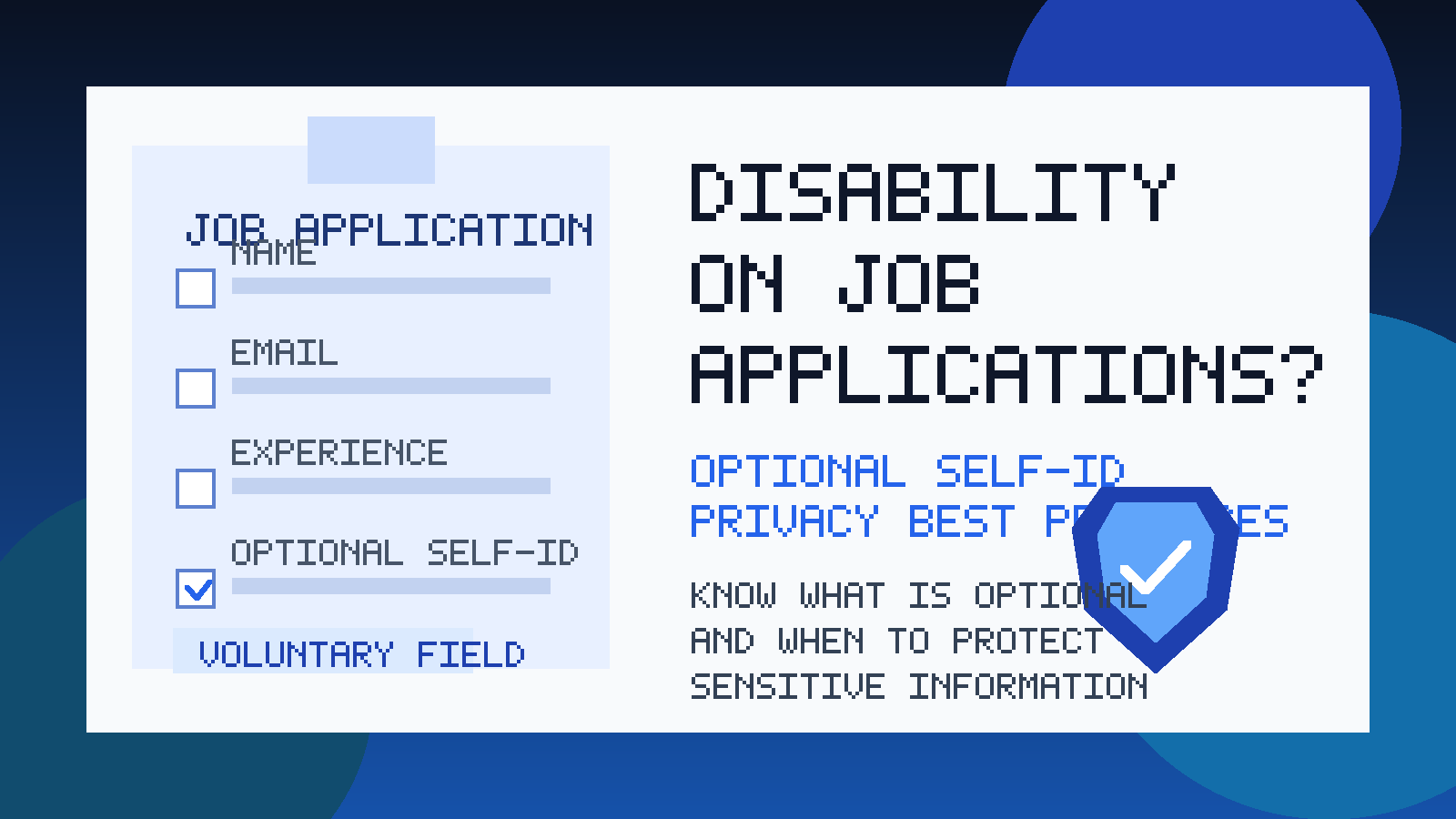
That is the practical answer, but the real decision is a little more nuanced. Disability questions show up in different places for different reasons. Some employers use separate self-ID forms. Some application systems include broad demographic sections by default. Some recruiters ask clumsy questions they probably should not ask that early. And some job seekers need to think about accommodations, timing, privacy, and bias all at once.
So the goal is not to memorize a blanket yes-or-no rule. The goal is to understand what kind of question you are looking at, how legitimate the employer is, and how much control you want to keep over sensitive information.
Short answer: usually not in the core application, sometimes in an optional self-ID flow
For most roles, your qualifications are not improved by listing a disability in the main application itself. Employers usually need your experience, relevant skills, portfolio, availability, and contact details first. Disability information often sits outside that core evaluation.
That is why many employers treat disability questions as optional self-identification rather than a required part of screening. If the form clearly says the question is voluntary, includes a “Prefer not to say” style option, or appears in a separate demographic section, that is a signal that you are not expected to disclose it in order to be considered.
If a disability is directly relevant to the role, your lived experience, or an accommodations conversation you actively want to begin, disclosure may make sense. The important part is that it should be intentional and tied to a real reason, not something you feel forced to type into every form by default.
Important distinction: self-ID form, main application field, and accommodations request are not the same thing
A lot of confusion comes from treating three different situations like they are one decision.
1. Optional self-identification form
This is the most common place disability questions appear. A larger employer or applicant tracking system may include a separate section for demographic or equal-opportunity reporting. If it is truly optional and clearly labeled, answering it is different from volunteering disability information in your resume summary or cover letter.
2. Main job application field
If disability appears as a required field mixed into the main application with no explanation, the privacy trade-off is much more serious. That does not automatically mean the employer is bad, but it does mean you should slow down and decide whether you trust the process.
3. Accommodation request
If you need an interview accommodation or later a workplace accommodation, that is usually its own conversation. You can request what you need without turning the first version of your job application into a broad disclosure document.
Once you separate those three scenarios, the decision becomes easier. You are not really asking “Should I always disclose my disability on applications?” You are asking “What is this field for, who will see it, and do I want to share this information here?”
Why employers ask about disability at all
There are a few reasons disability questions show up in hiring systems:
- Standard HR software templates: many application systems include demographic modules by default.
- Internal reporting or equal-opportunity tracking: some employers collect aggregate information separately from the hiring decision.
- Accommodation planning: an employer may want a path for candidates to request support if they need it.
- Poor form design: sometimes a field appears simply because nobody cleaned up an old template.
The presence of a disability question does not automatically mean the employer is doing something wrong. But it also does not mean you have to answer casually. The context matters more than the existence of the field itself.
When it can be reasonable to answer
There are situations where sharing disability information may be perfectly reasonable.
- You are applying directly through a legitimate company careers page you have verified.
- The question appears in a separate optional self-identification section.
- The form explains why the data is being collected and offers a clear opt-out choice.
- You need to open the door to an accommodations conversation soon.
- Your disability is directly relevant to the work, such as accessibility, disability advocacy, assistive technology, or lived-experience-led roles.
- You are personally comfortable being open in this context.
In those cases, disclosure can be a calm, deliberate choice rather than a risk you are being pushed into. Some job seekers prefer openness from the start. Others prefer to wait until there is a real interview or offer conversation. Both approaches can be valid.
When leaving it blank is often the better move
There are also plenty of cases where not answering is the cleaner, safer choice.
- The field is optional and you would rather keep the information private.
- The employer is unfamiliar and the application flow feels vague or sloppy.
- The question appears too early with no explanation.
- There is no “Prefer not to say” or similar choice.
- You are applying through a third-party job board or recruiter form rather than an official employer page.
- You do not yet know whether the opportunity is real enough to justify the privacy trade-off.
Leaving an optional disability field blank is not the same as being dishonest. It is simply choosing not to volunteer sensitive information earlier than necessary.
What if the field is required?
If the system will not let you continue without an answer, pause before you treat that as normal. Ask yourself:
- Is this clearly a legitimate employer or hiring platform?
- Is the role valuable enough that I am willing to make this privacy trade-off?
- Is there any alternate route, such as applying on the official careers page instead of a third-party mirror?
If the employer is real and the opportunity matters to you, you may decide to proceed. But if the role already feels shaky, a mandatory disability field with no context can be a reason to stop. A good application process should not make you guess how deeply personal information will be handled.
If the employer looks legitimate but the form still feels off, look for a privacy policy, FAQ, or recruiter contact. Sometimes the better move is to apply through the company site directly or email recruiting for clarification rather than forcing your way through a questionable form.
Privacy and bias risks to think about
Disability information may not be as obviously sensitive as a Social Security number or bank account, but it is still personal data. Once you share it, you lose some control over where it goes and who sees it.
More exposure than you may intend
Job applications move through applicant tracking systems, third-party vendors, recruiters, coordinators, and hiring managers. Even when the employer means well, the information may end up visible to more people and systems than you expected.
Bias concerns
Many employers try to handle disability-related information appropriately, but hiring decisions still involve people, and people do not all bring the same level of awareness or care. If you are concerned about assumptions being made too early, that concern is reasonable.
Loss of timing control
Sometimes the biggest issue is not whether you will ever disclose. It is whether you want to do it before a recruiter has even decided to speak with you. Timing matters. Many job seekers prefer to discuss sensitive topics when there is more context and less guesswork.
Low-trust databases and recruiter lists
Third-party application forms, talent pools, and reposted job listings can collect more personal information than they really need. If the role never turns into a real conversation, you may still have given away more than you wanted.
How to handle accommodations without oversharing
Needing an accommodation does not mean you have to write a mini medical disclosure in every application. Usually the more practical path is to separate the support you need from the broadest stage of the process.
For example, if you need captioning, extra time for a test, a different interview format, a screen-reader-friendly document, or another specific adjustment, it is often easier to raise that once an interview or assessment is actually scheduled. Then the conversation is tied to a real need and a real next step.
You also do not need to share every detail. In many cases, what matters most is the adjustment itself, not an expansive explanation of your diagnosis or medical history. Keeping the request focused can protect your privacy while still helping you get what you need.
When disclosure may help instead of hurt
There are cases where disclosing disability information can strengthen the application rather than complicate it.
- You are applying for disability advocacy, accessibility, inclusive design, or assistive technology work where lived experience is directly relevant.
- You have already made disability part of your public professional identity through speaking, writing, community work, or portfolio projects.
- You want to be open because it aligns with your values and your personal comfort level.
Even then, context matters. It is usually better to connect the disclosure to your perspective, accomplishments, or role relevance rather than dropping it into the application without explanation.
Red flags that deserve extra caution
Be more careful if the disability question appears alongside other warning signs, such as:
- no clear company identity or official careers page,
- pressure to finish the application immediately,
- recruiters who avoid company email addresses,
- requests for financial or identity documents far too early,
- application pages that look broken, generic, or copied from somewhere else, or
- forms that ask for a large amount of sensitive information before any real interview process exists.
One awkward field alone does not prove a scam. But when a disability question shows up alongside several other privacy red flags, it is smart to step back instead of pushing forward automatically.
A practical decision checklist
Before you answer a disability-related field on a job application, run through this quick checklist:
- Is this a real employer or a verified application system?
- Is the question clearly optional, separated, and explained?
- Do I actually want to disclose this at this stage?
- Would waiting until an interview or accommodations conversation give me more control?
- Does this role justify the privacy trade-off?
- Is anything else about the form making me uneasy?
If the answers point toward a professional, transparent process, disclosure may be fine. If the answers point toward confusion, pressure, or unnecessary exposure, holding back is often the wiser move.
How this fits into a broader privacy-minded job search
Disability disclosure is only one piece of job-search privacy. Applicants also make decisions about personal email, work email, phone numbers, home addresses, salary details, references, LinkedIn profiles, and identity documents long before they know which companies are worth trusting.
That is why it helps to use a layered approach. Share the basic information you need to get considered, share more sensitive details only when there is a clear reason, and keep your search organized. For example, many job seekers use a separate application email with a tool like Anonibox so that early-stage forms and recruiter follow-ups do not spill into their primary inbox. That will not solve every privacy issue, but it can reduce clutter and give you a bit more control while you decide which opportunities are real.
Final answer: should you put your disability on job applications?
Usually only if the question is clearly optional or contextually necessary, the employer looks legitimate, and you are comfortable sharing it. Most job seekers do not need to volunteer disability information in the main body of a job application just to be considered.
The best rule is to treat disability like sensitive personal information, not automatic form filler. Share it when there is a clear reason, keep it private when there is not, and separate accommodations conversations from broad early-stage applications whenever possible. That gives you more control, better privacy, and a calmer way to navigate a sensitive part of the hiring process.