Yes—if a legitimate application specifically asks about convictions or criminal history, answer truthfully and narrowly based on the question and your local rules. If the form does not ask, or if the law where you live limits when employers can ask, do not volunteer more than necessary.
That is because criminal-record questions are sensitive, rules vary widely by country, state, and city, and oversharing too early can create privacy risk without improving your chances.
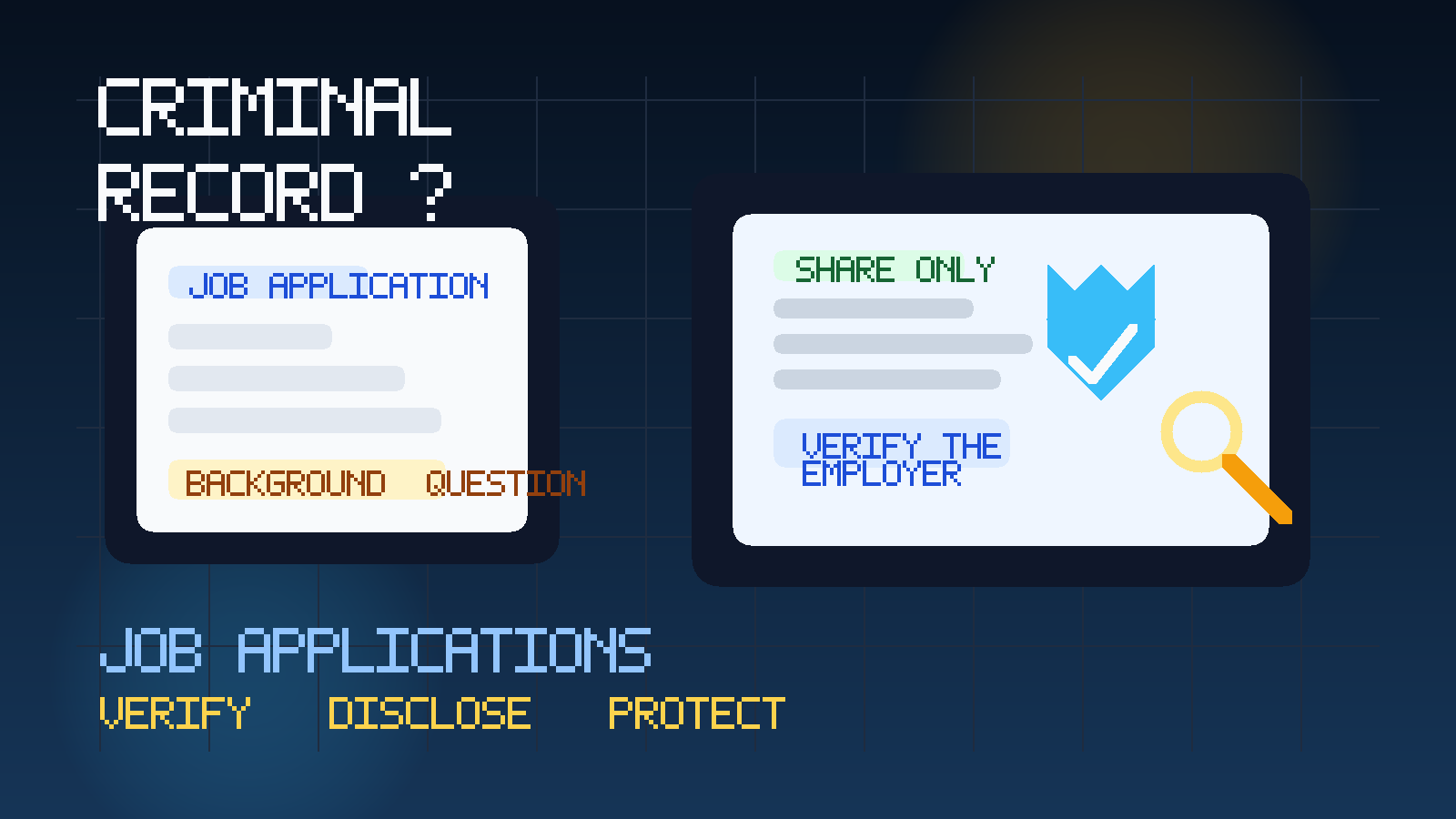
For job seekers, this sits in the same privacy-heavy category as whether to share your Social Security number, whether to disclose your current employer, or whether it is smarter to use a separate email address for applications. A criminal record can affect hiring decisions more directly than most other fields, so the best answer is not a blanket yes or no. It depends on what the employer is asking, when they are asking it, and what the law allows in your area.
Short answer
If a verified employer or official application portal asks a lawful criminal-history question, you should usually answer honestly and as precisely as possible. If the form does not ask, you generally do not need to bring it up on your own. And if you are not sure whether the question is appropriate where you live, it is worth checking local fair-chance or employment rules before you submit the form.
The key idea is simple: disclose when required, avoid volunteering more than necessary, and protect your privacy while you figure out whether the opportunity is real and worth pursuing.
Why employers ask about criminal records
Employers do not all ask for the same reasons. In some roles, criminal-history screening is tied to legal, regulatory, or trust requirements. In others, it is part of a standard background-check process that does not happen until later in hiring.
- Safety-sensitive roles: jobs involving children, vulnerable adults, healthcare, finance, security, or licensed work may have stricter screening rules.
- Role-specific trust concerns: positions handling cash, confidential data, or unsupervised access may trigger extra checks.
- Internal policy: some employers ask because their applicant tracking system or HR process includes it by default.
- Later-stage verification: some employers do not ask on the initial application at all and only run a background check after interviews or a conditional offer.
That last point matters. A lot of job seekers assume they must explain everything upfront. In reality, many employers separate the application stage from the background-check stage, and some places legally require them to do that.
Not every question means the same thing
One of the biggest mistakes applicants make is treating every background question as identical. They are not. A form might ask about convictions, pending cases, offenses related to the job, or a time-limited disclosure window. Another form may ask something broader or poorly written.
That distinction matters because “criminal record” is a broad phrase. An application may or may not be asking about arrests, dismissed charges, expunged records, sealed records, juvenile matters, or only certain convictions. Rules also vary widely on what employers can consider.
So before you answer, slow down and read the exact wording. If the form asks about convictions in the last seven years, answer that question. If it asks whether you can lawfully perform the job and pass a later screening, that is different from asking for a full written explanation on the first page.
When disclosure is usually appropriate
1. The application clearly asks
If a legitimate employer asks the question directly, ignoring it or answering dishonestly can create a bigger problem later. Even when a record itself is not automatically disqualifying, inconsistent answers can damage trust.
2. The job is in a regulated or screened field
For some jobs, background screening is normal and expected. If the role involves licensing, regulated access, fiduciary duties, or legally mandated checks, trying to dodge the issue often backfires.
3. The question is limited and specific
A narrower question is often easier to answer correctly. If the form asks about felony convictions in a defined time period, or convictions relevant to the role, answer that exact question rather than writing a life story.
4. You are later in the process
Some employers wait until a later stage, such as after interviews or after a conditional offer. If that is when disclosure happens, that timeline is often more privacy-protective than putting everything into a public-facing application form on day one.
When you should not volunteer more than necessary
If the application does not ask about criminal history, you usually do not need to add it on your own. Job applications are not confession documents. Their purpose is to assess fit for the role.
That does not mean hiding or lying if the issue comes up later. It means sticking to the information the employer actually requests. Oversharing can create privacy risk, increase the chance of misunderstanding, and put sensitive details into databases earlier than necessary.
This is especially true when the job board, recruiter, or application form itself has not yet earned your trust. Before you hand over sensitive personal details, make sure you are dealing with a real employer and a real role.
Privacy risks of disclosing too early
Sensitive data spreads easily
The more job boards, recruiters, and forms you use, the more copies of your information may exist. A sensitive disclosure written into an early-stage application can end up stored across systems you never see.
Low-quality recruiters may mishandle it
Not every recruiter or staffing intermediary handles sensitive details carefully. If you are not applying directly through a trusted employer portal, caution is reasonable.
Scammers use background-check language too
Fraudsters know that job seekers expect identity and screening steps eventually. That makes fake background-check requests one of the easier scams to disguise. A message that says, “Complete this screening now and pay the fee,” or “Text us your documents so we can clear the background check today,” should make you pause.
This is one reason many privacy-conscious job seekers separate their application contact details from everyday life. If you use a dedicated email for early applications, you can keep unknown recruiters and suspicious follow-up contained while you decide who is legitimate. Anonibox can help at the exploratory stage when you are testing job boards, alert signups, or recruiter forms and do not want every contact point tied to your main inbox immediately.
How to answer safely if the question is real
Answer the exact question asked
Do not turn a checkbox into a full biography. If the form asks “Have you been convicted of a felony in the last seven years?” answer that question. If it provides a space for context, keep the explanation relevant, factual, and brief.
Be truthful
Inaccurate answers can create separate hiring problems even when the original issue might have been manageable. Honesty matters more than perfection here.
Do not guess about legal terms you do not understand
If a form uses language like expunged, sealed, pending, dismissed, or conviction-related exceptions, and you are unsure what applies to you, do not wing it. Check local guidance or get qualified advice. Employment law and background-screening rules are location-specific.
Keep supporting details off casual channels
If more explanation is needed, use official channels. Do not send sensitive records, ID scans, or long personal explanations over text, WhatsApp, Telegram, or a random recruiter’s personal email account.
Document what you submitted
Save a copy of the form, the wording of the question, and your answer. That way, if the employer raises it later, you know exactly what you disclosed and when.
Red flags that suggest you should slow down
- The employer wants a “background check fee” before you have a real interview process.
- The recruiter refuses to email from a company domain.
- The application asks for highly sensitive data unusually early, along with other red-flag items like banking details or a full SSN.
- You are pushed to move from a job board to text or chat apps immediately.
- The company website, job description, and recruiter story do not line up.
If you spot several of those signs at once, stop sharing more. A real employer may use a screening vendor later, but a real employer should also have a verifiable identity, a coherent hiring process, and a clear explanation of why information is being requested.
What if you are not sure whether you have to disclose?
That is a common situation. Maybe the wording is vague. Maybe you know the rules changed where you live. Maybe your record was sealed or expunged. Maybe the application only says “background issues” without specifics.
In those cases, the safest practical approach is:
- Read the wording carefully and literally.
- Verify the employer and the application channel.
- Check the employer’s instructions or FAQ, if available.
- Review the local rules that apply to employment screening where you live.
- Get qualified legal or reentry-employment advice if the issue is important and unclear.
That is more useful than either overreacting and disclosing everything everywhere or underreacting and pretending the question does not matter.
A practical checklist before you submit
- Is this a real employer or verified staffing firm?
- Does the application actually ask about criminal history, or am I volunteering extra information?
- Is the question about convictions, arrests, a time period, or job-related conduct?
- Does my location have fair-chance or delayed-inquiry rules that affect timing?
- Am I using secure, official channels for any sensitive disclosure?
- Have I kept copies of what I submitted?
If you can answer those clearly, you are much less likely to overshare or stumble into a scam.
Final takeaway
Should you disclose a criminal record on job applications? Usually yes when a legitimate employer clearly asks and the disclosure is actually required, but no, you do not need to volunteer more than the form or local rules require. The best approach is accurate, narrow, and privacy-aware.
Read the question carefully, answer truthfully, verify the employer, and keep sensitive follow-up inside official channels. If you are still at the early research stage of a job search, using separate contact details can also help you stay organized and reduce unnecessary exposure while you figure out which opportunities are real. That gives you a better balance of honesty, caution, and control.