Yes — a temp email for signable setup can make sense if you only want to verify the account, click through the first onboarding emails, and test a few harmless sample signing flows without giving your main inbox to another vendor right away.
No — it becomes a bad idea once the account is tied to real agreements, signer notifications, reusable templates, billing, or account recovery that you may actually need later.
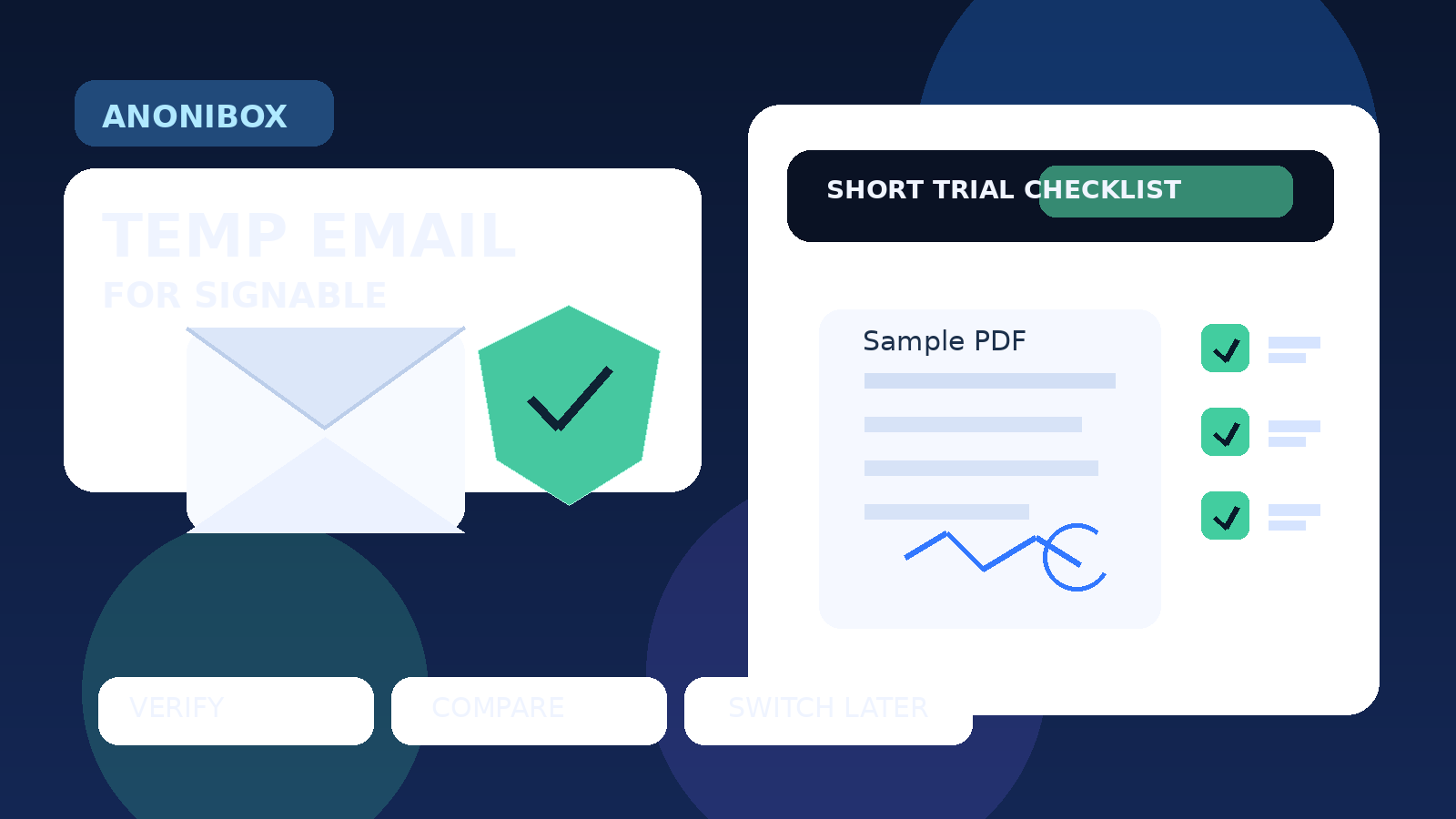
That distinction matters more than it first appears. E-signature tools are not like casual newsletter signups where the only downside is a few extra marketing emails. The inbox behind the account can quickly become the place where you receive signer updates, completion notices, reminder messages, password resets, workspace alerts, and anything else tied to ownership of the account. A temporary inbox from a service like Anonibox can be useful at the beginning, but it is fragile if you keep relying on it after the evaluation stage.
That is why people keep searching terms like temp email for signable. They want the privacy benefit of a disposable address during a product trial, but they also do not want to create a long-term mess. The right answer is not “always use one” or “never use one.” The right answer depends on what stage of the workflow you are in and what would happen if you lost access to that inbox later.
Why people want a temp email for Signable
Most of the time, the motive is completely practical. People usually want one or more of these things:
- To test the signup flow first. They want to see how quickly the product becomes usable after account verification.
- To keep trials separated. If they are comparing multiple signing platforms, they do not want every vendor sending into the same inbox.
- To avoid unnecessary inbox clutter. Product tours, webinars, feature announcements, upgrade nudges, and sales follow-ups add up fast.
- To protect their main address until the product is a real contender. That is especially sensible if the evaluation is still early and informal.
Those are good reasons. Disposable email is often just a privacy and organization tool. It helps you learn whether the product fits before you commit your long-term contact details to yet another SaaS platform.
When a temporary inbox makes sense
A temp inbox is useful when the account itself is still temporary in purpose. For Signable, that usually means:
- creating the account and completing email verification,
- reviewing the dashboard and basic sending flow,
- uploading a sample PDF or test document,
- checking how signer requests, reminders, or completion notices look,
- comparing the product with other e-signature tools before a deeper rollout.
In that stage, the account is low stakes. You are not relying on it to store important agreements or support a process that other people depend on. You are simply trying to answer the question: does this tool deserve more serious attention?
When it becomes the wrong choice
The problem is not using a disposable inbox at the beginning. The problem is keeping it attached after the account starts to matter. Once a signing workspace becomes part of real operations, the email address behind it matters too.
You should switch to a permanent monitored inbox before any of these become true:
- you are sending live agreements instead of test files,
- customers, candidates, vendors, or teammates are expected to interact with the workspace,
- you care about signer history, completed-document notices, or reminder timing,
- templates or branded document flows may be reused later,
- you may need password recovery, admin changes, billing notices, or long-term account ownership.
At that point, the address behind the workspace is no longer just a gatekeeper for trial access. It becomes part of the operational backbone of the account. That is the point where temporary email stops being smart privacy hygiene and starts becoming avoidable risk.
How to use a temp email for Signable safely
1. Treat it as a short trial tool, not a permanent identity
Create the disposable inbox before signup and use it only for the first checkpoint: verification, initial access, and the first round of harmless testing. If you decide the product is promising, plan the switch early instead of telling yourself you will do it later.
2. Test with low-risk sample documents
Use mock approvals, fake contracts, dummy onboarding packets, or other non-sensitive examples. The goal is to evaluate the flow, not to begin real signing work on top of a mailbox that might disappear or become inconvenient to monitor later.
3. Save anything important right away
If you receive a useful setup link, onboarding tip, or note you want to keep, move it into your own notes. Temporary inboxes are fine for short-lived access, but they are a bad place to rely on as your long-term record of what happened.
4. Decide quickly whether Signable belongs on the shortlist
A disciplined evaluation should not drag on forever. Usually, after one serious session, you already know whether the interface feels clear, whether the recipient experience makes sense, and whether the product deserves a proper internal review.
5. Switch before real workflows begin
Do not wait until you already have live agreements, active signers, or shared ownership issues. The cleanest time to switch is just before the account becomes meaningful, not after it already is.
What to actually evaluate during the short trial
If you are going to use a temp email for Signable, make the trial count. Focus on the product behavior that will matter later.
Signup and verification friction
How fast can you go from first visit to a usable account? If the trial feels heavy before you even send a sample document, that is worth noting. A signing platform should not turn basic setup into guesswork.
Document setup clarity
Upload a harmless test file and see how easy it is to prepare. Are the steps obvious? Can you place fields, organize signers, and move through the flow without constantly second-guessing what comes next?
Recipient experience
The sender view is only half the story. Review what the recipient actually sees. The email copy, the call to action, the signing page, and the reminder pattern all matter. A tool that feels fine in the admin area can still create friction for real signers.
Template and repeatability potential
If you expect recurring forms, approvals, or agreements, look at whether the workflow feels easy to repeat. You do not need every advanced feature in the first trial, but you do need a sense of whether the tool will scale beyond a single one-off send.
Operational fit
Ask the real question behind the trial: would your team actually want to use this in daily work? A product can be technically capable and still feel too clumsy for repeated contract workflows, internal approvals, or external signer communication.
The main risks of leaving a disposable inbox attached
You can lose your recovery path
If you ever need to reset access, confirm ownership, or respond to an unexpected account issue, a temporary inbox may no longer be dependable. That is a small problem during a test and a much larger problem once real work depends on the account.
You may miss important messages
In e-signature software, email is not just a marketing channel. It can also carry reminders, completion notices, error messages, and administrative updates. Missing those messages can create confusion or delays even when nothing catastrophic happens.
You create messy ownership history
Once a teammate is invited or a real document is sent, the account stops being purely personal. If the original login lives behind a throwaway inbox, the workspace may become harder to hand off or manage cleanly later.
You encourage procrastination
This is the most common failure pattern. People intend to switch later, but later never comes. One template turns into three. One test send turns into a real agreement. The account becomes operational before anyone notices that the foundation was never meant to be permanent.
What is better than a temp inbox once the account matters?
If you like the privacy logic behind disposable email but need something durable, use one of these instead:
- a permanent secondary inbox for software trials and vendor accounts,
- an email alias that still forwards into a monitored mailbox you control,
- a shared operations or contracts inbox if the workspace may eventually belong to more than one person.
Those options preserve most of the privacy and organization benefits while removing the fragility that makes a disposable inbox risky for long-term use.
Common mistakes to avoid
- Uploading live documents too early: keep the first test safely low stakes.
- Using the temp inbox as archive storage: save what matters somewhere you control.
- Forgetting the recipient side: the signer experience matters as much as the dashboard.
- Keeping the disposable address attached after the trial feels successful: switch sooner, not later.
- Confusing privacy with permanence: a temp inbox protects your main address, but it is not a durable account strategy.
A quick decision checklist
Before you use a temp email for Signable, ask yourself:
- Am I only evaluating the product right now?
- Would losing access to this inbox later create a real headache?
- Am I testing with sample files rather than live agreements?
- Do I already have a permanent monitored inbox ready if the tool makes the shortlist?
- Could this workspace become part of a recurring team workflow?
If the answers point to a short, low-stakes evaluation, a disposable inbox is reasonable. If the answers point to real agreements, real recipients, or long-term ownership, switch to a stable address before you go any further.
Final answer
A temp email for signable approach is practical for short product testing. It helps you verify the account, inspect the signing flow, and compare the platform without immediately giving your main inbox to another vendor.
It is not the right long-term setup for real contract workflows. Once the account might matter for signer updates, reusable templates, billing, recovery, or shared ownership, move it to a permanent monitored inbox you control. That gives you the privacy benefit of early evaluation without the unnecessary risk later.