A temp email for Sertifi is fine for low-stakes testing, demos, or early evaluation. It is a bad idea for real agreements, payment authorization forms, or anything you may need to access, prove, or recover later.
Use a temporary inbox only during the exploration stage. Once a Sertifi workflow involves real signatures, customer approvals, hotel or event contracts, or payment-related communication, switch to a permanent email you control.
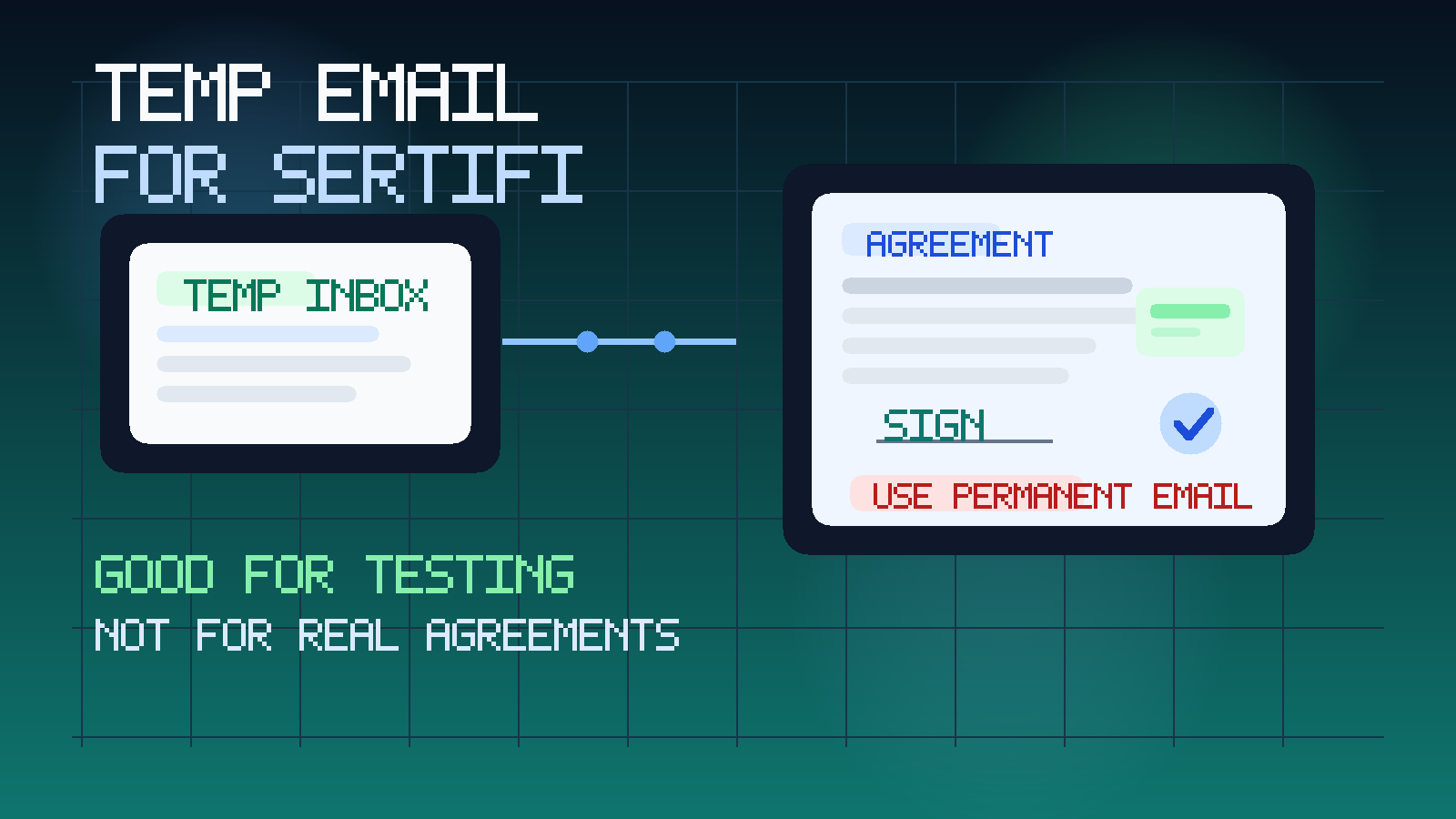
Sertifi sits in a higher-stakes part of the inbox than a random newsletter signup. People use it for approvals, signatures, agreements, payment authorization, and workflow steps that can affect sales, hospitality operations, customer commitments, and internal accountability. That changes the answer immediately. A temporary inbox can be useful when you are simply trying to understand the product, watch how the emails behave, or evaluate whether the workflow fits your team. It becomes risky the moment the messages matter beyond a short test.
That distinction is the whole point. Temporary email is not automatically wrong. It is just context-sensitive. If you are screening vendors or testing a flow without committing, it can reduce long-term inbox clutter. If you are dealing with live agreements, payment details, signers, compliance expectations, or future disputes, a disposable address is the wrong foundation.
When a temp email for Sertifi makes sense
There are legitimate reasons to use a temporary inbox during the earliest part of a Sertifi evaluation.
- You want to request a demo or trial without opening your main inbox to long-term sales follow-up.
- You are comparing several document or agreement workflow tools at once.
- You want to see what the verification, onboarding, or first-run emails look like.
- You are testing a simple internal proof of concept before deciding whether the platform belongs on a shortlist.
- You want to isolate one-off research from your permanent business mailbox.
That is where a service like Anonibox can help. If the goal is to inspect the product without turning one curiosity click into months of vendor follow-up, a temporary inbox is a reasonable filter. You still get access to the welcome message, login steps, and basic setup emails, but you keep early-stage noise away from the mailbox that runs your actual work.
When a temp email for Sertifi is a bad idea
The answer changes as soon as the workflow becomes real.
Real signatures and agreements
If a document actually matters to your business, your customer, or your team, it should not live behind a temporary inbox. Real agreements may need to be reopened, verified, resent, referenced during negotiations, or reviewed months later. A disposable address makes that much harder than it needs to be.
Payment authorization and card-adjacent workflows
Some Sertifi use cases touch payment authorization, billing approvals, or commercial details that carry financial consequences. That is exactly the kind of workflow where continuity matters more than convenience. You do not want a critical confirmation or dispute trail tied to an address you never intended to keep.
Multi-person approvals
Once several stakeholders are involved, the cost of a weak inbox setup grows. If sales, finance, event operations, procurement, or legal teams need to review or revisit the process later, a temporary inbox becomes a fragile link in the chain.
Account ownership and recovery
Even if the first interaction feels light, software relationships have a habit of becoming more permanent than planned. If Sertifi ends up connected to real customer work, an inbox you do not keep becomes a liability for password resets, audit trails, notifications, and administrative handoffs.
Why Sertifi deserves more caution than a casual signup
Not every product sends the same kind of email. That matters. A temporary inbox is less risky for a simple content download than for a workflow product tied to real business approvals. Sertifi is not just another marketing form. It often sits close to revenue, agreements, approvals, guest or client commitments, and records you may need to prove later.
That does not mean every Sertifi message is mission-critical. It means you should assume the relationship can become important quickly. If there is any realistic chance that a test account becomes a real workflow, start thinking about your email choice as part of process design rather than a throwaway convenience.
A practical rule: temporary for testing, permanent for transactions
If the goal is evaluation, a temporary inbox is reasonable. If the goal is execution, use a permanent email.
That rule keeps things simple. The moment you move from “I want to see how this works” to “I am sending or receiving real agreements,” you should switch to a durable address. The same applies if you are inviting teammates, storing documents that may matter later, or expecting a long-running workflow.
How to evaluate Sertifi safely with a temporary inbox
1. Use the temp inbox only for the first-touch stage
Use it for signup verification, demo requests, introductory emails, and light setup. That is the low-risk zone where temporary email earns its keep.
2. Save important notes outside the inbox
Write down login URLs, trial dates, comparison notes, and key observations in your own document or evaluation sheet. Temporary email is a filter, not a permanent record system.
3. Test the workflow, not just the interface
Look at the actual sequence of events. How does Sertifi handle reminders, signer notifications, approval steps, and document follow-up? A clean dashboard is nice, but the real product experience lives in the workflow.
4. Decide early whether the tool is staying
If the product is clearly not a fit, the temp inbox did its job. If the platform looks promising, do not wait until the last minute to migrate to a stable email address.
5. Switch before anything real happens
Do not let a test inbox become the default for live agreements. Move to a permanent, team-controlled address before production documents, payment-related messages, or customer-facing workflows begin.
What to evaluate during a Sertifi trial
If you are keeping the email side tidy, use the saved attention on the product itself. Practical evaluation points include:
- Signer experience: Does the process feel clear, fast, and professional for the recipient?
- Reminder logic: Are notification emails helpful, predictable, and easy to manage?
- Approval flow: Can the platform support the internal review steps your team actually needs?
- Document traceability: Is it easy to understand status, completion, and follow-up needs?
- Operational fit: Does the workflow suit your sales, hospitality, events, or contract process, or does it create extra friction?
- Ownership and administration: If the tool becomes real, can your team manage account continuity sensibly?
Those questions are more valuable than obsessing over the signup form itself. A temporary inbox only helps if it gives you cleaner space to evaluate the actual workflow.
Common mistakes to avoid
- Letting a test inbox drift into production use. That is the biggest avoidable mistake.
- Using temporary email for real agreements because it worked during setup. Early success is not proof of long-term suitability.
- Forgetting account recovery. If you may need to reset access later, a disposable inbox is a poor foundation.
- Treating payment-related workflows like ordinary marketing signups. They are not the same risk category.
- Skipping a handoff plan. If teammates will own the workflow later, move to a durable shared or role-based address before that transition matters.
Better alternatives once Sertifi becomes important
Once the workflow moves beyond testing, the safest choice is a permanent business email you control. Depending on your setup, that could mean:
- a dedicated operations or agreements mailbox
- a team-controlled role address rather than one person’s personal inbox
- a professional alias that forwards into a durable shared account
- a permanent personal or business address for solo operators who control their own domain
The key is continuity. Whoever needs the documents later should be able to access the related communication without depending on a disposable inbox that vanished after the trial.
Final takeaway
A temp email for Sertifi is good for testing and bad for real agreement or payment workflows. If you just want to inspect the platform, compare vendors, or keep early-stage outreach out of your main inbox, temporary email is a practical tool.
But once the workflow involves real signers, payment authorization, approvals, or business records, switch to a permanent email you control. That keeps the process cleaner, easier to recover, and much safer to manage over time.