Use a temp email for Justworks when you only want to request a demo, test the first signup flow, or compare payroll and PEO platforms without feeding your main inbox into another vendor sequence.
Do not keep a disposable inbox attached once the account is tied to real payroll, benefits, onboarding, employee records, or admin recovery, because those workflows need a permanent address you control long term.
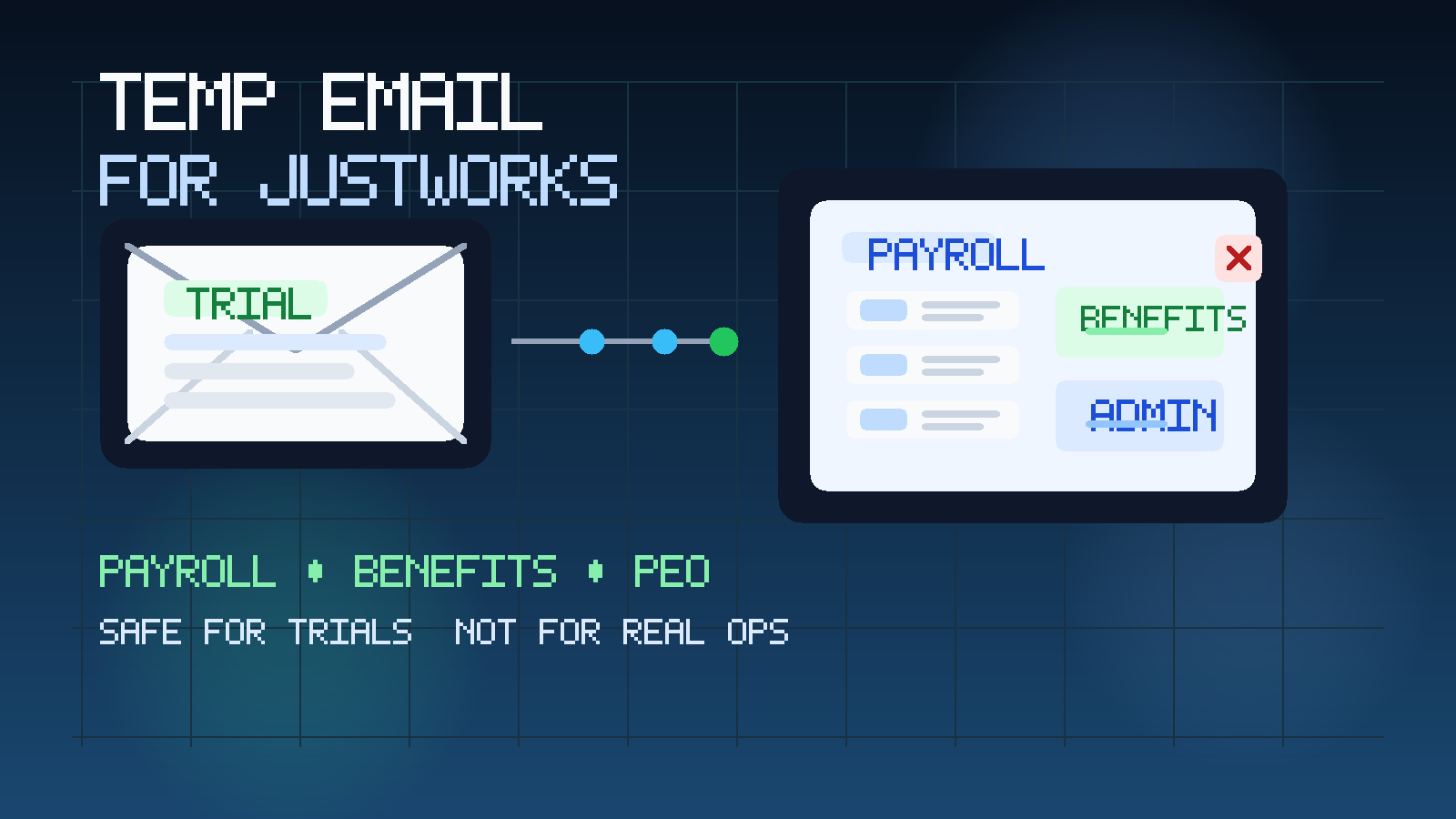
That is the short answer, but the useful answer is about timing. People search for a temp email for Justworks because they want to protect their primary inbox while they explore payroll software, compare PEO options, or accept a low-stakes first invite. That is a sensible instinct. A quick demo request or trial can easily turn into welcome emails, meeting links, onboarding nudges, product explainers, sales follow-up, and team-invite reminders that continue long after you decide whether the platform belongs on your shortlist.
A temporary inbox gives you a buffer during that early stage. You still receive the verification message and first access email, but you do not have to commit your everyday business address to every platform you touch while researching HR, payroll, and benefits tools. Used carefully, an option like Anonibox helps you keep the evaluation phase tidy. The important part is knowing when to stop being temporary and switch to a stable inbox before the account starts carrying real operational weight.
Why someone would use a temp email for Justworks
Justworks sits in a category where the first interaction is often lightweight, but the later relationship can become important fast. A founder may request a demo. An operations lead may want to compare payroll systems. A people team member may want to understand how onboarding, benefits administration, or employee support might feel in practice. None of that means the company is ready to commit yet.
At this stage, a temporary inbox can help for several practical reasons:
- Inbox control: exploratory vendor traffic stays out of the mailbox you use for customers, contracts, and day-to-day work.
- Cleaner comparison: if you are evaluating several HR or payroll tools at once, separate inboxes make it easier to tell which messages belong to which platform.
- Better privacy: your main work address does not have to go straight into every sales funnel the moment you click a form.
- Lower commitment: you can review the first workflow before deciding whether the vendor deserves a more permanent contact path.
That does not mean you are trying to hide. It just means you want to control when a casual evaluation becomes an ongoing account relationship.
When a temp email for Justworks makes sense
A temp inbox works best when the cost of losing access later would be inconvenient rather than harmful. For Justworks, that usually means early-stage evaluation.
Demo requests and first-touch research
If you mainly want the first meeting link, product materials, or introductory follow-up, a temporary inbox can be reasonable. You are gathering information, not yet depending on the account for something mission-critical.
Shortlisting payroll or PEO vendors
Teams often compare several platforms in a short window. When the goal is simply to judge usability, pricing fit, workflow clarity, or support quality, a temporary inbox helps keep those vendor streams separated until a real shortlist emerges.
Testing the signup and invite flow
Sometimes you do not even need a full evaluation. You may only want to see how the first login, verification, or invite process feels before involving more stakeholders. A disposable inbox is fine for that kind of first pass.
Keeping exploratory HR tooling away from a busy operations inbox
Small teams already have enough email. Payroll, benefits, recruiting, vendor billing, and customer communication can all land in the same few mailboxes. A temporary inbox prevents “just looking” from creating another long-tail thread in the middle of real business traffic.
When a temp email is the wrong tool
The wrong time to use a temp email is when the account stops being a trial and starts becoming infrastructure.
- Real payroll setup: payroll notices, account changes, approvals, and follow-up questions should go to a durable inbox.
- Benefits administration: if the workflow touches enrollment, employee notices, or ongoing plan communication, stability matters more than convenience.
- Employee onboarding: once the account is involved in real people joining the company, a disposable address becomes a liability.
- Admin ownership and recovery: if the inbox controls access, password resets, or account recovery, it needs to be permanent.
- Long-term team use: if multiple stakeholders will rely on the account later, temporary email is the wrong foundation.
A good rule of thumb is simple: if missing the next email would create an operational problem, stop using temporary email and move to a stable monitored address immediately.
What to evaluate inside Justworks during an early trial
If you are going to isolate the trial with a temp inbox, use the saved attention on the product itself. The whole point is to learn quickly and judge whether the platform fits your team.
Payroll workflow clarity
Ask whether the platform feels understandable from an admin perspective. Can you quickly see how recurring payroll activity would be handled? Does the overall workflow feel like something your team would trust every cycle, or does it feel heavier than expected?
Benefits and people-ops usability
Look beyond the demo language and focus on how the workflow feels. If you are evaluating a system that may eventually sit close to benefits and employee administration, clarity matters. The question is not whether the product has a lot of screens. The question is whether those screens would actually make everyday work easier.
Team and role handoff
Many evaluations start with one person and expand quickly. Consider whether the first account setup and invite flow seem manageable if finance, operations, or HR stakeholders need visibility later. If collaboration already feels awkward in the trial, that usually does not improve under real pressure.
Support and follow-up quality
Vendor follow-up is not everything, but it is part of the buying experience. Pay attention to whether communication feels useful or merely persistent. Helpful onboarding guidance is valuable; endless pressure is not. A temp inbox makes it easier to notice that difference without sacrificing your main mailbox.
Fit for your company stage
Early-stage companies, growing teams, and more mature organizations often care about different things. The best trial question is not “is this platform good in general?” It is “does this fit how our team actually operates right now?” A separated trial inbox helps you stay focused on that instead of getting distracted by every automated follow-up email.
How to use a temp email for Justworks without creating future problems
1. Generate the inbox before you sign up
Create the address first so the whole evaluation lives in one place. That keeps the verification link, welcome email, and first-touch outreach separate from your permanent inbox from the beginning.
2. Use it only for early-stage access
A temp email is strongest when it covers low-stakes actions: demo requests, first login, first invite, or an exploratory review. That is enough for most initial evaluations.
3. Save anything you would hate to lose
Do not treat a disposable inbox like long-term documentation. Save meeting links, rep names, setup notes, evaluation criteria, and anything your team may want later. Temporary email should be an intake layer, not your permanent source of truth.
4. Keep one vendor per inbox when comparing platforms
If you are looking at multiple payroll or PEO options, separate inboxes make the process dramatically easier to track. You avoid mixing several onboarding flows together and can tell at a glance which platform generated which message.
5. Switch early if the platform becomes serious
If Justworks moves from “interesting option” to “real candidate,” update the contact path before anything sensitive begins. The earlier you move to a permanent address, the cleaner the handoff will be.
Temp email vs. a dedicated vendor-evaluation inbox
Some teams ask for a temp email when what they really need is a separate long-term evaluation inbox. The distinction matters.
- Use a temp email when you only need the first verification, a short test, or a low-commitment evaluation.
- Use a dedicated evaluation inbox when the research may last several weeks or involve multiple stakeholders.
- Use a permanent operational inbox when the platform is entering real payroll, benefits, HR administration, or account ownership territory.
That progression is often smarter than forcing one address strategy onto every stage. A temp inbox solves the “I want to look without committing my main mailbox yet” problem. It does not solve the long-term ownership problem.
A practical example
Imagine a small company comparing three people-ops platforms in the same week. The founder wants pricing clarity. The operations lead wants to understand admin workflow. The finance contact wants to know what the future payroll relationship might look like. At that moment, the company is still screening. A temporary inbox for the first Justworks demo request or invite can be perfectly sensible. It keeps the evaluation isolated while the team decides whether the platform deserves deeper review.
But once the conversation becomes serious—shared evaluations, implementation questions, real account ownership, or operational planning—that same temp inbox becomes the weak link. The right move is to graduate the relationship to a permanent monitored address before the account starts holding anything important.
Common mistakes to avoid
- Keeping the temp inbox attached too long: what starts as privacy protection turns into an account-recovery headache.
- Using one disposable inbox for every vendor: you lose most of the organizational benefit.
- Judging the vendor only by the email sequence: the product and workflow matter more than the nurture campaign.
- Failing to document the handoff: one person signs up, another person later needs access, and nobody knows where the important messages went.
- Confusing early evaluation with real operations: the inbox strategy that works for a trial is not the one you want for live payroll or benefits communication.
Where Anonibox fits naturally
Anonibox makes sense at the front end of this process. If you only need the verification message, the welcome email, or a short period of trial access, a privacy-first temporary inbox can keep vendor exploration from spilling into the mailboxes you actually rely on every day. That is especially helpful if you are comparing several tools, screening a platform quietly, or trying to keep a first-touch demo request from becoming a long sales thread in your main inbox.
What it should not become is the permanent home for a serious HR or payroll relationship. Temporary email helps you control exposure early. It is not a substitute for a stable address once the account matters.
Final takeaway
A temp email for Justworks is a good idea when you are only requesting a demo, testing the first signup flow, or comparing payroll and PEO options. It keeps early-stage vendor traffic out of your main inbox and gives you more control over when you share a permanent address.
It is a bad idea once the account is tied to real payroll, benefits, onboarding, employee records, or admin recovery. Use temporary email for exploration, then move serious workflows to a durable inbox you and your team can monitor long term.