A temp email for GoHighLevel can help with short early trials, demo requests, and inbox protection, but a permanent monitored address is safer once real client pipelines, automations, billing, or team access are involved.
If you are only testing GoHighLevel to see whether it belongs in your agency stack, a disposable inbox can be useful. If the account is becoming part of real lead management or client delivery, switch to an address you actually control before anything important depends on it.
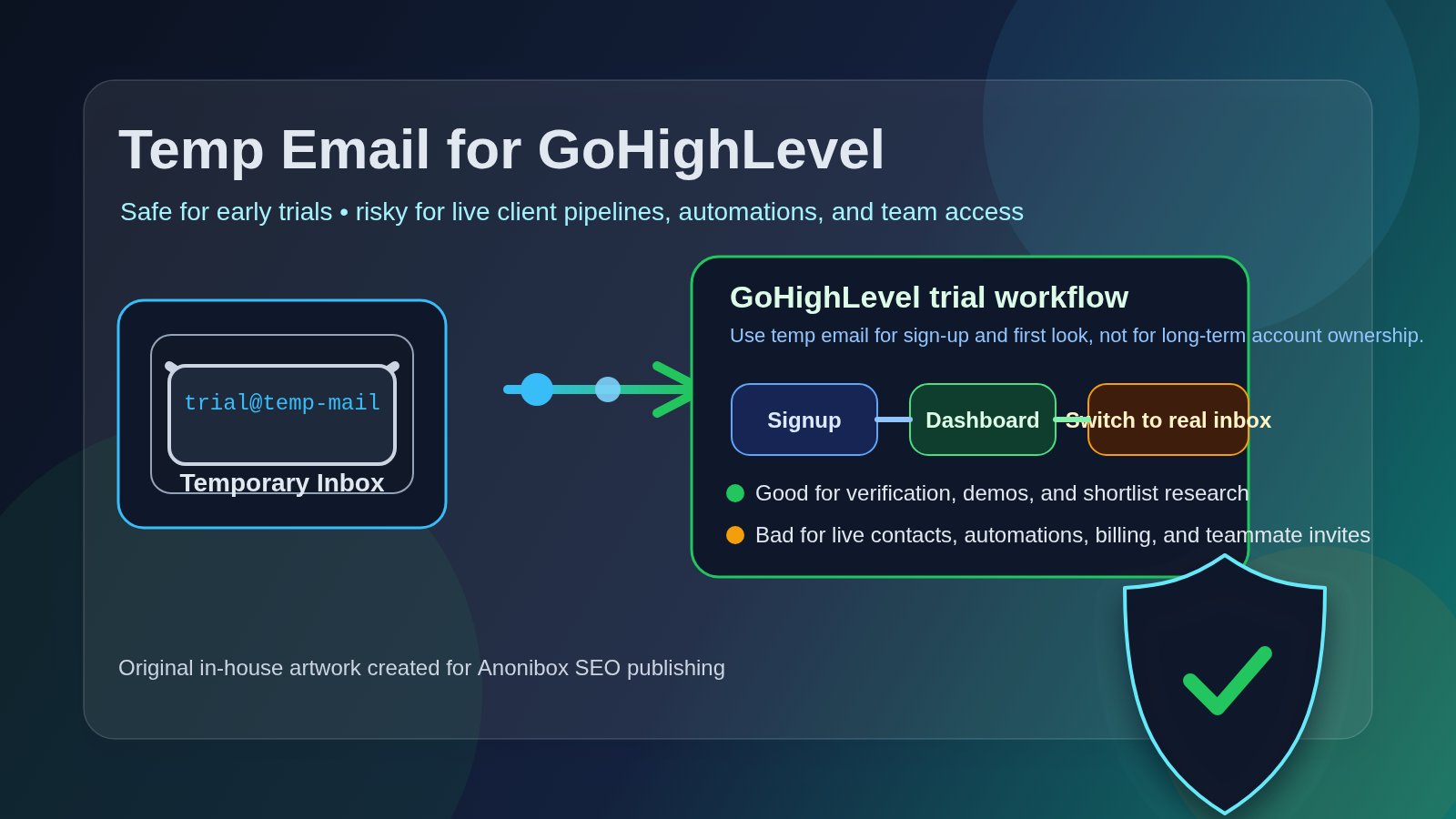
That distinction matters because GoHighLevel is not just a lightweight newsletter signup. It can become the control layer for lead capture, follow-up automation, appointment booking, funnels, contacts, conversations, reporting, and client sub-accounts. A temporary inbox can reduce the early flood of vendor email, but it is a weak long-term anchor for a tool that may end up sitting close to revenue and customer communication.
The better question is not simply whether you can use a temp email for GoHighLevel. The better question is when it makes sense, how long it stays low-risk, and what should trigger a switch to a stable inbox you monitor.
If you already use a tool like Anonibox to keep trial signups separate from your everyday inbox, GoHighLevel is a good example of a platform where that approach can help early on but should not remain your permanent setup.
Short answer: yes for first-pass evaluation, no for live client operations
For a short first look, a temp email for GoHighLevel can be perfectly reasonable. You may want to request a demo, inspect the dashboard, compare the funnel builder with other tools, or keep your main inbox out of another sales sequence until you know the platform is worth serious time.
But once the account starts holding real leads, live automations, client work, payment settings, or team access, a disposable address stops being a convenience and starts becoming a liability. The inbox tied to the account may receive password resets, billing notices, login alerts, setup confirmations, domain verification steps, and support replies. Those are not the kind of messages you want attached to an inbox that might expire or become hard to monitor.
Why people look for a temp email for GoHighLevel
The motivation is usually practical rather than shady. Agency owners, freelancers, consultants, and in-house marketers often want to test a platform without sending their real work address straight into a long onboarding and follow-up cycle. That is especially true when they are comparing multiple CRM or automation platforms side by side.
A temporary inbox can help with:
- Early product research: you want to see the interface before committing your main inbox to another vendor.
- Demo and trial cleanup: you only need the verification message and the first onboarding emails.
- Shortlisting tools: you are comparing GoHighLevel against alternatives like HubSpot, Keap, or other all-in-one agency systems.
- Inbox separation: you want trial traffic isolated from real client and campaign communication.
- Lower exposure: you do not want every exploratory signup tied to the same long-term email identity.
That use case is sensible. The key is to treat the temporary inbox as part of a research workflow, not as the permanent owner of a serious account.
When a temporary inbox can make sense
There are several situations where using a temporary email for GoHighLevel is reasonable and low-risk.
1. You only want to clear the first verification step
If your goal is to receive the signup email, log in once, and decide whether the platform is even relevant, a disposable inbox can do that job well. You get access without volunteering your everyday address too early.
2. You are comparing agency platforms in a short research window
Maybe you are reviewing funnel builders, CRM dashboards, automation tools, or white-label agency systems in one batch. In that case, separate inboxes can make the comparison cleaner. You can quickly see which vendors send useful onboarding information and which ones mostly send sales pressure.
3. You want to inspect the workflow before speaking to sales
Some buyers prefer to explore the dashboard first, then decide whether a call is worth their time. A temp inbox gives you room to do that without turning one curiosity click into months of follow-up mail.
4. You are testing alone, not setting up shared ownership
The risk is lower when the account is still a solo experiment. Once colleagues, contractors, or clients get involved, email ownership matters much more.
Why the risk rises quickly inside GoHighLevel
GoHighLevel can move from “trial” to “infrastructure” faster than people expect. The first login may feel casual. The second week can look very different if you start building workflows or bringing real business data into the system.
Pipelines and contact records create real dependency
As soon as you start storing leads, notes, stages, or customer contact details, the account matters more. If the inbox tied to the account becomes unavailable, recovery and verification get harder at exactly the wrong moment.
Automations and messaging raise the stakes
Platforms like GoHighLevel are often used for follow-up sequences, reminders, nurture campaigns, forms, and inbound lead routing. Even if the email address itself is not customer-facing, the account behind those workflows still needs stable ownership and reliable recovery.
Calendar, form, and funnel setup can become expensive to lose
Once you have built landing pages, forms, booking flows, or automation paths, you no longer want a fragile account identity. Losing access is not only annoying. It can mean rework, missed leads, or a messy support conversation.
Client sub-accounts and team access complicate ownership
If you run an agency, the danger increases once clients or staff are involved. A throwaway inbox is a poor foundation for an account that may control sub-accounts, permissions, and shared delivery work. Stable ownership matters more than inbox hygiene at that stage.
Billing, renewals, and support are not optional emails
It is easy to dismiss vendor email as noise, but some of it matters. Billing notices, plan updates, domain-related instructions, support replies, and security alerts should land in a real monitored inbox. A disposable address is not a good place to park messages you may need months later.
Best workflow if you want privacy without creating account problems
The safest approach is stage-based. Use the temporary inbox for exploration, then graduate the account to a stable address before it becomes operational.
Use the temp inbox only for the first pass
Let it handle the verification email, the welcome message, and maybe the first product tour or setup instructions. That is where the privacy benefit is strongest and the downside is still low.
Save anything useful right away
If the vendor sends setup notes, pricing details, contact information, or a demo recap that matters, save it outside the temporary inbox. Disposable tools are great for reducing clutter and terrible at being your long-term memory.
Switch before importing real data
Do not wait until the account already contains live contacts, real automations, or client deliverables. Move to a permanent monitored inbox before the platform becomes important. That keeps the transition clean and reduces the chance of future recovery pain.
Separate research from production
A simple internal rule helps: disposable for research, durable for production. Once a tool starts touching real leads, client communication, or internal reporting, it belongs under an email identity you expect to keep.
Dedicated evaluation inbox vs. disposable inbox
For many teams, a dedicated evaluation inbox is the better long-term compromise. It gives you separation from your main daily inbox without the fragility of a truly temporary address.
A temporary inbox is best when:
- you only need to verify signup and look around briefly
- you are not sure the platform deserves deeper evaluation
- you want to reduce immediate spam and sales follow-up
A dedicated evaluation inbox is better when:
- the trial may last more than a day or two
- you expect multiple team members to review the platform
- you may need reliable access to support or billing messages
- the account could become a real implementation instead of a quick experiment
For GoHighLevel specifically, the dedicated evaluation inbox often becomes the smarter option sooner than people expect.
Signs you should switch to a permanent inbox immediately
- You are importing real leads or customer records.
- You are building automations that will actually run.
- You are connecting domains, calendars, forms, or live landing pages.
- You are inviting teammates, contractors, or clients.
- You may need dependable billing, support, or security communication.
- The platform has moved from “interesting trial” to “serious finalist.”
If two or three of those are already true, the disposable phase is probably over.
What if GoHighLevel rejects temporary email domains?
That can happen. Some platforms block known disposable domains to cut down on abuse, duplicate trials, and low-quality signups. If that happens, do not fight the system just to force a temp-email workflow. Use the rejection as a decision point.
If you still want privacy and separation, a dedicated trial inbox you control is usually the best middle ground. It keeps the vendor out of your oldest personal or business inbox while avoiding the fragility that comes with a short-lived address.
Common mistakes to avoid
- Keeping the temporary inbox too long: the account quietly becomes important before you change the contact address.
- Using one throwaway inbox for every vendor: that makes comparison and cleanup harder, not easier.
- Forgetting to save important emails: onboarding and support details should not live only in an expiring mailbox.
- Connecting live business assets too soon: once real funnels, contacts, or workflows are involved, stability matters more than inbox minimalism.
- Assuming you can always fix it later without friction: maybe you can, but it is cleaner to switch before the account becomes critical.
Final verdict
A temp email for GoHighLevel is a smart short-term tool for early evaluation, first-login verification, and keeping your main inbox clear while you compare platforms. It is not a smart long-term identity for an account that may hold real leads, automations, client assets, billing notices, or shared team access.
Use the temporary inbox to research, compare, and decide. Then move to a permanent monitored address before GoHighLevel becomes part of your real operating stack. That gives you the privacy benefit at the start without creating avoidable recovery and ownership problems later.