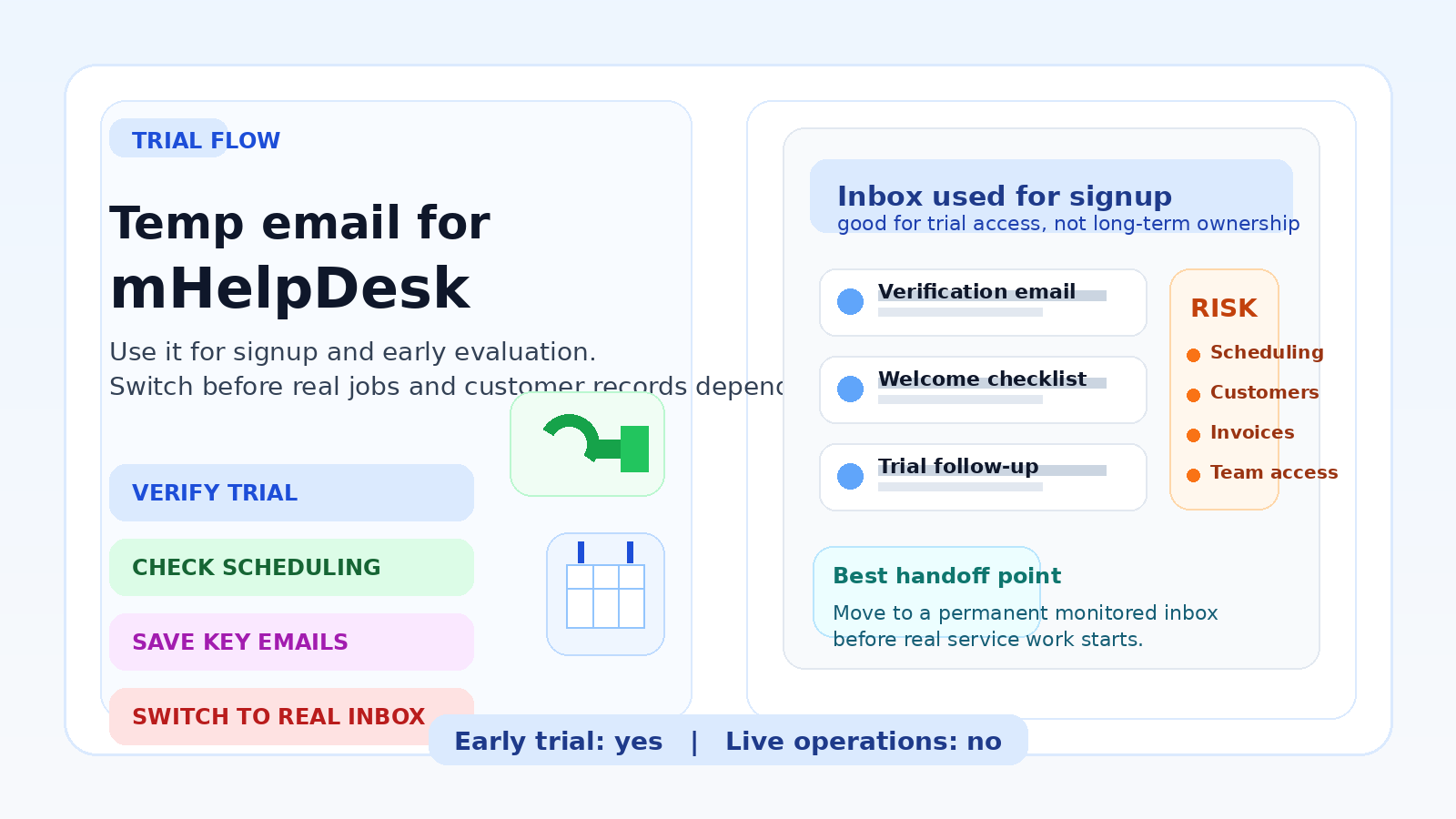
A temp email for mHelpDesk can be useful for a short trial, demo signup, or first-pass evaluation. It becomes risky once scheduling, customer records, estimates, recurring service reminders, or shared team access depend on that inbox.
Use a temporary inbox for verification and early onboarding, then switch to an address you control before the account starts holding real jobs, customer communication, or long-term ownership details.
Why people look for a temp email for mHelpDesk
mHelpDesk sits in a familiar field-service software category: you sign up because you want to see how the product handles estimates, dispatching, schedules, invoices, job tracking, and customer management without immediately inviting months of follow-up email into your main inbox. That is a reasonable goal.
During early research, many teams are comparing several tools at once. One vendor wants a trial request, another wants a demo form, and another starts sending onboarding sequences the moment you confirm your address. A temporary inbox creates a buffer. You still get the activation email and setup instructions, but you do not have to commit your everyday work inbox before you know whether the platform is even a serious contender.
If you are using a service like Anonibox, that first step can stay tidy: verify the account, read the welcome email, review the initial setup prompts, and keep your permanent inbox out of the early vendor-nurture loop.
When a temporary inbox makes sense
A temporary email address is most useful when you are still in the evaluation phase and the inbox is only acting as a gateway into the product.
- Quick trial access: you just need the verification link and first login details.
- Feature comparison: you want to compare mHelpDesk against other field-service platforms before choosing a shortlist.
- Low-stakes exploration: you are checking the interface, workflows, or pricing structure rather than running live operations.
- Inbox protection: you want to avoid turning one software test into a long-term sales follow-up stream.
- Segmented research: you want each trial to stay separate so later follow-up is easier to track.
In those situations, the email address is just the key to the front door. It gets you into the product without forcing a long-term contact commitment on day one.
What you can safely evaluate before switching inboxes
Early product evaluation does not usually require permanent email ownership. You can learn a lot from the first session.
1. Estimate and quote workflow
Check how quickly you can create a quote, adjust line items, add pricing, and move from estimate to approved work. If that experience is clunky, it is better to find out now rather than after the inbox becomes tied to a live account.
2. Job scheduling and calendar layout
Look at how the software handles dispatching, technician calendars, appointment updates, and rescheduling. A field-service tool can look fine in screenshots but feel awkward once you try to route actual work through it.
3. Customer record structure
Review how contacts, service addresses, notes, estimates, invoices, and work history are organized. You want to know whether the system feels practical before you move real customer data into it.
4. Mobile and field workflow
If mobile access matters to your business, inspect the technician experience early. Can teams update job status quickly? Is the flow usable on a phone? Can notes, signatures, photos, or completion steps be handled without friction?
5. Onboarding quality
The first few emails tell you something about the vendor too. Are the setup instructions clear? Are they pushing straight into aggressive sales sequences? Are there useful getting-started resources? A temporary inbox lets you observe that without sacrificing your main address.
Where a temp email for mHelpDesk becomes risky
The trouble starts when the inbox stops being temporary in practice, even if it still looks temporary on paper.
Scheduling and dispatch
Once real appointments, route changes, and staff schedules depend on the account, you need a monitored inbox behind it. Missed password resets, confirmation emails, or account notices can turn into real operational pain.
Customer records and service history
As soon as the system starts holding live customer details, addresses, notes, and job history, the account should be attached to an address your business controls long term. A disposable inbox is not a solid foundation for a system of record.
Quotes, invoices, and approval trails
If mHelpDesk becomes part of your quoting or invoicing workflow, inbox continuity matters more. You do not want key account alerts, billing notices, or approval-related messages disappearing because an early trial address expired.
Team access and ownership
Shared software needs clear ownership. If a temporary inbox remains the primary account contact after technicians, office staff, or managers are invited in, you create avoidable recovery and governance problems later.
Integrations and account recovery
Once you connect calendars, payments, automation tools, or other business systems, account recovery gets more serious. A disposable inbox is fine for a test. It is a weak anchor for a live operating stack.
How to use a temporary inbox safely during evaluation
If you want the privacy benefits without creating a mess later, treat the temporary inbox as a short-term tool with a clear handoff point.
- Create the inbox before signup. Keep the trial isolated from the start instead of trying to sort it out after the follow-up emails begin.
- Use it for verification and first login only. Let it receive the activation message, welcome email, and first setup steps.
- Save anything that matters immediately. If an email contains a trial link, setup note, contact name, or pricing detail you may need later, copy it into your own notes right away.
- Evaluate with intention. Do not wander through the interface. Test the exact workflows your business cares about: estimates, scheduling, invoicing, customer records, and mobile updates.
- Switch to a permanent inbox if the tool survives the first cut. The moment mHelpDesk becomes a serious candidate, move the account to a durable monitored address.
That approach keeps the trial clean without pretending a disposable inbox should support a live business process forever.
A practical field-service evaluation checklist
If you are signing up for mHelpDesk with a temporary inbox, make the session count. Focus on the questions that actually determine whether the platform fits your workflow.
- Can office staff create and update jobs quickly?
- Is scheduling easy to read and adjust?
- Do customer records feel organized enough for repeat service work?
- Can estimates move smoothly toward invoices or completed jobs?
- Does the mobile experience look realistic for technicians in the field?
- Will the reporting and job-history views be useful after the first week, not just the first hour?
- Does the vendor seem to expect a long sales cycle, or can you actually learn enough during the early trial?
Using a temporary inbox is only helpful if it makes your evaluation sharper. If it just helps you procrastinate without testing the real workflow, it is not doing much.
Temp inbox, email alias, or real work inbox?
These options are not interchangeable.
- Temporary inbox: best for early verification, low-stakes trials, and keeping your main inbox out of broad vendor outreach.
- Email alias: better when you want filtering and privacy but still need longer-term control.
- Real work inbox: best once the software becomes a finalist, a paid account, or part of a live business workflow.
For many teams, the smartest pattern is simple: temporary inbox first, controlled permanent inbox second. That gives you privacy during research and stability once you commit.
Clear signs it is time to stop using the temp address
- You are inviting coworkers into the account.
- You are loading real customer data instead of dummy records.
- You plan to rely on the tool for active jobs, schedules, or invoices.
- You may need support, password recovery, or audit trails later.
- The software is now on your real shortlist instead of being a casual test.
If any of those are true, move the account to a durable address you own and monitor. That is the point where privacy protection should give way to account stability.
Final answer
A temp email for mHelpDesk is a practical choice for early signup, trial verification, and first-pass field-service software evaluation. It helps you protect your main inbox while you compare tools and decide whether the platform deserves deeper attention.
It is not the right long-term inbox once real schedules, customer records, estimates, invoices, or team access are involved. Use the temporary address to get in, learn what you need, and keep your evaluation tidy. If mHelpDesk becomes a serious option, switch to a permanent monitored inbox before the account starts carrying real operational weight.