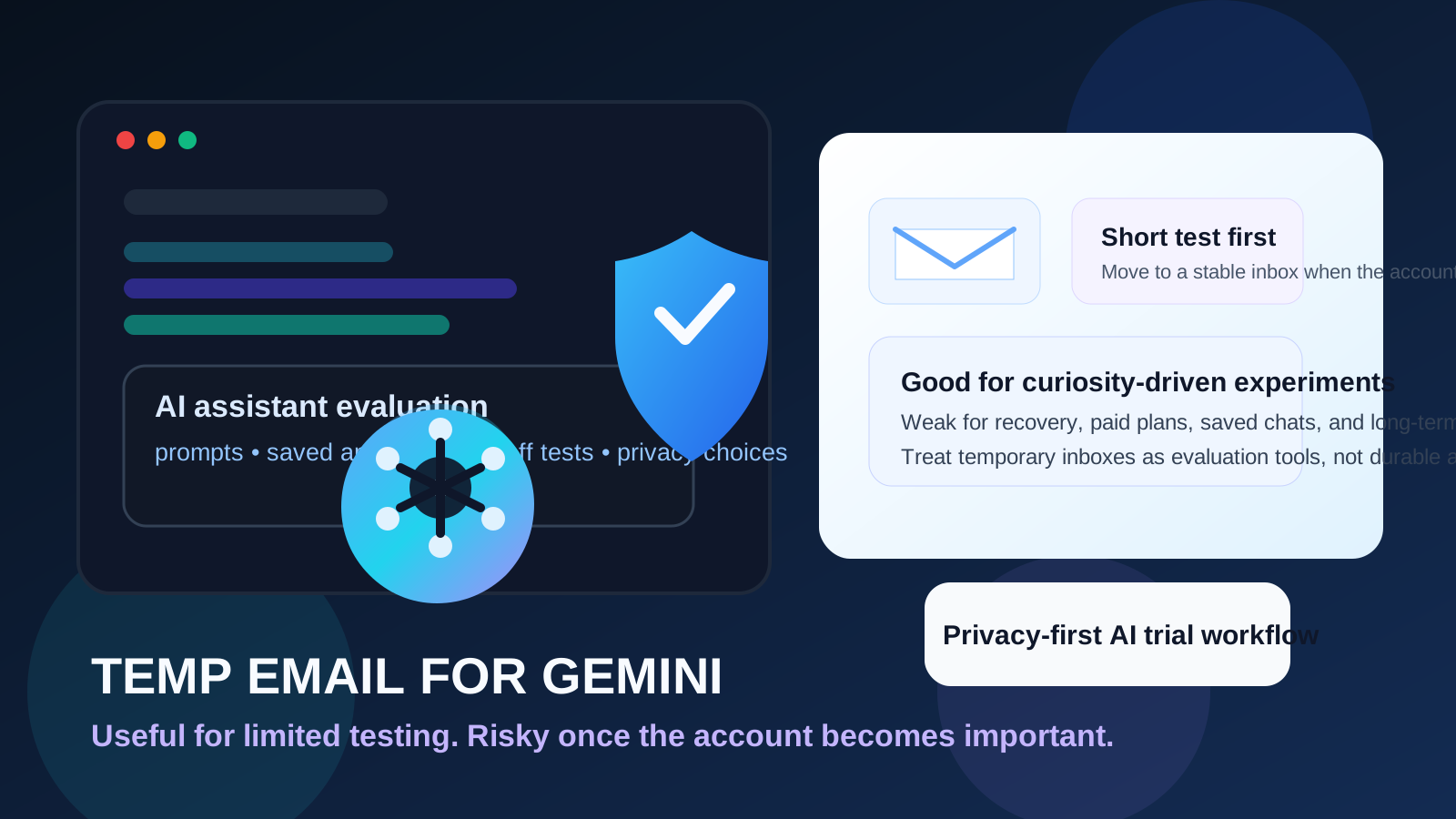
A temp email for Gemini is only useful in limited early-testing situations. It can help keep one-off AI experiments out of your main inbox, but it becomes a weak choice as soon as saved chats, account recovery, paid access, or long-term identity start to matter.
If you are just exploring the product and the current signup path allows it, a temporary inbox can be reasonable. If you expect to rely on the account later, switch early to an address you control long term.
Why people search for a temp email for Gemini
AI tools create a weird kind of signup fatigue. You want to try a new assistant, compare the answers against another model, run a few prompts, maybe upload a sample document, and figure out whether the product is worth remembering. But every trial also creates another inbox thread, another update flow, another account footprint, and another place where your primary address can start collecting promotional mail.
That is why the phrase temp email for Gemini makes intuitive sense. People are not always looking for long-term commitment on day one. Sometimes they just want a clean way to test the product, see how it handles prompts, and keep experimentation separate from the inbox they use for work, personal life, or critical accounts.
That said, AI assistants are not all equally disposable. The more an account starts storing conversations, history, preferences, subscription details, or recovery value, the less sensible a temporary inbox becomes. So the real question is not just “can I use one?” It is “at what stage does it stop being a smart idea?”
Short answer: fine for light experimentation, weak for durable use
If your goal is to test Gemini briefly, compare outputs, and keep a one-off signup from following your main address around forever, a temporary inbox can be a practical privacy move.
If your goal is to keep the account, revisit prompts, save useful output, depend on account recovery, or connect the identity to longer-term work, a temporary inbox is usually the wrong foundation. It solves short-term inbox clutter by creating long-term account fragility.
When a temporary inbox makes sense
There are situations where a temp inbox is a reasonable fit:
- You are only checking whether Gemini feels useful for your workflow.
- You want to compare it with adjacent tools like ChatGPT, Claude, or Perplexity without giving each test your main address right away.
- You are running a few prompts, browsing the interface, and deciding whether the product deserves more time.
- You want to isolate early experimentation from your personal or work inbox.
- You do not yet know whether this assistant will become part of your long-term routine.
This is the stage where Anonibox can be helpful. A temporary inbox lets you keep evaluation lightweight, especially when you are trying several AI products in a short period and do not want every curiosity-driven signup to become a permanent inbox relationship.
When a temp email is a bad idea
The trade-off changes fast once the account starts mattering. A temp email is usually a poor choice if any of the following are true:
- You expect to return to the same account repeatedly over time.
- You are relying on saved chats, prompt history, or stored output.
- You may need password resets, sign-in confirmation, or security notices later.
- You are attaching billing, subscriptions, or other payment-related activity.
- You plan to use the account as part of your real work, research, or business routine.
- You care about continuity more than you care about avoiding a few marketing emails.
Once those conditions are true, the email on file is no longer just a signup detail. It is part of your account ownership and recovery path. That is where disposable convenience turns into avoidable risk.
Why this question is trickier for AI accounts than for ordinary newsletters
A disposable inbox is easy to justify for a coupon, a download gate, or a single-use waitlist. AI assistant accounts are different because they can become valuable faster than people expect. A few test prompts can turn into a saved workflow. A casual experiment can become a go-to research habit. A disposable trial can quietly become a tool you depend on.
That is why the smartest approach is not all-or-nothing. It is staged. Use temporary email for the evaluation stage if that fits your privacy goals, then move to a stable address before the account becomes something you would hate to lose.
The biggest risks of keeping a temp email attached too long
1. Recovery gets harder at exactly the wrong time
Temporary inboxes are great for quick access. They are not great for long-term recovery. If you ever need to reset a password, confirm a new device, or respond to a security prompt later, a throwaway address can turn a simple fix into a serious headache.
2. You may underestimate how valuable the account becomes
This happens all the time with AI tools. What starts as “I am just testing it” can become a place where you store useful prompts, compare ideas, summarize documents, or revisit earlier work. The more useful the account becomes, the less acceptable a temporary recovery channel becomes.
3. Paid or premium use changes the stakes
The moment billing, subscriptions, or paid access enter the picture, inbox durability matters more. Account notices, plan changes, failed payments, policy updates, and login alerts should go to an address you still control months later.
4. Your digital identity gets fragmented
If you spread important AI use across temporary addresses, personal accounts, and work accounts without a plan, you create confusion. Which inbox owns what? Which address receives security messages? Which identity holds the useful history? Fragmentation makes future account management worse, not better.
5. You may delay the switch until it becomes messy
The most common mistake is not using a temporary inbox at the start. The mistake is forgetting to change it when the account becomes important. Switching early is usually easy. Switching late, after you have built habits around the account, is where friction shows up.
How to use a temp email for Gemini more safely
1. Decide whether this is a trial or a real adoption path
Be honest before you sign up. Are you doing a quick comparison, or are you already pretty sure this account may become part of your daily workflow? If it is truly a short test, temporary email can make sense. If you already suspect you will keep the account, start with a permanent address.
2. Use it only for the earliest stage
The cleanest use case is simple: verify the account, explore the product, run a few prompts, and judge whether the experience is worth keeping. Do not assume that because the first session worked with a temporary inbox, the same setup will stay smart forever.
3. Keep the test focused
A focused evaluation makes the decision easier. Maybe you want to compare answer quality, speed, brainstorming usefulness, summarization, or how well the assistant handles a specific kind of prompt. A focused test tells you quickly whether the account should be discarded or upgraded to a more durable identity.
4. Save anything important outside the account
If the test produces something genuinely useful, capture it. Do not leave valuable output living only behind an identity you still consider disposable. Temporary email works best when the experiment itself is treated as temporary too.
5. Move to a long-term address before the account becomes part of real life
The ideal time to switch is before you start relying on the assistant regularly, before you attach payment details, and before you would feel genuine pain from losing access. At that point, you are not “just testing” anymore. You are establishing a durable account relationship.
What temporary email actually helps with here
Used correctly, a temp inbox gives you a few real benefits:
- Inbox control: early testing stays separate from your main address.
- Cleaner comparisons: you can try multiple AI tools without immediately tying them all to your personal or work identity.
- Lower commitment: it becomes easier to abandon a trial that is not useful.
- Privacy during experimentation: your primary inbox does not need to become the default landing place for every new AI signup.
Those are real advantages. They just belong to the testing stage, not the ownership stage.
What it does not solve
A temporary inbox does not solve long-term account security. It does not replace a stable recovery path. It does not guarantee that every product will continue to work smoothly with disposable addresses. It does not protect you from weak password habits. And it does not magically turn an account with lasting value into something safe to treat casually.
In other words, temporary email is an inbox-management tool. It is not a substitute for clear account strategy.
A smarter way to think about AI signups
Instead of asking whether temporary email is always good or always bad, it helps to break AI signups into stages:
- Curiosity stage: you just want to see what the tool can do.
- Evaluation stage: you are comparing it against alternatives and testing repeat use.
- Adoption stage: the tool is becoming part of your real workflow.
- Dependency stage: losing the account would be disruptive.
Temporary email fits the first two stages better than the last two. Once you move toward adoption or dependency, a stable address wins.
Best practices before you commit to long-term use
Use an email you will still monitor later
If the account is sticking around, use an address you actually check. Recovery notices and sign-in alerts only help if they arrive somewhere that still belongs to your real life.
Separate testing from ownership
You do not need to hand every experiment your best long-term inbox. But you also should not let a throwaway inbox quietly become the permanent owner of something valuable.
Review your account habits periodically
AI tools are easy to accumulate. Every few months, it is worth reviewing which services still deserve a real identity and which ones were just short-lived experiments. That keeps your inbox and your account map both cleaner.
Do not confuse convenience with resilience
A temp inbox is convenient. A long-lived account needs resilience. Those are not the same thing, and treating them as if they were is what causes problems later.
A quick decision checklist
- Am I only testing Gemini, or do I expect to keep using this account?
- Would losing access to the inbox on file create a future problem?
- Am I saving work, prompts, or outputs I may want later?
- Is this strictly a curiosity-stage experiment?
- Would a permanent address give me better continuity with very little downside?
If your answers mostly point toward short-term experimentation, temporary email may be fine. If they point toward continuity, saved value, or account recovery, move to a stable address early.
Final takeaway
A temp email for Gemini can be a smart privacy move for limited early testing, especially when you want to compare AI assistants without turning every experiment into a long-term inbox relationship.
It stops being smart once the account becomes useful enough to keep. If you expect to rely on saved history, recovery access, paid features, or durable identity, use temporary email only as a short bridge and switch to a permanent address before the account starts to matter.