A temp email for Leonardo AI can be useful for a quick trial, prompt experiment, or one-off signup if you mainly want to explore the tool without feeding your main inbox into another long onboarding sequence.
It becomes a bad idea once the account starts holding saved image generations, paid credits, shared projects, or anything you would be annoyed to lose access to later.
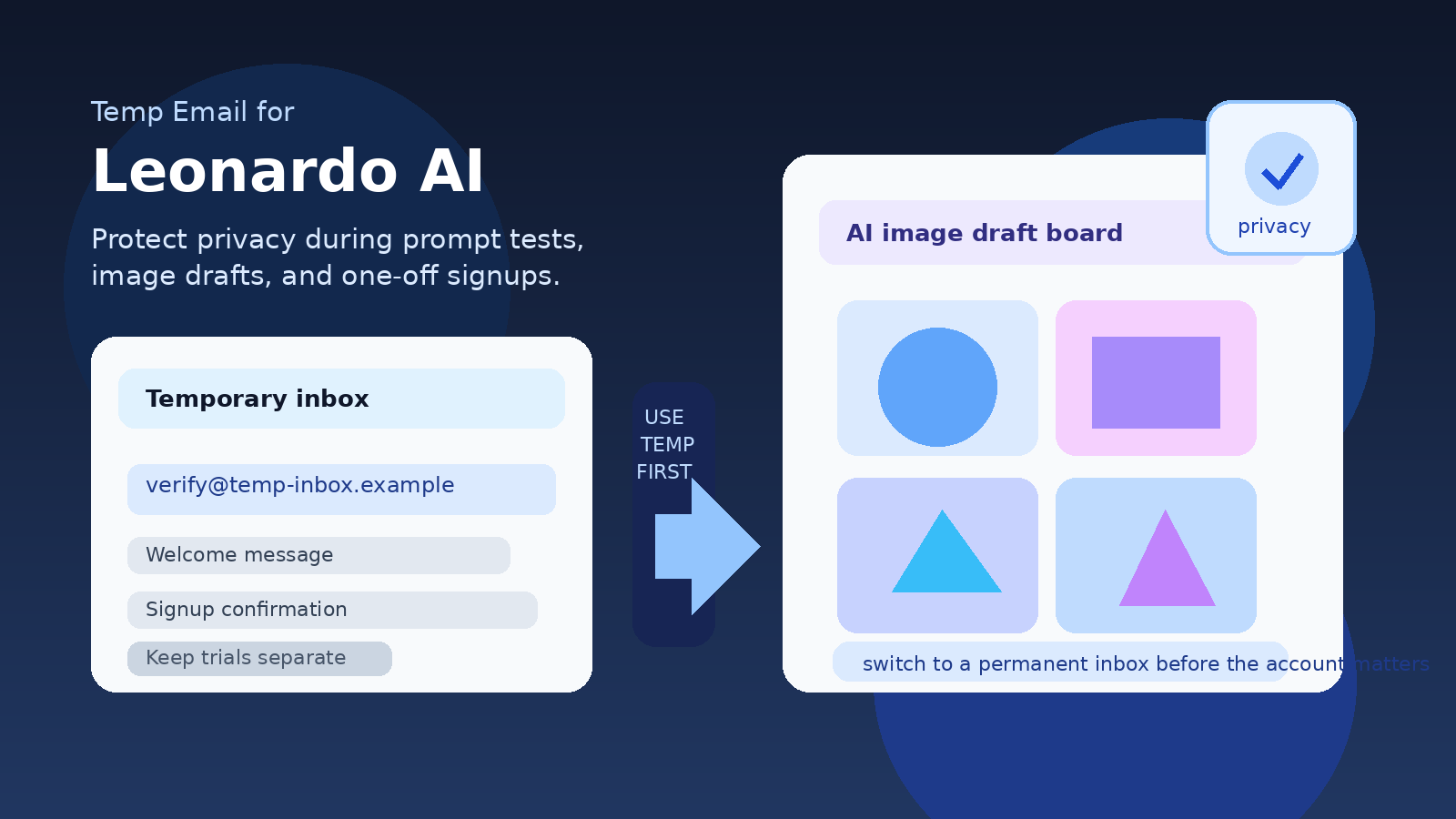
That is the practical answer. People usually search for a temp email for Leonardo AI because they want to test another creative tool without giving away their permanent address too early. That instinct is reasonable. AI image platforms often come with welcome emails, update announcements, prompt tips, credit reminders, upgrade nudges, and community messages that keep arriving long after the first experiment is over.
If you are using a service like Anonibox, the goal is not to be sneaky. It is to keep low-stakes testing separate from your real inbox, then switch to a long-term address before the account becomes important. Used that way, a temporary inbox is just organized inbox hygiene.
Why people look for a temp email for Leonardo AI
Leonardo AI sits in the kind of category where casual curiosity turns into account sprawl fast. You might start by testing one image model, comparing a few prompts, or seeing how the interface feels. Then suddenly you have draft generations, favorite styles, saved settings, or a tool you want to revisit next week.
That is why disposable email demand shows up around creative tools. People are often comparing several services in one session, not committing to a single platform on day one. Someone testing Leonardo AI may also look at Midjourney, Canva, or Figma depending on whether they care more about generation, editing, collaboration, or design handoff.
Using a temporary inbox during that early comparison phase can help you:
- verify the signup without exposing your long-term address immediately,
- keep trial-related email out of your personal or work inbox,
- separate experimental accounts from tools you actually rely on, and
- decide whether the product deserves a permanent login later.
Short answer: fine for testing, risky for anything you may want to keep
If you only want to poke around, a temp inbox can make sense. If you expect the account to become part of your real creative workflow, it usually stops making sense quickly.
The difference is simple:
- Good fit: quick exploration, one-off access, prompt testing, rough comparison shopping, and low-stakes curiosity.
- Bad fit: saved projects, paid credits, collaboration, portfolio work, client work, account recovery, and anything tied to ongoing output.
That line matters because AI creative tools feel temporary right up until they do not. A throwaway test can turn into reference images, concept directions, iteration history, or work you want to return to later.
When a disposable inbox makes sense
There are several situations where a temp email for Leonardo AI is a practical choice.
1. You are comparing tools in one sitting
If you are deciding between multiple image-generation or design tools, a separate inbox keeps the comparison neat. You can verify access, read the first welcome email, and judge the product itself instead of cluttering your everyday inbox with follow-ups from every platform you tried for ten minutes.
2. You only need a low-stakes look around
Sometimes you are not trying to build a repeatable workflow. You just want to see the dashboard, test a prompt style, check output quality, or understand how the product positions itself. A temporary inbox is reasonable for that kind of scouting.
3. You do not yet trust the tool with your permanent inbox
Even legitimate services vary a lot in how aggressive their lifecycle email becomes. A disposable address lets you evaluate the product before volunteering your long-term contact info to another marketing system.
4. You want cleaner project separation
Some people deliberately separate experimental AI tooling from core work accounts. That is a sane habit, especially if you regularly test new products and do not want your main address sprayed across dozens of trials.
When it is smarter to use a permanent email instead
A disposable address stops being the right choice once the account starts carrying real value.
Saved generations and prompt history
If you create outputs you may want to revisit, improve, or export later, you need reliable access. That means using an inbox you control for the long haul.
Paid credits or subscriptions
The moment money enters the picture, temporary email becomes the wrong tool. Billing issues, invoices, renewal notices, and recovery links are not things you want tied to a mailbox that may disappear.
Shared work or team use
If other people may depend on the account, stability matters more than inbox cleanliness. Collaboration and client-facing workflows should live on a durable email address.
Portfolio or client deliverables
If the output could become part of professional work, treat the account like a real asset. A stable address is the safer move.
How to use a temp email for Leonardo AI without creating future headaches
If you decide to use one, a little discipline goes a long way.
Step 1: decide whether this is a trial or a real account
Before you sign up, be honest with yourself. Are you genuinely just testing, or do you already suspect you may keep the account? If there is a good chance the account will matter next week, start with a permanent address and save yourself a later migration problem.
Step 2: use the temporary inbox only for early verification
The best use case is simple: confirm the signup, open the first messages, and inspect the tool. Do not treat the temp inbox as a forever identity layer. Treat it as a staging area.
Step 3: save any essential links or onboarding notes
Some disposable inboxes are short-lived. If a message contains something important for the evaluation, save it before it vanishes.
Step 4: switch to a permanent email before the account becomes important
If the tool looks promising, change the account email early while the stakes are still low. Doing it after you have saved work, added payment details, or started sharing projects is needlessly risky.
Step 5: retire the throwaway workflow once the decision is made
The whole point is to reduce clutter and exposure, not create ongoing identity confusion. Once you know whether the tool is a keeper, cleanly move on.
What can go wrong if you keep using a disposable inbox too long?
The biggest mistake is confusing a useful trial tactic with a sustainable account strategy.
- Lost recovery access: if you cannot reach the mailbox later, password resets and security notices become a problem.
- Missed billing or policy messages: you may not see account changes that actually matter.
- Broken collaboration: teammates or clients may rely on an account identity that you cannot support well.
- Fragmented workflow: your creative history ends up scattered across accounts you no longer manage cleanly.
Those are not theoretical issues. They are the normal failure modes whenever people keep throwaway signups far longer than intended.
A better long-term alternative: a dedicated creative inbox
If your real problem is not privacy but inbox overload, a dedicated secondary email can be better than a disposable one. It gives you separation without giving up persistence.
That middle-ground setup works well when you:
- want to test lots of AI tools,
- need account recovery later,
- want one place for receipts and security notices, and
- still do not want everything tied to your primary personal inbox.
In other words, use a temporary inbox for disposable trials and a dedicated secondary inbox for serious experimentation that may continue.
Privacy best practices beyond the email choice
Email strategy helps, but it is only one layer. If you are testing creative AI tools regularly, a few other habits matter too.
- Do not upload sensitive client material casually. Inbox privacy does not solve content privacy.
- Read the account settings once the tool looks promising. Check whether you can change the email later before you depend on the account.
- Keep your naming organized. If you test many platforms, track which inbox goes with which trial.
- Avoid mixing throwaway and important accounts blindly. The more scattered your signups are, the easier it is to lose track of which ones matter.
Quick decision checklist
Before signing up, ask yourself:
- Am I just testing the product, or do I expect to keep using it?
- Would I care if I lost access to this account next month?
- Will this account ever hold paid credits, saved work, or collaboration?
- Would a dedicated secondary inbox serve me better than a disposable one?
If your answers point to short-term curiosity, a temp email for Leonardo AI is reasonable. If they point to real creative use, switch to a permanent address early.
Final answer
A temp email for Leonardo AI is a good fit for low-stakes exploration and a poor fit for long-term ownership. It helps when you want to test prompts, compare tools, and protect your main inbox from another stream of trial messages. It stops helping once the account becomes valuable.
The best workflow is simple: use a temporary inbox only at the evaluation edge, keep the experiment organized, and move to a stable email as soon as the account starts holding work you care about. That gives you the privacy benefit without turning a useful creative tool into an avoidable account-recovery headache.