A temp email for Stytch is a smart choice when you are only testing sign-in flows, opening a demo project, or comparing identity tools without wanting another long vendor email trail in your main inbox.
It becomes a bad idea once the account matters for production auth, B2B organization invites, billing, account recovery, or shared team ownership.
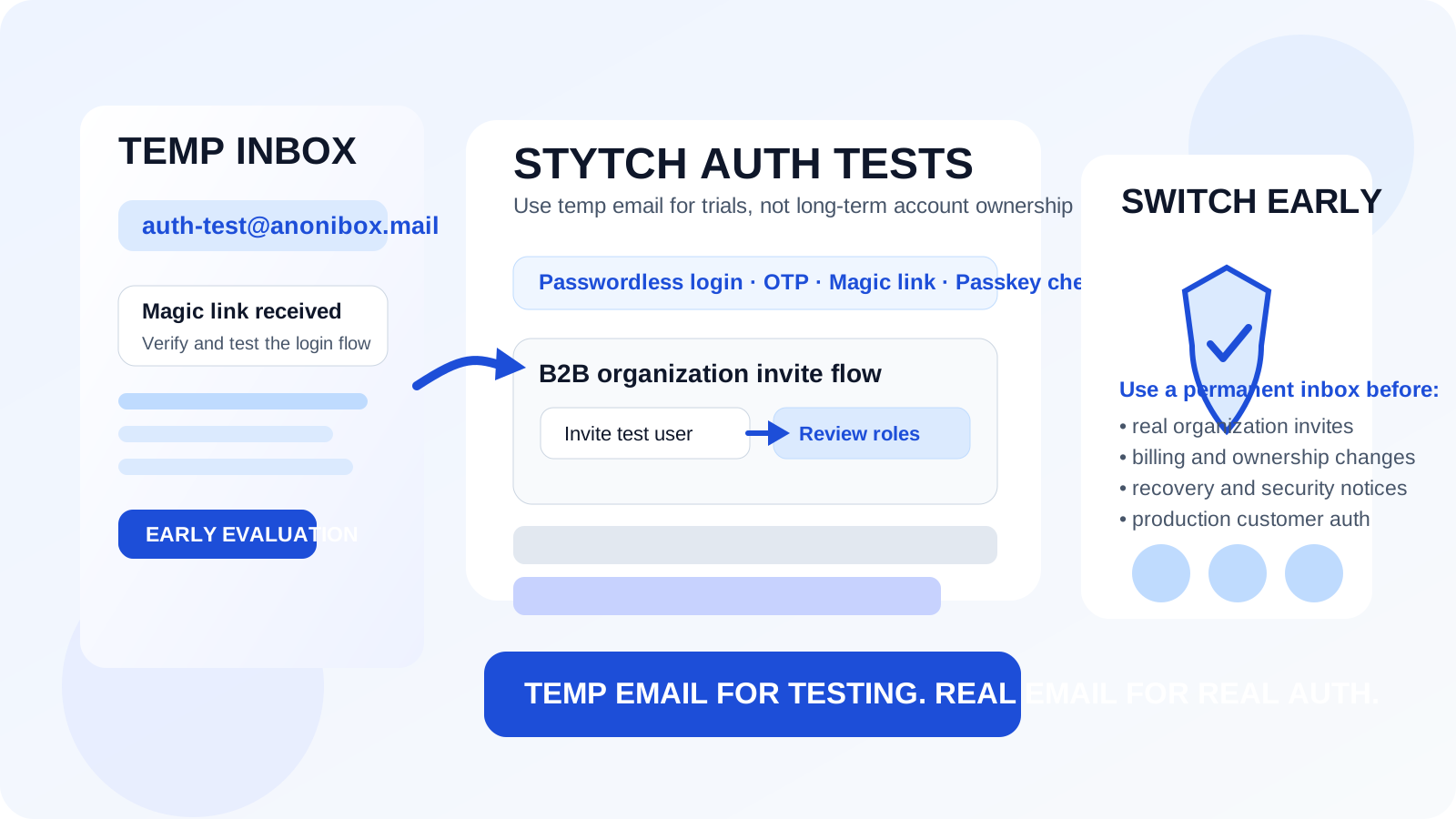
That is the short answer, but Stytch is exactly the kind of product where the boundary matters. Identity tools often begin as a quick experiment: a developer wants to test passwordless login, a product team wants to compare sign-up flows, or a startup wants to see whether an auth stack feels easier than the other options on the shortlist. In that stage, a disposable inbox can help a lot.
The trouble starts when “just testing” quietly turns into “this now controls how real people get into our product.” A temporary inbox is helpful for low-stakes evaluation. It is a poor long-term owner for authentication, organization management, support escalation, or recovery paths that could matter later.
Why people look for a temp email for Stytch
Stytch sits in a category where teams often move fast. You may want to try magic links, one-time passcodes, passkeys, session management, B2B organization features, or basic user flows before making any serious commitment. That usually means signing up, verifying an email, and poking around the dashboard long before you know whether the tool belongs in your real stack.
That early stage creates two common annoyances. First, every product trial wants your email. Second, identity-platform signups often lead to a long follow-up sequence: onboarding messages, implementation tips, invitations to book a demo, security content, upgrade prompts, and reminder emails aimed at turning a casual evaluation into a sales process.
A temporary inbox helps keep that noise separate. If you use a service like Anonibox for exploratory signups, Stytch is a reasonable place to apply the same habit. You still get the verification link and first-run messages you need, but you do not automatically tie another identity vendor evaluation to the inbox you use every day.
When a temp email for Stytch makes sense
A disposable address is most useful when the account is clearly experimental rather than operational.
1. You are testing core auth flows
If the goal is to see how signup, login, verification, session handling, passwordless options, or passkey flows feel, a temporary inbox is fine. You need the verification email and maybe a few login-related messages, but you do not yet need a permanent account owner.
2. You are opening a demo app or proof of concept
Many teams spin up a small demo before they know whether a platform will survive internal review. In that phase, the account may only exist to answer basic questions: does the SDK feel straightforward, is the dashboard understandable, and does the implementation model fit the product? A temporary inbox keeps the test lightweight.
3. You are comparing Stytch with adjacent identity tools
It is normal to compare several identity platforms side by side. You may be weighing Stytch against tools focused on B2B orgs, passwordless UX, enterprise SSO, or developer-first auth setup. During that comparison window, separate throwaway inboxes can keep the process cleaner and reduce clutter from vendors that never make the shortlist.
4. You want to avoid unnecessary inbox spillover
Even legitimate software trials create noise. Welcome messages turn into nurture sequences quickly. If you are only trying to decide whether Stytch deserves a deeper look, there is nothing wrong with keeping that exploration separate from your long-term work email.
What to test while you still have the temporary inbox attached
If you are going to use a temp email for Stytch, use that limited window well. The point is not just to create the account. The point is to get enough signal to decide whether the platform fits.
Email delivery and sign-in experience
Since email can sit directly inside the login flow, your first useful test is simple: do the verification messages arrive promptly, are the links clear, and does the overall experience feel trustworthy? A disposable inbox is ideal for this early check because you can receive the magic link or code without mixing those messages into a business inbox that already handles real work.
B2B organization and invite behavior
If you care about organization setup, role models, or member invitations, test those concepts early. Can you understand how a company or team would be structured? Do invite flows make sense? Does the admin experience feel workable for a product that may eventually involve multiple organizations and permission boundaries?
This is also where the limit of temporary email starts to show. A quick invite test is fine. A real team ownership model is not.
Developer setup friction
Identity platforms are rarely judged only by feature lists. The real question is how much effort they add to implementation. During a short trial, evaluate how easy it is to understand the setup steps, wire in a basic app, and reason about the auth model. If the product feels confusing while the stakes are low, that matters.
User-journey quality
A decent early test should look beyond admin setup. Ask whether the actual user path feels clear. Is registration predictable? Does sign-in feel modern rather than brittle? Can you imagine support teams, product managers, and developers all understanding what happens when users verify email, switch devices, or get invited into an organization?
When a temp email for Stytch becomes a bad idea
The right time to stop using a temporary inbox is earlier than many people think. Once the account begins to matter, the mailbox behind it matters too.
Production auth is in scope
If your app is moving beyond a toy demo, the identity layer is no longer just another SaaS trial. It is part of the path users depend on to access your product. At that point, you want a stable monitored email on the account, not something disposable.
Real organization invites and teammate access begin
As soon as more than one person depends on the workspace, ownership gets serious. Shared admin access, organization setup, support requests, and settings changes all become harder to manage if the original owner email is temporary or forgotten.
Billing, contracts, or compliance notices matter
Invoices, renewal reminders, security notifications, policy updates, and vendor communication should go to a durable address the right people can actually monitor. A temp inbox is the wrong home for anything financial or operationally important.
Recovery paths start to matter
This is the biggest long-term risk. Identity products often touch the exact workflows you never want to mishandle later: account recovery, admin confirmation, ownership transfer, and security-sensitive notices. If the original inbox disappears or becomes inaccessible, you can create a painful problem for yourself.
A simple workflow that avoids the usual mess
The best approach is not “never use temp email” and it is not “keep the throwaway address forever.” It is to separate evaluation from ownership.
- Use a temp inbox for the first signup if the goal is purely exploratory.
- Run the critical early tests fast: verify the email flow, inspect the dashboard, test a sample login path, and review invite logic.
- Decide whether Stytch is a serious contender before you build more around it.
- Move to a permanent monitored mailbox before production work, collaboration, billing, or account recovery become relevant.
That sequence gives you the privacy benefit without letting a disposable inbox become the accidental owner of an important system.
Good and bad examples
A good use case
You want to compare developer-focused identity providers for a new app idea. You sign up with a temporary address, verify the account, test a basic authentication flow, review how organization invites work, and decide within a day whether the platform is worth deeper implementation. If it is not, your main inbox stays clean.
A bad use case
You sign up with a throwaway inbox, build part of a real product on top of the account, invite coworkers later, and forget that the original email is not stable. Months later you need to recover access, change ownership, or handle billing, and suddenly the weakest part of the whole setup is the inbox tied to the account.
The best middle ground
Use the temporary address as a shield for the evaluation stage only. The moment the answer changes from “we are testing this” to “we may actually depend on this,” switch the account to a permanent address your team can control properly.
Mistakes to avoid
- Do not confuse a successful signup with a safe long-term setup. Passing the first verification step does not mean the mailbox choice will age well.
- Do not leave teammate access tied to a disposable owner address. That is how routine admin work becomes fragile.
- Do not ignore recovery and security messages. In identity tooling, those messages matter more than they do in many ordinary SaaS trials.
- Do not wait too long to switch. It is much easier to move early than after the account is connected to real apps, real users, and real responsibilities.
Final answer
A temp email for Stytch is useful when the account is still a low-stakes experiment. It helps with early auth testing, demo apps, one-off verification, and trial privacy while keeping yet another vendor sequence out of your main inbox.
It stops being a good idea when the account becomes real infrastructure. Once Stytch is tied to production sign-in, B2B organization invites, billing, admin ownership, or recovery workflows, move the account to a stable email immediately. That way you get the convenience of temporary email during evaluation without creating a fragile ownership problem later.