Yes, you can use a temp email for Brightspace when you are testing a sandbox course, checking an enrollment flow, or reviewing notifications without feeding your main inbox into every LMS experiment.
No, it is a bad long-term address once a real admin, instructor, or student account depends on that inbox for access, announcements, password resets, or recovery.
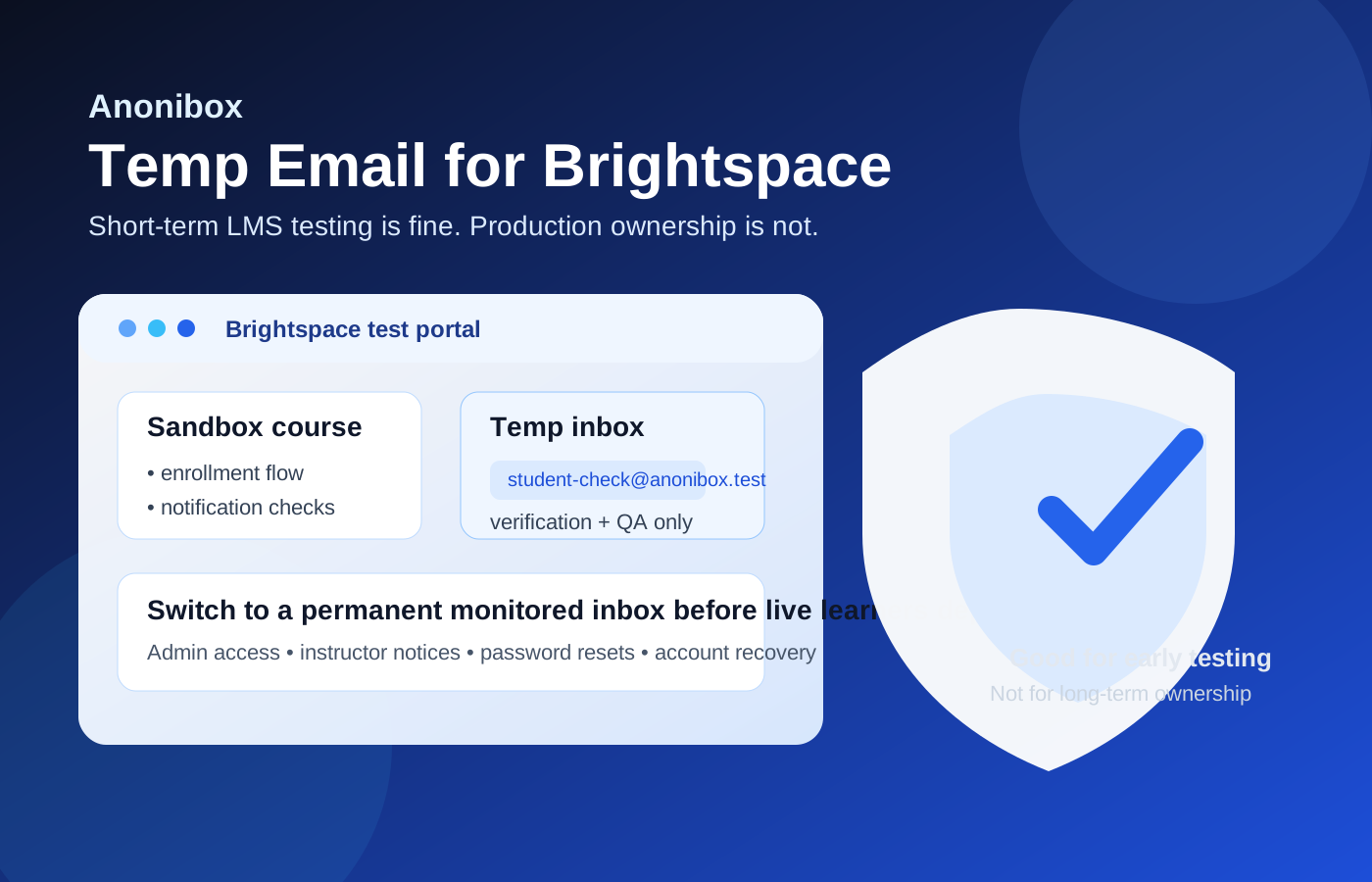
That is the practical rule. Temporary email can be useful during short-lived Brightspace evaluation and QA, but it becomes risky the moment the account matters to real people or real coursework. If you are exploring D2L Brightspace for higher education, K-12, training, or corporate learning, the safest approach is to use a disposable inbox only for the early testing phase and then move anything important to a permanent monitored address.
Why people look for a temp email for Brightspace
Brightspace is exactly the kind of platform where email becomes part of the workflow almost immediately. Even a basic trial, demo environment, or pilot can involve account invitations, verification steps, password setup, course enrollment notices, announcements, and routine notifications. If you are comparing learning platforms or building test personas, that can create a lot of inbox noise very quickly.
That is why a temporary inbox is appealing. You may want to test how learner signup works, see what a course invitation looks like, compare message timing, or spin up role-based accounts without tying every experiment to your daily work email. A tool like Anonibox is handy in that early stage because it lets you catch the messages you need for setup and QA without committing a permanent inbox to every short-lived test.
The problem is that Brightspace accounts do not always stay short-lived. A test portal can turn into a real portal, a pilot learner can become a real learner, and an admin account created for convenience can quietly become the account people rely on later. That is the moment a disposable inbox goes from useful to fragile.
When a temp email makes sense for Brightspace
A temp inbox is most useful when both the account and the environment are temporary. Good examples include:
- Early platform evaluation: You want to see how Brightspace account creation, login, or first-run communications work before sharing a permanent address more widely.
- Sandbox course testing: You need throwaway learner or instructor-style accounts to check navigation, access rules, and enrollment behavior.
- Notification QA: You want to inspect welcome emails, invite emails, announcement notices, or other automated messages without cluttering your everyday inbox.
- Workflow comparisons: You are reviewing Brightspace alongside another LMS and want to keep the vendor and system traffic separate.
- Short-lived proof-of-concept work: You are helping a school, training team, or client validate a setup before the real rollout begins.
Those are all low-stakes, reversible situations. If the goal is simply to learn how the platform behaves, temporary email can save time and reduce clutter.
When it becomes a bad idea
Brightspace stops being casual the moment real people depend on the account for ongoing access. At that point the email address tied to the profile is no longer just a convenience detail. It becomes part of sign-in recovery, message delivery, and account ownership.
A temporary email becomes risky when it is attached to:
- The main admin account that controls settings, users, integrations, or environment-level decisions
- Instructor accounts that need reliable access to course communication and password resets
- Real student or learner accounts that may need to return later, recover access, or receive important notices
- Any account tied to grades, completion records, or formal training history
- Any production workflow where missed email could create confusion, support load, or lock someone out
Some Brightspace environments are also connected to institutional identity systems, official domains, or more permanent onboarding rules. In those cases, a temp inbox may be useless anyway, or it may create a messy partial setup that has to be cleaned up later. Either way, it is not something to treat casually once the environment is real.
A safe way to use temporary email during Brightspace evaluation
If you want the privacy and inbox-control benefits without causing future headaches, use a simple boundary:
- Create the disposable inbox only for testing. Use it for signup confirmation, initial invites, or notification QA.
- Label those accounts clearly. Make it obvious that they are sandbox users, demo personas, or short-term test accounts.
- Document what you are testing. Capture the messages you actually care about, such as invite wording, reset behavior, or timing.
- Do not let the test account become the real owner. If the environment is moving beyond QA, switch the important accounts to permanent monitored addresses before launch.
- Retire the throwaway identities when testing is done. That keeps your Brightspace environment cleaner and avoids confusion later.
This gives you the best part of disposable email without letting the convenience leak into production governance.
Common mistakes to avoid
Using one temp inbox for every role
If you are testing different user journeys, one shared inbox can make results harder to interpret. Separate test personas are usually cleaner than shoving every notification into one place.
Forgetting that recovery matters later
People often focus on the first login and forget the second, third, or tenth one. Password resets and account recovery are usually where disposable email becomes painful.
Leaving a pilot account in place too long
A pilot learner account or temporary admin account can easily survive past its original purpose. If you do not clean it up, someone may keep using it out of habit until it becomes a real risk.
Assuming the LMS workflow is the whole story
Brightspace is not only about course access. Notifications, support communication, invitations, and institutional processes may all depend on reliable inboxes. A disposable address might work for a narrow QA task while still being a poor fit for the overall lifecycle.
What schools, training teams, and consultants should do instead
If you are managing a serious evaluation, the best middle ground is usually not “use a temp email forever” and not “use your real inbox for everything.” A better approach is to separate testing identities from production identities.
For example, you can use temporary email for early verification and workflow review, then switch important accounts to inboxes that your team actually monitors. That gives you cleaner testing and cleaner governance. If you need more structure, use role-specific permanent test inboxes that your team controls instead of disposable ones for accounts that may persist beyond a day or two.
This matters even more if multiple people are involved. The more stakeholders you have, the more dangerous it becomes to anchor a useful Brightspace account to an inbox nobody really owns long term.
Is a temp email good for student privacy?
Only in a narrow sense. A disposable inbox can reduce exposure during a short evaluation because it keeps your main address out of one more system while you are still deciding whether you need it. That is a reasonable privacy benefit.
But once a real learner depends on the account, privacy is not improved by making the inbox unreliable. If the trade-off means missed notices, broken recovery, or confusion over account ownership, the privacy gain is usually not worth it. Temporary email is better seen as a testing tool, not as a long-term student privacy strategy.
Quick decision checklist
Before using a temp email for Brightspace, ask:
- Is this account only for a short-lived test or sandbox?
- Will a real learner, instructor, or admin depend on it later?
- Do I need reliable password recovery for this account?
- Am I testing notifications, or am I creating a real production identity?
- Will this environment likely connect to permanent institutional workflows?
If the account is temporary and the answers stay low-stakes, a disposable inbox is probably fine. If the account is becoming real, switch to a permanent monitored address before it becomes a problem.
Final answer
A temp email for Brightspace is useful for early LMS testing, sandbox setup, and notification QA. It helps you evaluate the platform without turning your normal inbox into a dumping ground for every pilot and experiment.
It is a poor choice for production admins, real students, instructors, or any account that may need reliable recovery and ongoing communication. Use temporary email to test Brightspace early. Do not let it become the long-term home of an account people actually depend on.