Use a temp email for 360Learning when you are testing a trial workspace, checking learner invites, or reviewing notifications without pushing every LMS experiment into your main inbox.
Do not leave a disposable address on a real 360Learning admin, manager, or learner account once course access, password resets, or long-term communication depends on that inbox.
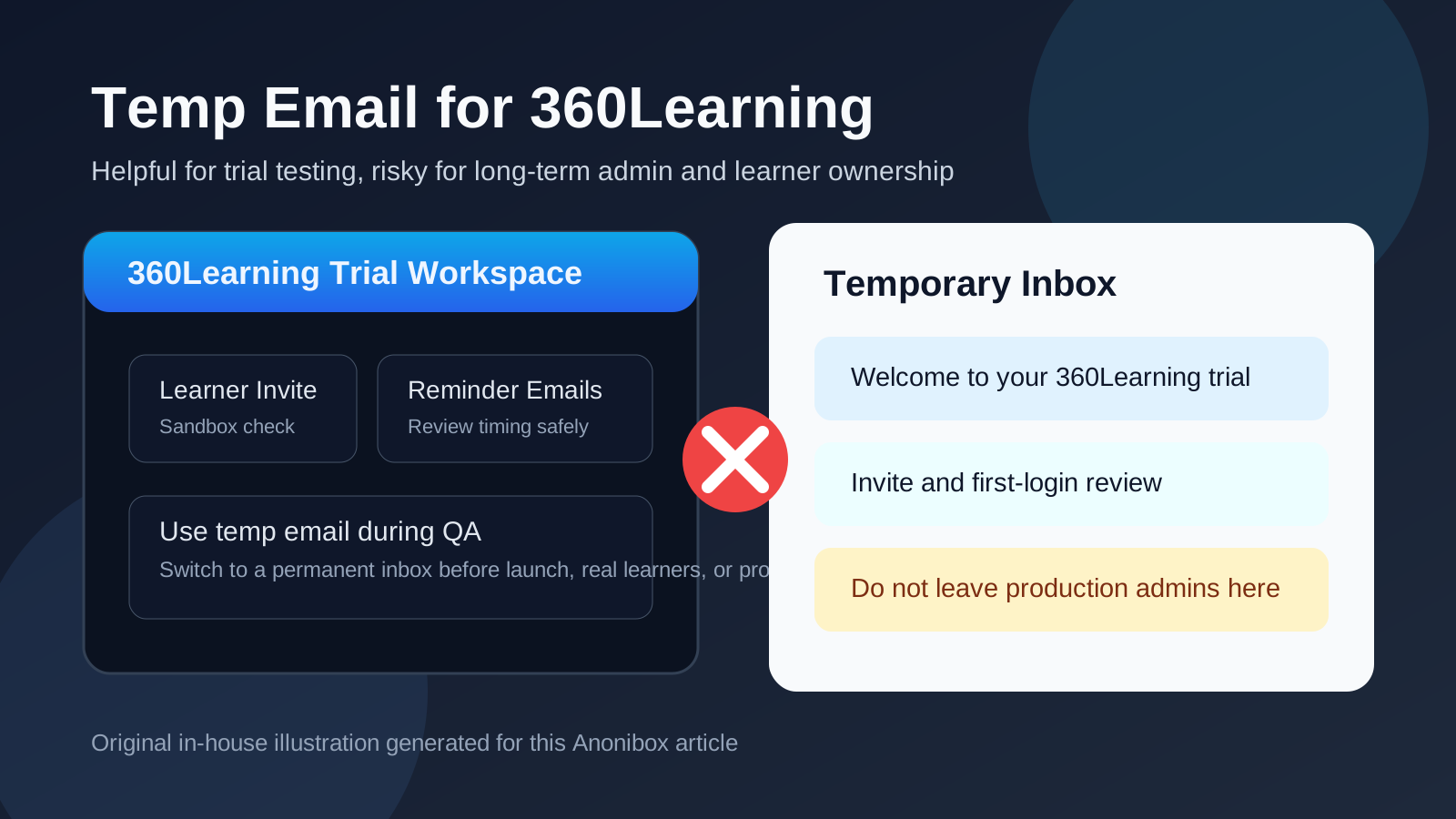
That is the practical answer. Temporary email is useful during early evaluation and QA, but it becomes fragile once the account matters to a real training program, partner academy, customer education flow, or employee learning path. If you are piloting 360Learning, the safe approach is to use a throwaway inbox only while the account is clearly temporary, then switch important identities to a permanent monitored address before launch.
Why people look for a temp email for 360Learning
360Learning is the sort of platform where email starts doing work immediately. Even a basic test can trigger verification links, learner invitations, password setup messages, reminder emails, cohort communication, and admin notifications. If you are comparing several LMS platforms or creating multiple test users, that traffic can get noisy fast.
That is why a temporary inbox is appealing. You may want to inspect the welcome flow, review the wording of invites, test a learner journey, or create role-based accounts without giving your everyday work address to every trial account along the way. A tool like Anonibox fits well at that stage because it helps you catch the messages you need while keeping exploratory testing separate from your regular inbox.
The problem is that LMS accounts have a habit of outliving their original purpose. A sandbox admin becomes the person still running the workspace. A demo learner account turns into the one everyone uses for screenshots or stakeholder reviews. A temporary academy becomes the starting point for a real rollout. That is when the convenience of disposable email becomes a liability.
When a temp email makes sense for 360Learning
A disposable inbox is most useful when both the account and the environment are clearly temporary. Good examples include:
- Early platform evaluation: you want to see how 360Learning handles invites, course access, and first login before involving a permanent address.
- Sandbox learner testing: you need throwaway learner-style accounts to check enrollment, navigation, assignment visibility, and completion flows.
- Notification QA: you want to review reminder emails, invite timing, and password-reset behavior without cluttering your normal mailbox.
- Vendor comparison work: you are comparing 360Learning with tools like Moodle, TalentLMS, Blackboard, Canvas LMS, Brightspace, Schoology, Docebo, Absorb LMS, or Litmos and want cleaner inbox separation.
- Short proof-of-concept builds: you are helping a team validate setup choices before anyone starts depending on the environment long term.
These are low-stakes, reversible situations. If the goal is to learn how the platform behaves rather than to operate it permanently, temporary email can save time and keep testing tidy.
When it becomes a bad idea
360Learning stops being casual the moment a real person depends on the account for ongoing access. At that point the email address is no longer just a signup field. It becomes part of account recovery, communication, and ownership.
A temp inbox becomes risky when it is attached to:
- the main admin account that controls users, groups, learning paths, or workspace settings
- manager or instructor accounts that need reliable access to assign or review learning
- real learner accounts tied to onboarding, enablement, compliance, or certification work
- external partner or customer academy users who may return weeks or months later
- any account involved in deadlines, reporting, or long-lived training records
If missing one email could mean a lockout, a missed assignment, or an unnecessary support ticket, the account should not be anchored to a disposable inbox.
360Learning-specific complications people overlook
Collaborative learning still depends on reliable account access
360Learning is often used for collaborative learning programs rather than one-off course dumps. That means learners, managers, and admins may need to come back repeatedly, not just sign in once. A temporary inbox is fine for checking how the first invite looks, but it is weak footing for an account that may need to live through repeat access, resets, and follow-up communication.
Manager and admin roles are not disposable in practice
Manager-style accounts can influence assignments, follow-up, reporting, and visibility into learner progress. Admin roles go even further. If one of those accounts is attached to a throwaway inbox, the issue usually shows up only later, when someone needs a reset link or ownership change quickly.
Academies and long-running programs can quietly outgrow the pilot
Teams often start with a limited trial and then keep building on it. A demo academy used for internal testing can turn into a real onboarding hub. A short customer education pilot can become the basis of a long-running training space. If the original identities were created casually on temporary email, recovery and governance can get messy at exactly the wrong time.
Notification quality matters more than people expect
LMS communication is not always just noise. Invites, reminders, and completion nudges can become part of how programs actually function. It makes sense to use temporary email to review those messages in QA, but not to keep production users on an inbox that may disappear.
A safe way to use temporary email during 360Learning evaluation
If you want the privacy and inbox-control benefits without creating a future cleanup problem, use a simple boundary:
- Use the disposable inbox only for testing. Keep it for signup confirmation, invite review, and notification QA.
- Label those accounts clearly. Make it obvious they are sandbox learners, demo managers, or short-term QA admins.
- Capture the messages you actually need. Save useful examples of welcome emails, invite links, and reset messages before the inbox disappears.
- Do not let the test identity become the real owner. If the workspace is moving beyond evaluation, switch important accounts to permanent monitored addresses before launch.
- Retire throwaway users when testing ends. That keeps the environment cleaner and reduces future confusion.
This approach gives you the privacy benefit of temp email without quietly turning a disposable address into part of your real learning infrastructure.
What to test while you still have the disposable inbox
Invitation and first-login flow
Create a fresh learner-style account and walk through the full first-login experience. Does the invitation arrive quickly? Is the call to action clear? Does the learner land in the right place after activation?
Password reset behavior
Do not stop at account creation. Trigger a reset on purpose. Recovery flows are where systems often feel fine in demos but create real friction later.
Assignment and reminder emails
Check what actually lands in the inbox after a course assignment, reminder, or follow-up notification. That is one of the fastest ways to see whether the communication model feels useful or noisy.
Role-based differences
Admin, manager, and learner experiences are not identical. If you are testing a serious rollout, create separate personas rather than using one inbox for everything. It becomes much easier to spot role-specific issues before production.
Common mistakes to avoid
- Using one temp inbox for every role: that makes message review messy and hides role-specific differences.
- Forgetting about recovery: the first login is rarely the hard part; the second or fifth login is where temporary email starts to hurt.
- Letting a pilot account linger: temporary admin and learner accounts often survive by habit until they become real dependencies.
- Confusing privacy with durability: a disposable inbox can improve privacy during evaluation, but it does not improve reliability once the account matters.
What teams should do instead for real rollouts
If you are running a real 360Learning implementation, the best middle ground is usually not “use temp email forever” and not “use your personal inbox for every test.” A better pattern is to separate testing identities from production identities.
Use temporary email for early verification, throwaway QA users, and message review. Then move production admins, true managers, and any account tied to real learners or real programs to inboxes your team intentionally monitors. If you need persistence during a longer pilot, a dedicated project mailbox is usually safer than a disposable one.
That balance keeps early testing flexible without making later governance sloppy.
Quick decision checklist
Before using a temp email for 360Learning, ask:
- Is this account only for a short-lived sandbox or evaluation?
- Will a real learner, manager, or admin depend on it later?
- Do I need reliable password recovery for this account?
- Am I testing notifications, or am I creating a real operational identity?
- Is this workspace likely to become part of a long-term onboarding or learning program?
If the account is temporary and the answers stay low-stakes, a disposable inbox is probably fine. If the account is becoming real, move it to a permanent monitored address before it turns into technical debt.
Final answer
A temp email for 360Learning is useful for early LMS testing, invite review, learner-flow checks, and notification QA. It helps you evaluate the platform without turning your everyday inbox into a dumping ground for every pilot and experiment.
It is a poor choice for production admins, real learners, managers, or any account that may need dependable recovery and ongoing communication. Use temporary email to test 360Learning early. Do not let it become the long-term home of an account people actually depend on.