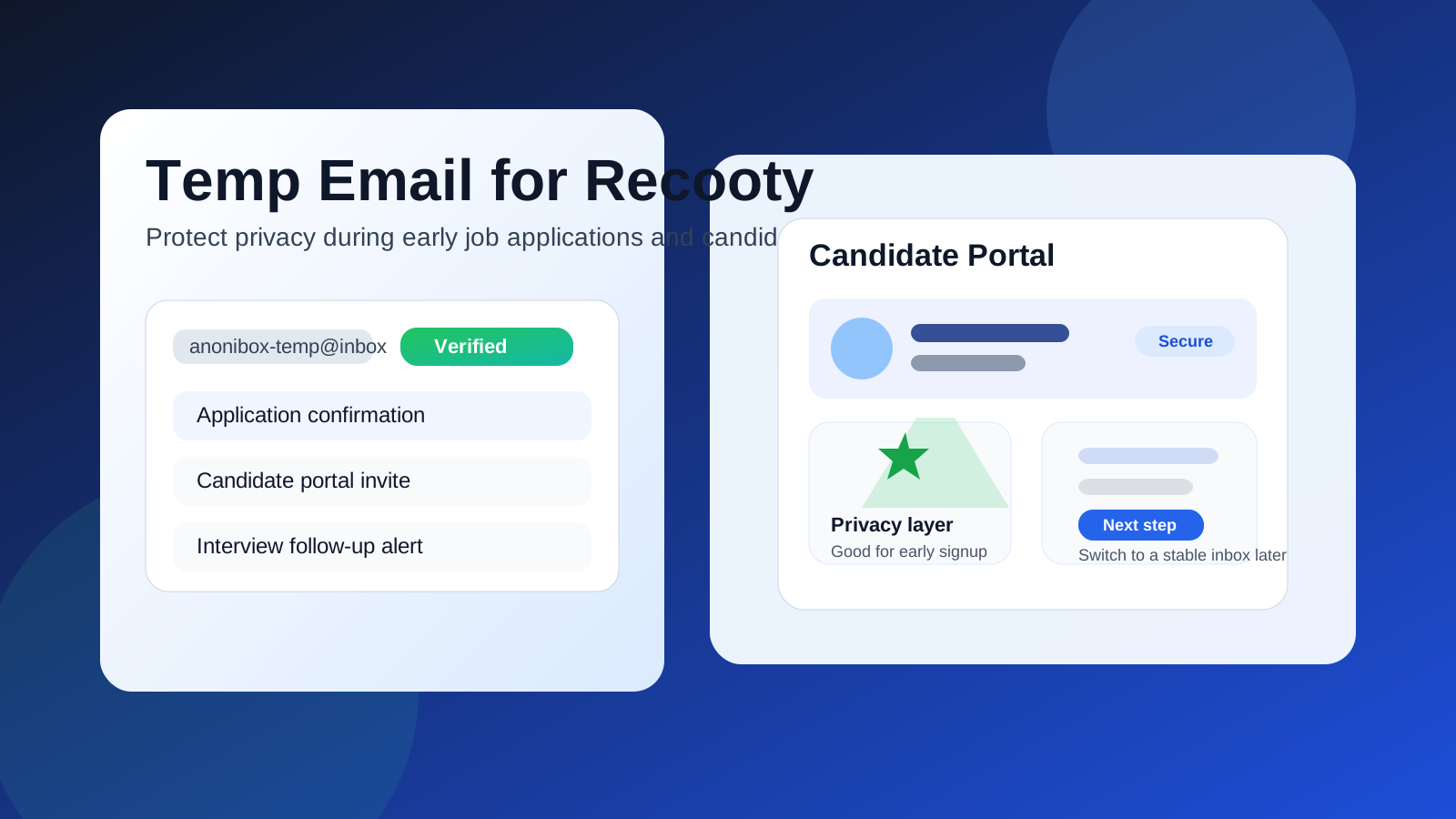
Yes — a temp email can be useful for Recooty when you want to keep early job applications, candidate portal signups, and follow-up messages out of your main inbox.
No — it is usually not the right long-term address once a real employer starts relying on that inbox for interviews, password resets, and time-sensitive hiring updates.
That balance matters because Recooty is not just a passive form on a careers page. Depending on how an employer uses it, the platform can become an actual communication channel for applications, screening steps, candidate portal access, and recruiter follow-up. A temporary inbox can reduce clutter and protect your privacy at the exploratory stage, but it can also create risk if you keep using it after a role becomes serious.
The smartest way to think about a temp email for Recooty is as an early-stage filter. It can help you test the legitimacy of a role, avoid long-tail spam, and keep low-priority applications separate from your personal inbox. But once the process moves toward interviews or any account you may need to recover later, convenience stops being the main priority. Reliability matters more.
Why Recooty can generate more email than people expect
Many job seekers assume a hiring platform only sends one confirmation message and then stays quiet. In practice, platforms like Recooty can generate a longer email chain than that, especially when employers are actively recruiting or using built-in automation.
You may receive:
- application confirmations and account-verification messages
- candidate portal links and password-reset emails
- follow-up questions from a recruiter or hiring team
- status updates, screening requests, or interview instructions
- future-job alerts or talent-pool messages if you stay in their system
If you are applying broadly, that can add up fast. A single role is manageable. Ten or twenty applications across different systems can turn your main inbox into a messy mix of real opportunities, rejection notices, old alerts, and promotional recruiting emails.
When a temp email for Recooty makes sense
A temp inbox is most helpful when the application is still early, low-stakes, or uncertain. Good use cases include:
- Testing a candidate portal: You want to see how the application flow works before tying it to your long-term address.
- Applying for lower-priority roles: You are interested, but not enough to give every employer ongoing inbox access right away.
- Protecting your privacy during broad searches: If you are sending many applications, a temporary or segmented address can stop your personal inbox from becoming the permanent target for future campaigns.
- Filtering unknown opportunities: Some job listings are legitimate but noisy. Others may be vague enough that you want more distance until you trust the employer.
- Separating research from commitment: You may want to explore a company, role, or recruiter workflow without treating it as a serious long-term application yet.
In those situations, a tool like Anonibox can be useful as a controlled first layer. You still get the verification link or first recruiter message you need, but you do not hand out your primary inbox everywhere on day one.
When using a temp email becomes risky
The downside appears when the process stops being casual. Recooty may still be the same platform, but your relationship to the role changes. A temp email becomes risky when:
- the employer is clearly legitimate and progressing you to the next stage
- the role involves interviews, assessments, or document requests
- you expect to log back in multiple times over several days or weeks
- the account might need a password reset later
- you would genuinely care if you missed a time-sensitive message
This is where many people get tripped up. A temporary inbox feels efficient until something important lands there: an interview invite, a scheduling request, or a screening deadline. Missing one of those messages can cost you the role entirely, even if the original reason for using the temp inbox was sensible.
A practical workflow that protects privacy without hurting your chances
1. Use a temp inbox only for the earliest stage
If you are testing the waters, a temporary inbox is reasonable. Use it for the first application, the verification step, or the first confirmation email. Do not assume it has to stay attached forever.
2. Decide quickly whether the role is real enough to escalate
As soon as a recruiter replies personally, the employer starts asking screening questions, or the role looks worth serious effort, switch to a stable inbox you control. The right time to change is usually earlier than people think.
3. Save the important details immediately
Keep your own record of the employer name, role title, portal link, recruiter contact, and application date. Do not rely on the platform to be your only source of memory. This matters even more if you started with a disposable address.
4. Move to a monitored email before interviews
If an application is progressing, do not wait until the day before an interview to update your contact information. Switch before scheduling becomes urgent.
5. Keep one clear inbox strategy per application
A common mistake is starting with one address, casually replying from another, and then forgetting which inbox the recruiter or portal is actually using. That creates confusion fast. Once you change to a permanent address, confirm that the employer has it on file.
Common mistakes people make with Recooty and temp email
- Treating every application as low-stakes: some employers respond faster than expected.
- Assuming the portal itself is unimportant: even if recruiter emails are light, the account may still matter later.
- Leaving a temp inbox attached too long: early privacy protection is useful; late-stage unreliability is not.
- Failing to document what you applied for: broad job searches get messy unless you keep your own notes.
- Ignoring account-recovery risk: if you ever need to re-enter the portal, that inbox may become important again.
How to judge whether a Recooty application deserves your real email
Ask yourself a few practical questions:
- Would I be annoyed or genuinely disappointed if I missed a next-step message from this employer?
- Does this look like a real hiring process instead of a speculative signup?
- Will I probably need this account again after today?
- Would I be comfortable letting this employer continue contacting me if the role evolves?
- Am I protecting privacy, or just postponing a switch I know I will need anyway?
If most of the answers point toward a serious opportunity, you are better off moving to a stable inbox. It does not have to be your oldest personal email. A dedicated job-search address is often the sweet spot: more private than your everyday inbox, but far more dependable than a disposable one.
If you already used a temp email and now the role is getting serious
That is fixable. Do it early.
- Log into the candidate portal while you still have access.
- Check whether the profile email can be updated in account settings.
- If not, contact the recruiter or hiring team directly and ask them to change it.
- Save every important email, link, and deadline before you switch.
- Confirm which inbox they will use going forward.
The earlier you do this, the easier it is. Once assessments, interviews, or offer paperwork begin, confusion around email ownership becomes much more expensive.
A simple rule of thumb
Use a temp email for Recooty when the goal is privacy during exploration. Stop using it when the goal becomes reliable participation in a real hiring process.
That rule sounds simple, but it keeps you out of most avoidable mistakes. It gives you a clean way to limit spam and protect your personal inbox without pretending that a disposable address is the best home for serious interview logistics.
Final answer
A temp email for Recooty is useful when you want to protect your privacy during early job applications, reduce inbox clutter, or test a candidate portal before committing your real contact details. It works best as a short-term filter.
It becomes a bad fit once the employer starts sending important updates, interview steps, or account-recovery messages. At that point, a stable monitored inbox is the safer move. Use the temporary layer to control exposure early, then switch to a dependable address before timing and access start to matter.