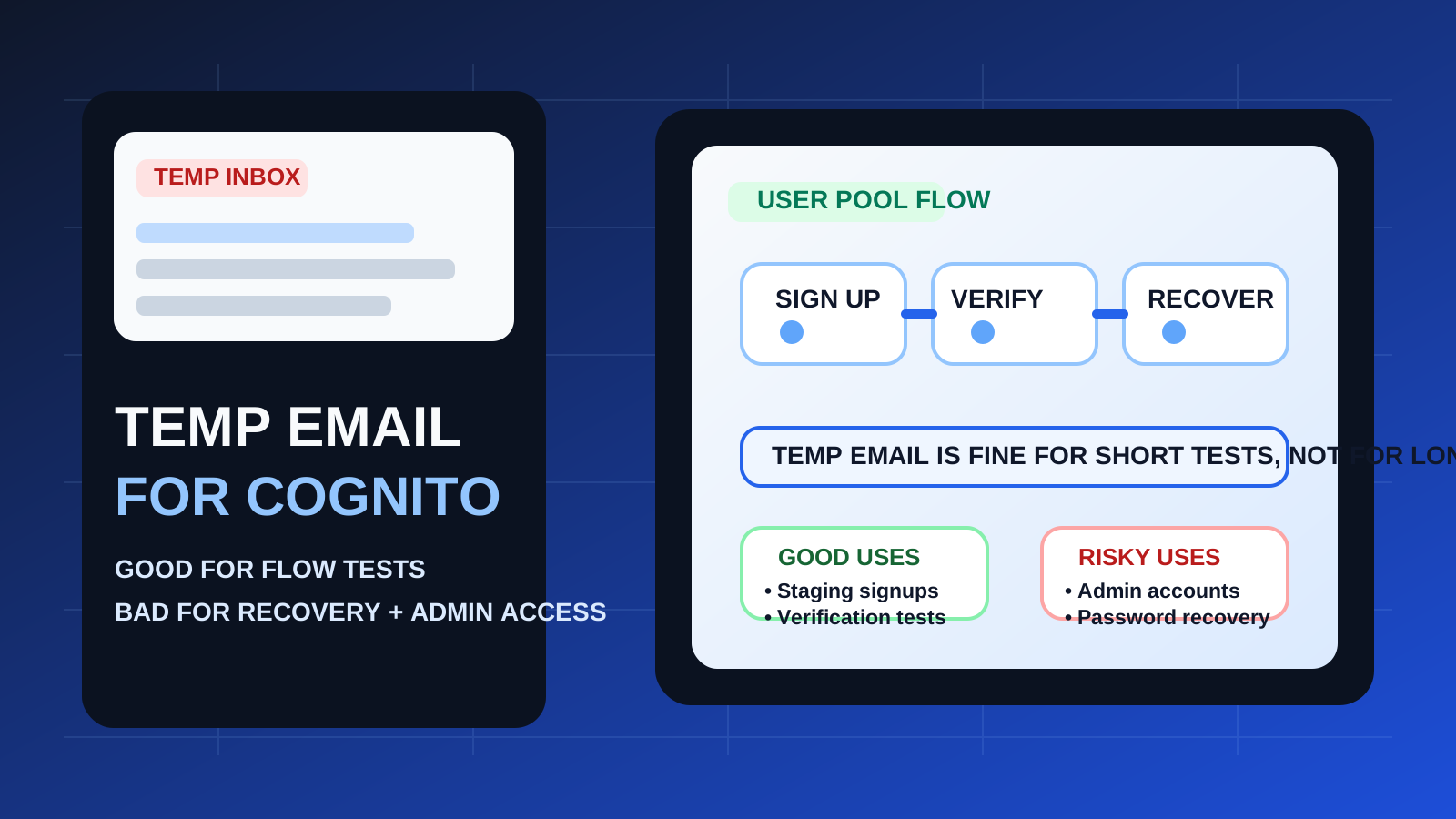
A temp email for Amazon Cognito is useful for early signup-flow testing, verification emails, and disposable staging accounts.
It is a bad fit for production users, admin access, password recovery, or any account your team may need to keep long term.
If you are building or testing an app with Amazon Cognito, email often shows up very early in the workflow. You may need it for account verification, password resets, sign-up confirmation, invite flows, or basic end-to-end testing. That makes a disposable inbox tempting. It gives you a fast way to create test accounts, confirm messages arrive, and keep your normal inbox out of yet another development workflow.
That instinct is usually correct at the beginning. A temporary inbox can be genuinely helpful when you are testing signup screens, checking whether verification emails are delivered, validating staging behavior, or making sure a user journey works from start to finish. But the same shortcut becomes fragile once the account stops being disposable. If the email belongs to an admin, a production user, a shared internal test account, or a real identity that may need recovery later, temporary email turns from a convenience into a weak point.
That is the real answer behind this keyword. A temp email for Amazon Cognito makes sense for low-stakes identity testing. It does not make sense for durable user identities, shared team ownership, or anything your product may depend on beyond the first round of checks.
Why people use temporary email with Amazon Cognito
Developers, founders, and QA teams usually look for this because they want speed and separation.
- Speed: you can create a fresh test account in seconds without cluttering your regular inbox.
- Separation: staging signups, sandbox checks, and throwaway experiments stay out of your main email account.
- Repeatability: it is easier to test multiple signup paths when each account starts clean.
- Inbox hygiene: repeated verification and reset messages do not pile up in an inbox you actually use every day.
That is why tools like Anonibox fit this stage well. You get a quick inbox for verification and flow testing without turning every experimental build into a permanent stream of email noise.
When a temp email for Amazon Cognito makes sense
There are several cases where temporary email is a practical choice.
1. Testing sign-up and verification flows
If your goal is to confirm that new-user registration works, verification messages arrive, and links behave correctly, a disposable inbox is ideal. You do not need long-term ownership. You just need to see the message, click the link, and verify the app behaves as expected.
2. Checking staging or preview environments
Many teams want staging to behave like production without using real identities for every test. A temporary inbox can help you run those checks without mixing development accounts into personal or company mailboxes.
3. Creating throwaway test users
If you are generating multiple sample users to validate onboarding logic, permissions, or edge cases, temporary email keeps those accounts clearly separate from real users and from each other.
4. Reviewing email content and timing
Cognito-related flows often depend on more than one message type. You may want to inspect verification emails, forgot-password emails, and invite messages to make sure the wording, timing, and links all work as intended. For short-term review, a temp inbox is perfectly reasonable.
Where temporary email becomes risky
The line is simple: temporary inboxes are good for temporary identities. They are risky for durable identities.
1. Production users should not rely on disposable inboxes
If an account belongs to a real user, customer, colleague, or stakeholder, the email address should be one they actually control over time. Verification is only the beginning. People may later need password resets, account-recovery links, security confirmations, or other messages tied to the identity. A disposable inbox is weak support for a persistent account.
2. Admin accounts need stable recovery paths
Admin or operator accounts are even more sensitive. If a team member loses access, changes devices, or needs to confirm an action later, the recovery path matters. A throwaway inbox may be fine for a quick proof of concept, but it is a poor foundation for accounts with operational access.
3. Shared internal testing gets messy fast
Sometimes a temporary account survives longer than anyone planned. The staging user you created for one QA session becomes the shared login people keep reusing. Then someone needs to re-verify it, reset the password, or confirm another email action. If no one still controls the inbox, that “temporary” shortcut creates avoidable friction for the whole team.
4. Long-running demos and pilots outgrow disposable email
What starts as a sandbox can quietly become a semi-real demo environment for teammates, clients, or stakeholders. At that point, the account is no longer disposable even if the email was. The longer the test lasts, the more important continuity becomes.
A practical rule of thumb
Use a temp email for Amazon Cognito when you are testing behavior. Use a permanent email when you are creating an identity that needs to survive.
That rule works because it maps to the actual risk. Cognito itself is not the problem. The problem is pretending a disposable inbox will still be convenient later when the identity starts to matter.
How to use temporary email safely during Cognito testing
1. Decide whether the account is temporary or durable before you create it
Do not leave this decision fuzzy. If the account exists only to test sign-up, reset, or invite behavior, temporary email is fine. If the account may become an admin login, demo identity, or shared team account, start with a stable email instead.
2. Keep temporary accounts clearly labeled
One easy mistake is forgetting which users were created for disposable testing and which ones became important later. Name and document test accounts clearly so nobody mistakes them for long-lived accounts.
3. Save what you need during the test
If a test matters, capture the useful evidence while the inbox is active. That may include:
- confirmation that the message arrived
- screenshots of verification or reset emails
- timing observations for delivery
- notes on broken links, formatting issues, or unexpected redirects
Temporary inboxes are good for quick access, not for becoming your permanent audit trail.
4. Do not let throwaway accounts drift into production habits
This is the mistake that causes most of the pain. A quick test account works, so people keep using it. A few weeks later it has real value, but the inbox behind it does not. If an account is becoming important, migrate early while the switch is still easy.
5. Separate app testing from identity ownership
The goal is usually to test the application experience, not to create an identity you will depend on forever. Treat those as different problems. Temporary email is great for the first. It is usually poor for the second.
Good examples of temporary-email use with Cognito
- Checking whether a new registration flow sends verification messages correctly
- Testing password-reset behavior in a staging environment
- Validating email templates after a UI or copy change
- Creating disposable sample accounts for QA
- Running a one-off demo where the identity itself is not important later
Bad examples of temporary-email use with Cognito
- Creating a production admin account
- Setting up a shared team login that may need recovery later
- Provisioning a customer or stakeholder identity you expect to keep
- Using a burner inbox for long-running UAT or client review cycles
- Leaving recovery-dependent accounts tied to an inbox nobody controls anymore
How this compares with similar identity tools
The same pattern shows up across adjacent identity and auth products. If you have already evaluated posts like Temp Email for Auth0, Temp Email for Keycloak, Temp Email for Descope, or Temp Email for Stytch, the logic is familiar: disposable email is excellent for early flow testing and poor for any identity that needs long-term continuity. Amazon Cognito fits that same pattern, especially where email verification and recovery flows are part of the user journey.
Common mistakes to avoid
- Using one temporary inbox for too many unrelated tests: it becomes harder to tell which message belongs to which flow.
- Failing to migrate important accounts: if the user matters later, move early.
- Treating admin accounts like disposable QA users: they are not the same risk level.
- Relying on temp email for recovery-heavy workflows: if password resets or security checks matter, use a stable inbox.
- Skipping documentation: temporary accounts are easiest to clean up when they are clearly tracked.
Final takeaway
A temp email for Amazon Cognito is a practical tool for testing signup flows, verification emails, reset behavior, and short-lived staging accounts.
It becomes risky once the identity needs to persist, recover, or support real users and admins. Use temporary email for short-term app testing, then switch to stable addresses before the account becomes part of something your team or product actually depends on.