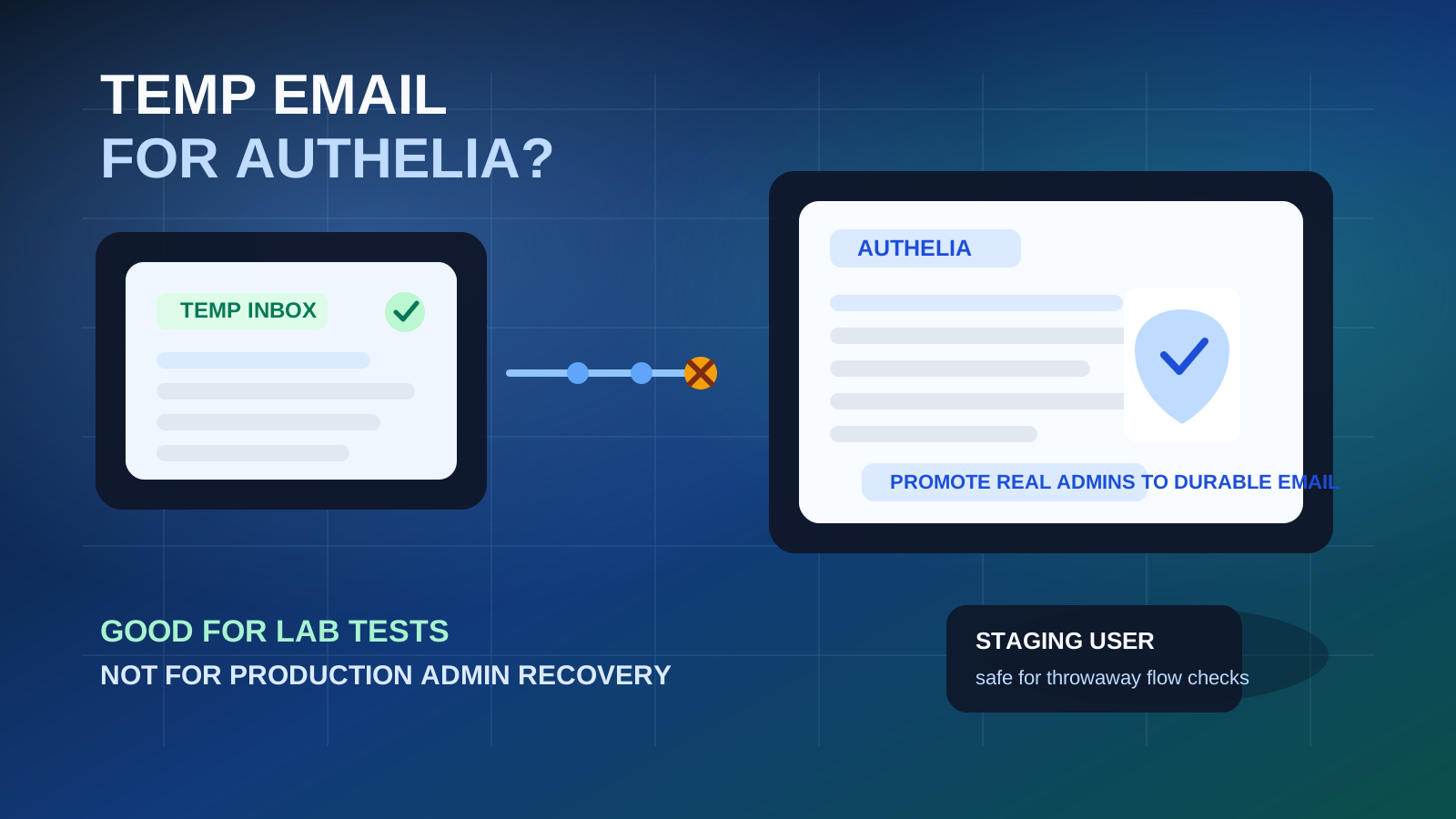
A temp email for Authelia is useful when you are only testing auth flows, staging identities, or mail delivery in a lab environment.
It becomes a risky choice once the mailbox is tied to production admins, shared team access, long-lived users, or account recovery you may need later.
That answer is a little different from the advice you would give for a normal SaaS trial. Authelia is usually part of an identity layer you run around your own apps, reverse proxies, or self-hosted services. Because of that, the email decision is not just about avoiding vendor follow-up. It is also about whether a mailbox is stable enough for password resets, access changes, admin continuity, and user recovery.
If you only want to validate that an auth flow works, a disposable inbox can be practical. You can test how messages arrive, confirm that links are generated correctly, and keep experimental accounts out of your main personal or work inbox. A service like Anonibox fits well in that early stage because it lets you create short-lived test addresses without turning every experiment into a long email trail.
But the moment an Authelia deployment starts protecting real dashboards, family services, internal tools, or shared team apps, a throwaway inbox stops being convenient and starts becoming fragile. The safest approach is to treat temp email as a lab tool, not as the permanent identity anchor for anything important.
Why email choice matters with Authelia
Authelia often sits in front of the tools you actually care about. That changes the risk profile. If a disposable inbox becomes unreachable, you are not just losing access to one trial account. You may be complicating recovery for the gateway that protects multiple apps behind it.
Email also tends to become more important over time than people expect. During setup, it may feel like one small field in a test identity. A week later, that same mailbox may be tied to password resets, admin notifications, access troubleshooting, or the user account you kept because the lab turned into a real deployment. That is why the right question is not “can I use a temp inbox?” but “what happens if this inbox disappears later?”
When a temp email for Authelia makes sense
1. You are smoke-testing a fresh lab deployment
If you just want to confirm that your identity stack comes up cleanly, a temp inbox is perfectly reasonable. It keeps the test separate from your everyday mail and helps you focus on whether the flow works at all.
This is especially useful when you are standing up a proof of concept, rebuilding a home-lab auth layer, or comparing Authelia against adjacent identity tools like Authentik or Better Auth. In that phase, isolation is a benefit.
2. You want to verify email-dependent flows without clutter
Identity work often involves repetitive testing. You may trigger multiple sign-in attempts, password resets, or policy checks while adjusting your config. A disposable inbox lets you watch those messages arrive without mixing them into your long-term mailbox.
That is practical, not just tidy. When you use a single-purpose inbox, it is easier to see whether the latest change fixed the problem or whether an old test message is confusing the result.
3. You are creating short-lived staging users
Sometimes you need more than one test identity. You may want one user with stricter policy rules, one user with limited access, and one admin-like staging account that should never become production. Temp email can help you build those throwaway identities quickly without polluting your primary inbox.
4. You want privacy while comparing identity stacks
Even when the software itself is self-hosted, documentation portals, community ecosystems, demo environments, or related tooling can still generate follow-up mail. Using a temporary inbox for early exploration keeps that noise controlled until you know what is actually worth keeping.
When a temp email for Authelia is a bad idea
1. The account is your real production admin
This is the clearest no. If the mailbox belongs to your main admin identity, it should be durable, accessible, and under your control for the long haul. Recovery matters more than convenience here.
2. Other people depend on that identity layer
If your Authelia deployment protects shared tools for a team, a family, a client, or a business, disposable inboxes stop being harmless. Access problems become other people’s problems too. Stable mailboxes are part of responsible identity administration.
3. The environment has moved beyond staging
Many deployments start as experiments and then quietly become permanent. That is exactly when temp email becomes dangerous. If the service is now fronting real apps, real dashboards, or real internal workflows, switch the important identities to durable inboxes before you forget.
4. You may need account recovery later
Any identity setup can eventually require a recovery path. Configuration changes, broken integrations, device loss, or simple human error happen. If the recovery path points to a disposable mailbox that no longer exists, you have created a future outage for yourself.
A practical setup that keeps testing useful and production safe
Use one dedicated disposable identity for the lab
Create a clear test user whose only job is validating flows. Give it a temporary inbox, document what it is for, and avoid letting it drift into broader use. This keeps your experiments separate without confusing them with the accounts that matter.
Keep your real admin on a permanent mailbox from day one
Even if everything else in the lab is disposable, your real owner account should not be. If the deployment survives, that early decision saves cleanup later.
Promote permanent users intentionally
If a staging system graduates into production, do not just keep using the old test identities out of inertia. Replace or update them deliberately so that durable inboxes back the accounts you genuinely rely on.
Write down what you tested
Disposable inboxes are most useful when paired with notes. Record which flow you tested, which message arrived, which link worked, and what changed after a config edit. Otherwise, the short-lived inbox gives you short-lived evidence too.
What should you actually test with a temp inbox?
If you are going to use a temporary inbox, use it for concrete checks instead of vague “it seems fine” testing.
- Mail delivery: did the expected message arrive at all?
- Link handling: did the reset or verification link open correctly?
- Message clarity: is the email understandable to a real user?
- Policy behavior: does the staged identity behave the way your access rules intend?
- Cleanup: can you remove or rotate the test identity cleanly after validation?
Those are the kinds of checks where a disposable inbox helps. They are time-boxed, repeatable, and low-risk.
Common mistakes people make
Letting the lab account become the real account
This is probably the most common failure mode. A temporary inbox feels harmless in week one, then the same account is still around months later because changing it seems annoying. That is exactly how small shortcuts become future recovery headaches.
Using temp email for shared ownership
If two or three people may need to coordinate around the same protected environment, the identity behind that access should not rely on an inbox that can vanish. Use a real mailbox with clear ownership rules instead.
Assuming “self-hosted” means recovery does not matter
Self-hosting reduces dependence on a vendor, but it does not eliminate the need for stable identity practices. If anything, it puts more responsibility on you to choose durable admin and recovery paths.
Testing only the happy path
A lot of people verify that one message arrives and stop there. Better testing asks harder questions: what happens after an address change, after a reset request, after a policy edit, or after you remove a user? Temporary inboxes are helpful, but only if you use them to learn something specific.
Should you use a personal inbox or a work inbox instead?
For production-critical identities, a stable personal or organization-controlled mailbox is usually safer than a temporary inbox. If the setup belongs to your employer or client, use the mailbox policy that matches that environment. If it belongs to you, use an address you expect to keep.
What matters most is control and continuity. The inbox should still exist when you need to recover access, transfer ownership, or explain the setup to someone else six months from now.
Where Anonibox fits best
Anonibox is most useful at the experimentation edge: short-lived mail checks, staging users, proof-of-concept auth flows, and one-off comparisons where you want privacy and less inbox clutter. It is not a substitute for long-term identity ownership. Think of it as a lab instrument, not the permanent keyring for your real admin layer.
Final takeaway
A temp email for Authelia is a smart tool for early auth testing, staging identities, and controlled mail-flow checks. It lets you validate the setup quickly without dumping every experiment into your main inbox.
Do not keep it attached to production admins, shared access, or any account you may need to recover later. Use a disposable inbox to test, then move the identities that matter to a durable mailbox you control long term.