Usually no — Facebook Messenger should not be your primary channel for job applications, especially before you have verified the employer, the role, and the person contacting you.
It can be acceptable later for simple follow-up with a real employer, but it exposes more of your personal social identity than email or an official careers portal and makes scammy conversations feel more trustworthy than they really are.
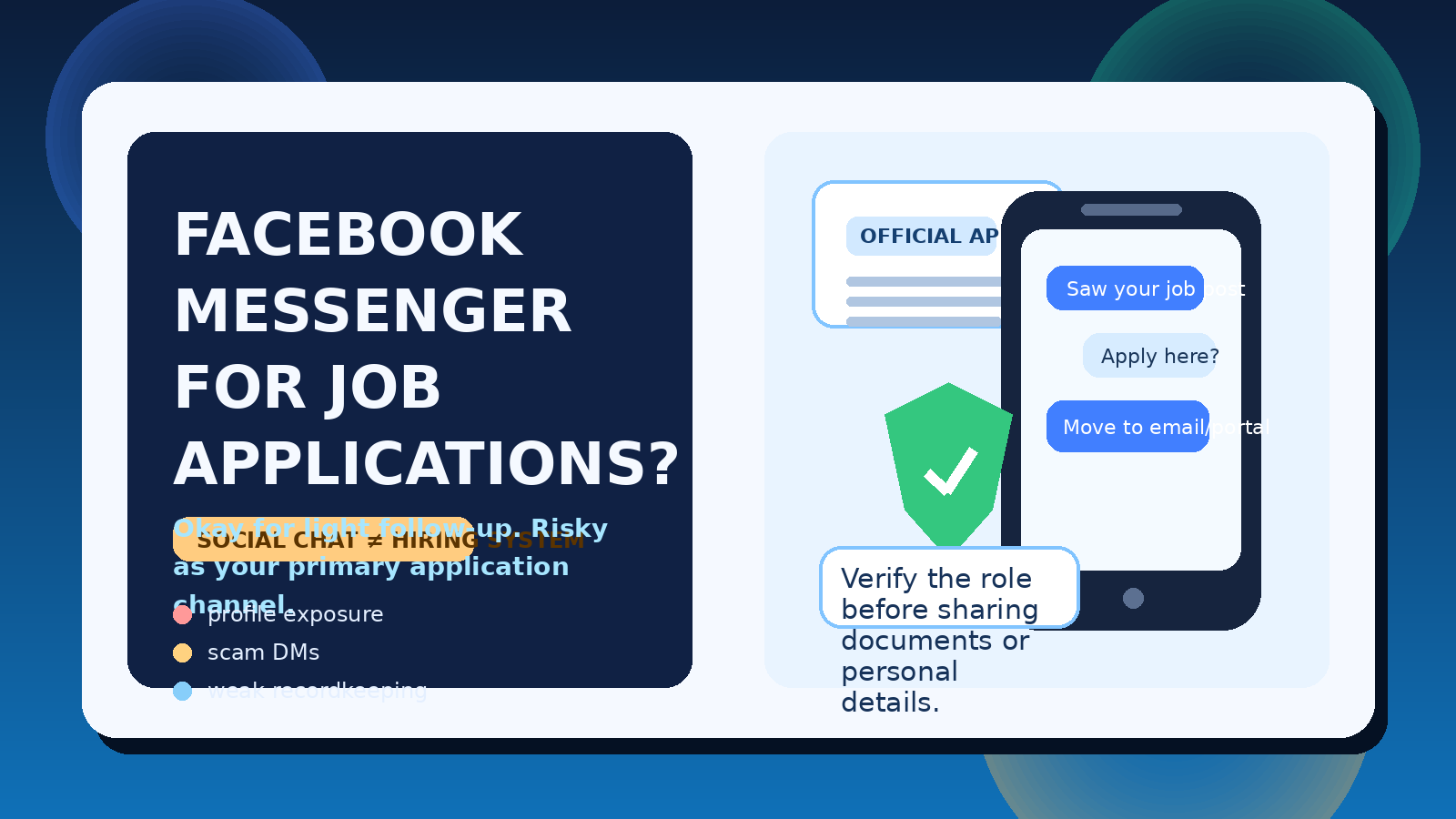
That is the practical answer behind searches like Facebook Messenger for job applications. The channel is fast, familiar, and widely used, so it is not surprising that some employers, small businesses, or staffing contacts reach out there. In local hiring, shift work, gig-style roles, community groups, and Facebook Page inquiries, Messenger sometimes appears naturally as a first point of contact.
But convenience is not the same thing as a good hiring workflow. Messenger is built for casual conversation, not for identity checks, recordkeeping, sensitive documents, or long application trails. It also sits much closer to your personal social footprint than email does. That difference matters when the person messaging you may be legitimate, may be sloppy, or may be a scammer trying to borrow trust from a familiar app.
If you are job hunting, the safer default is still boring on purpose: apply through a real company careers page, a verified recruiter email, or a normal applicant tracking system first. Then, if a genuine employer wants to use Messenger for quick coordination later, you can decide whether that limited use is worth it.
Short answer: okay for light follow-up sometimes, risky as a main channel
Messenger is not automatically suspicious. Some real businesses do use it, especially for retail, hospitality, local service work, small teams, and roles advertised through Facebook Pages or community groups. If a verified employer uses Messenger to confirm availability, answer a quick question, or point you to an official application link, that can be fine.
What is usually not fine is letting Messenger become the main application workflow from the beginning. That means sending your resume there first, sharing sensitive information in chat, treating a random DM as proof the job is real, or staying inside Messenger when the process should obviously move to email or a company portal.
Why Messenger comes up in hiring at all
It helps to understand why this happens. Messenger lowers friction. A hiring manager with a Facebook business presence can answer quickly. A local employer can post in groups and reply to candidates fast. A small company without a polished careers page may rely on whatever channel feels easiest. Candidates also like the speed because it feels more immediate than email.
That speed can be useful, but it also creates shortcuts where caution should exist. A fast message feels personal. A message from a Page or a profile can look legitimate at a glance. A conversation that starts casually can slide into requests for documents, availability, or personal details before you have done the basic verification work.
What makes Facebook Messenger different from email or an applicant system?
The privacy problem is not just “messaging app versus email.” It is that Messenger is tied to a broader Facebook identity. Even when your profile is limited, the app still tends to sit closer to your personal life, social graph, and informal communication habits than a job-search inbox does.
- Your social identity is closer to the surface: depending on settings, the employer may see your name, profile image, mutual context, or other clues that feel more personal than a professional inbox.
- Message requests feel informal: that can make it easier for someone to pressure you into quick replies or fast trust.
- Recordkeeping is weaker: Messenger is fine for short logistics, but it is a poor place to manage versioned documents, structured application history, or clear audit trails.
- Scam context is common: Facebook already contains Marketplace scams, impersonation, fake Pages, and copied business identities. Job scams can blend into that environment too easily.
In other words, the app is not just another neutral communication channel. It changes the trust dynamics around the job search.
Main risks of using Messenger for job applications
1. You expose more personal identity than the stage requires
Early in an application process, an employer usually does not need access to your social messaging footprint. Email gives you more separation. Messenger can reveal more about how you present yourself socially, and some candidates simply do not want a stranger entering that space so early.
2. Fake recruiters and fake business Pages are easy to stage
This is one of the biggest practical problems. Scammers do not need a polished system when they can create a convincing-looking Page, copy branding, or message from a profile that sounds urgent and friendly. They know people are more relaxed inside a familiar chat app than they are inside a formal applicant portal.
A message like “We saw your profile, send your resume here for immediate hiring” can feel normal on Facebook even when it deserves skepticism. That is exactly why the channel needs more verification, not less.
3. Messenger blurs personal and professional boundaries
Many people use Messenger for family, friends, neighborhood groups, buy/sell chats, and casual life admin. Turning it into a job-application channel can make the search feel too close to your personal space. Even if the contact is legitimate, you may not want recruiters, staffing contacts, or unknown managers lingering in the same environment as your everyday conversations.
4. It is a weak place for sensitive documents
If the conversation reaches ID requests, payroll forms, tax paperwork, background-check details, or anything similarly sensitive, Messenger is the wrong place. A legitimate employer should have a better destination for important documents than a social chat thread.
5. Informal chat can hide sloppy hiring behavior
Not every bad Messenger workflow is a scam. Some employers are just disorganized. But that still matters. If the hiring process lives entirely in chat, you may deal with vague instructions, missing records, inconsistent scheduling, and no clean way to confirm what was promised or sent.
When Messenger may be reasonable
There are situations where Messenger is not a red flag by itself. For example:
- you already found the role through a verified company Page or official website
- the employer is clearly identifiable and easy to confirm independently
- the message is only about simple follow-up, availability, or scheduling
- the business is small, local, and genuinely runs customer and hiring communication through Facebook
- the chat quickly points you toward a real application form or company email instead of keeping everything inside Messenger
In those cases, Messenger is acting more like a lightweight coordination channel than the application system itself. That is a much safer role for it.
When Messenger is a bad sign
You should slow down if any of the following shows up:
- the sender will not identify the company clearly
- the job supposedly exists, but there is no matching listing on the company site or no credible public footprint
- the contact becomes pushy as soon as you ask for an email, website, or official application link
- the role sounds unusually well paid, unusually easy, or weirdly urgent
- you are asked to pay for training, equipment, or processing fees
- you are asked for identity documents too early
- the conversation keeps drifting away from official channels on purpose
That last point matters a lot. Real employers may use Messenger sometimes, but real hiring processes still need better infrastructure than “just keep chatting here.”
Best practices if a recruiter or employer wants to use Messenger
Verify first, reply second
Before you share anything meaningful, confirm the company exists, the role exists, and the person contacting you is connected to both. Find the company website independently. Check whether the job is posted elsewhere. If the message came from a Facebook Page, see whether the branding, links, and contact details match the real business.
Move important steps to email or an official portal
Messenger is far safer as a lightweight bridge than as the whole process. If the conversation becomes serious, ask for the official application link or a company-domain email address. That creates a clearer record and reduces the chance that you are handing sensitive information to the wrong place.
Keep your privacy settings tight
Review what a new contact can see. Profile image visibility, active status, and other social signals may feel minor, but together they can make the interaction more personal than you intended. There is no reason a new hiring contact needs unnecessary access to your social messaging presence.
Do not send sensitive documents in chat unless there is a compelling verified reason
Even then, use judgment. A real employer should usually have a more appropriate upload destination than Messenger for anything important.
Separate your job-search contact stack
Privacy-conscious job seekers often keep some distance between personal life and job-search logistics. That can mean using a dedicated job-search inbox, a separate phone strategy, or both. For low-trust signups, one-off downloads, or exploratory applications where you do not want your main inbox spreading further than necessary, a temporary email option like Anonibox can help keep early-stage noise contained. That does not make Messenger safer, but it does make the rest of your workflow cleaner.
Treat friendliness as style, not proof
Scammers know how to sound casual, reassuring, and human. A warm tone, a profile photo, or a local-looking Page is not the same thing as verification. Trust the evidence, not the vibe.
Better alternatives to Messenger for job applications
If you want a cleaner process, these options are usually stronger:
- Official company careers pages: best for direct applications and recordkeeping.
- Verified recruiter email: better for attachments, follow-up, and a searchable paper trail.
- Applicant tracking systems: often clunky, but still better structured than social chat.
- Phone or video only after verification: useful for screening and scheduling once you know the opportunity is real.
Messenger can still have a small role, but it should usually be secondary, not primary.
A simple decision checklist
Before you use Facebook Messenger in a hiring conversation, ask yourself:
- Do I know exactly which company this is?
- Can I verify the role independently?
- Is Messenger being used for light logistics or for the whole application?
- Am I about to share more personal information than this stage actually requires?
- Would this conversation look more trustworthy if it moved to email or a real portal?
If several of those answers feel shaky, step back and move the process into a more formal channel.
Final answer
Facebook Messenger is usually not the best primary channel for job applications. It can be acceptable for quick follow-up with a verified employer, especially in small-business or local hiring contexts, but it exposes more of your personal social identity than most candidates need to share that early.
The safer approach is simple: verify the employer first, apply through official channels when possible, and use Messenger only for limited coordination if the context genuinely supports it. That way you stay reachable without letting a casual social app become the weak point in your job-search privacy.