Yes — Mailbox.org can be a smart choice for job applications if you want a privacy-conscious long-term inbox and you use a clean, professional address that you check every day.
No — it is not automatically the best option for everyone, because a niche provider only helps when recruiters can trust the address, your inbox stays active, and you are not treating a real hiring process like a throwaway signup.
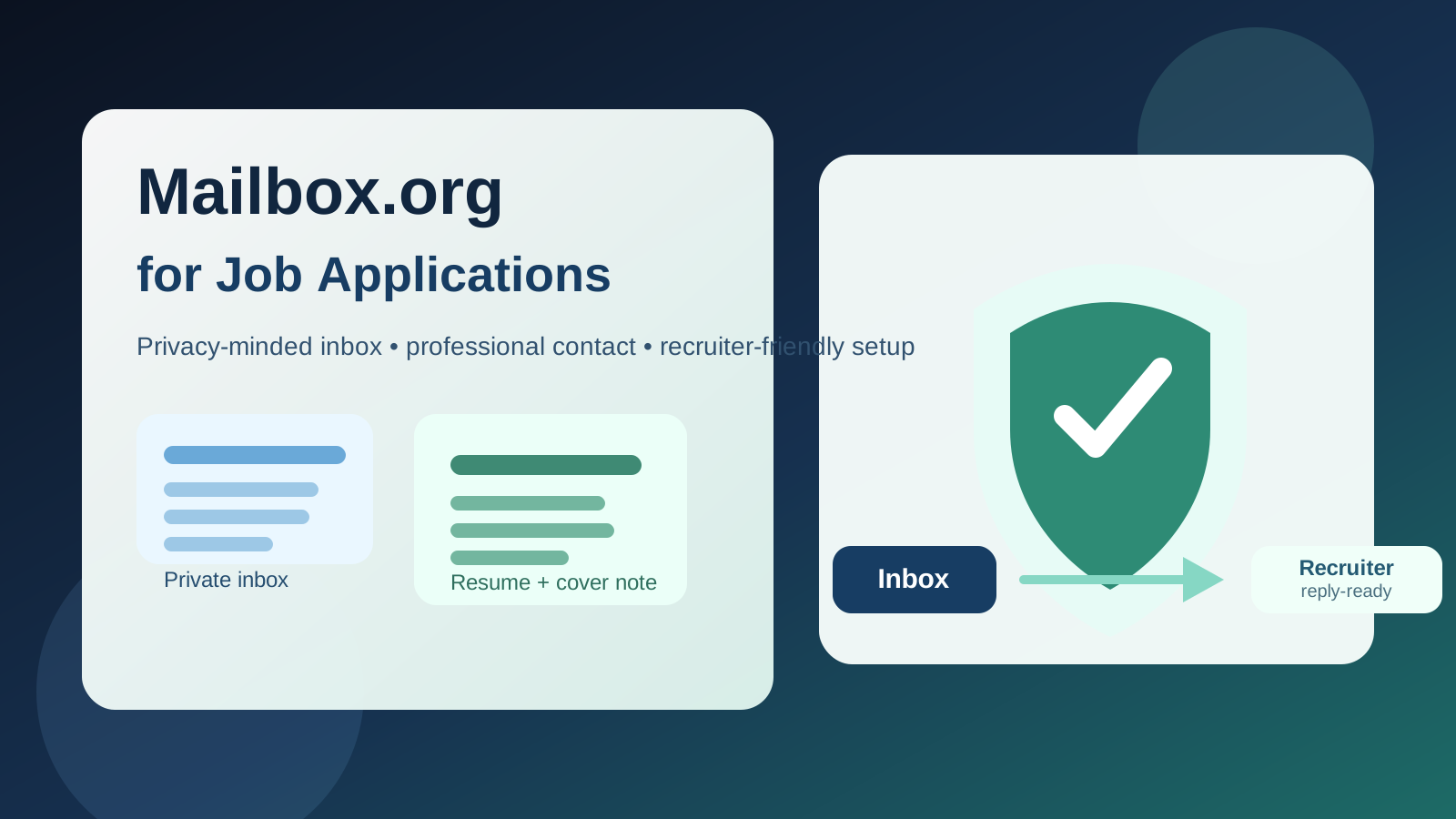
That distinction matters. Mailbox.org is not a classic disposable inbox, and that is exactly why it can work for job hunting. A real job application often turns into weeks of back-and-forth: confirmation emails, recruiter outreach, interview scheduling, assessment links, calendar invites, and occasional follow-ups after you think the process is finished. For that kind of communication, stability matters more than novelty.
At the same time, job searching is partly a privacy problem. Your contact details can spread across company career pages, staffing firms, résumé databases, scheduling tools, assessment platforms, and job boards in a hurry. Many applicants do not want their oldest personal inbox connected to every one of those touchpoints. That is where a separate provider like Mailbox.org can make sense: it gives you a dedicated mailbox for serious communication without looking like a disposable address.
Why some job seekers consider Mailbox.org in the first place
Most people are not looking at Mailbox.org because they think recruiters care deeply about email providers. They are trying to solve a practical problem: stay reachable for real employers without sending every job-search message into the same inbox used for bills, family, shopping, and years of personal accounts.
A separate mailbox can help if you want to:
- keep job-search email out of your main personal inbox
- reduce clutter from recruiter newsletters and job-board alerts
- limit the number of places that know your primary long-term address
- separate a current-job identity from a new-job search
- create a cleaner archive for applications, interviews, and offers
Those are good reasons. A dedicated mailbox is often more useful than people expect, especially when a search lasts longer than planned or spans multiple employers at the same time.
What recruiters are actually judging
Most recruiters are not running a deep analysis of your provider choice. They are usually looking at simpler signals:
- Does the address look readable and professional?
- Will this candidate actually see my message and reply quickly?
- Do the résumé, application, and email details feel consistent?
- Is there anything about the contact method that creates friction?
That is why Mailbox.org can work perfectly well. It is a real mailbox, not an obviously temporary inbox. But it is also less familiar than Gmail or Outlook, so you should remove every other point of friction. If your address is something tidy like your name or initials, your replies are prompt, and the rest of your application is polished, the provider itself is unlikely to be the issue.
Where Mailbox.org is a strong fit for job applications
You want a dedicated long-term job-search inbox
This is probably the clearest use case. A separate mailbox helps you keep applications, interview invitations, rejection emails, and recruiter follow-ups in one place. That makes it easier to search later, follow threads, and avoid missing deadlines because a hiring message got buried under everyday email.
You care about privacy but still need a serious address
There is a big difference between wanting privacy and wanting anonymity. Real employers need a stable way to reach you. Mailbox.org can be useful for applicants who want more separation from their main identity without sending the signal that the inbox might disappear tomorrow.
You are applying while still employed
People changing jobs often want cleaner boundaries. A dedicated mailbox lets you keep recruiter traffic away from the address tied to your current role, your daily subscriptions, and the accounts you have had for years.
You expect a longer hiring cycle
Some hiring processes stretch across screening calls, assessments, panel interviews, reference checks, and negotiated timelines. A stable mailbox is far safer for that than a temporary address that was only meant for one-time verification.
When Mailbox.org may not be the best choice
You rarely check secondary inboxes
A separate mailbox only helps if you treat it like a real communication channel. If you tend to forget alternate addresses, you may miss interview requests or reply too late. In practice, reliability matters more than privacy features.
Your address format looks odd or overly clever
The provider name is only part of the impression. The local part matters too. An address built around nicknames, jokes, random numbers, or privacy-themed gimmicks can feel less professional than the provider itself. Keep it simple: your name, initials, or a clean variation is usually enough.
You want maximum mainstream familiarity
If you are applying in very conservative environments or you simply want the least possible friction, Gmail and Outlook still win on recognition. That does not make Mailbox.org a bad choice. It just means a niche provider is best used intentionally, not because it sounds clever.
You are really looking for a temporary inbox
If your goal is only to protect your main inbox from low-trust signups, download gates, or early job-board experiments, Mailbox.org may be more mailbox than you actually need. A temporary inbox is better for one-off verification; a long-term provider is better once a real employer relationship starts taking shape.
Mailbox.org versus temporary email for job applications
This is where many people get mixed up. Disposable email and dedicated privacy-first email solve different problems.
- Temporary email: best for quick signups, low-trust forms, or early research where you do not want long-term follow-up.
- Mailbox.org: better for ongoing communication with real employers, interview scheduling, and any application process that may last for days or weeks.
If you use Anonibox, think of it as the top of the funnel tool: useful when you want to reduce spam exposure during low-commitment activity. Mailbox.org fits later in the process, when a legitimate employer needs a stable inbox that still sits apart from your oldest personal email identity.
How to make Mailbox.org look professional to employers
- Use a clean address. Choose a straightforward variation of your real name rather than a playful handle.
- Check it daily. During an active search, check it at least as often as your main inbox.
- Sync it to your normal workflow. Use notifications, forwarding rules, or whatever setup keeps you from missing messages.
- Match it to the rest of your application. Your résumé name, LinkedIn name, and email signature should not create confusion.
- Write like a professional. Fast, clear replies matter far more than the provider name.
- Keep records. Archive assessments, interview links, and recruiter threads so you can find them quickly later.
Those steps matter because the real risk is rarely “the recruiter dislikes Mailbox.org.” The real risk is looking disorganized, slow to respond, or inconsistent across your application materials.
Practical privacy rules if you use Mailbox.org for a job search
- Use the mailbox for real applications, not for everything on the internet.
- Be cautious with suspicious recruiter messages, especially those that push you to move quickly to text or chat apps.
- Do not send sensitive identity documents until you have independently verified the employer and the stage of the process truly requires them.
- Keep your phone strategy separate too. A dedicated email helps, but some applicants also prefer a dedicated job-search number.
- Save important interview details outside the inbox as well, especially if you are managing multiple opportunities at once.
Privacy in a job search is less about finding a magical provider and more about reducing unnecessary exposure while staying easy to reach. A separate mailbox, a clean résumé, and careful verification habits usually do more for you than any single branding choice.
So, should you use Mailbox.org for job applications?
Yes, if you want a dedicated long-term mailbox for a serious job search and you are willing to keep it polished, monitored, and easy for employers to trust. In that role, Mailbox.org can be a perfectly reasonable choice.
No, if you are really looking for a disposable inbox, if you know you will not monitor a second mailbox, or if you want the absolute lowest-friction mainstream option. In those cases, a temporary inbox or a standard Gmail/Outlook address may fit better.
The best answer is to match the tool to the stage of the process. Use temporary inboxes for low-trust or one-off activity. Use a stable mailbox like Mailbox.org when real conversations with real employers begin. That gives you privacy without sacrificing reliability, which is usually the balance job seekers actually need.