Yes — you can use Hide My Email for job offers if the alias stays active, your real inbox is monitored closely, and you are comfortable trusting an alias-forwarding setup for offer letters, deadlines, and onboarding follow-ups.
For most job seekers, though, the offer stage is where a durable direct inbox is usually safer than an alias-first workflow, because missing even one message can create unnecessary risk once the employer is sending formal documents and time-sensitive next steps.
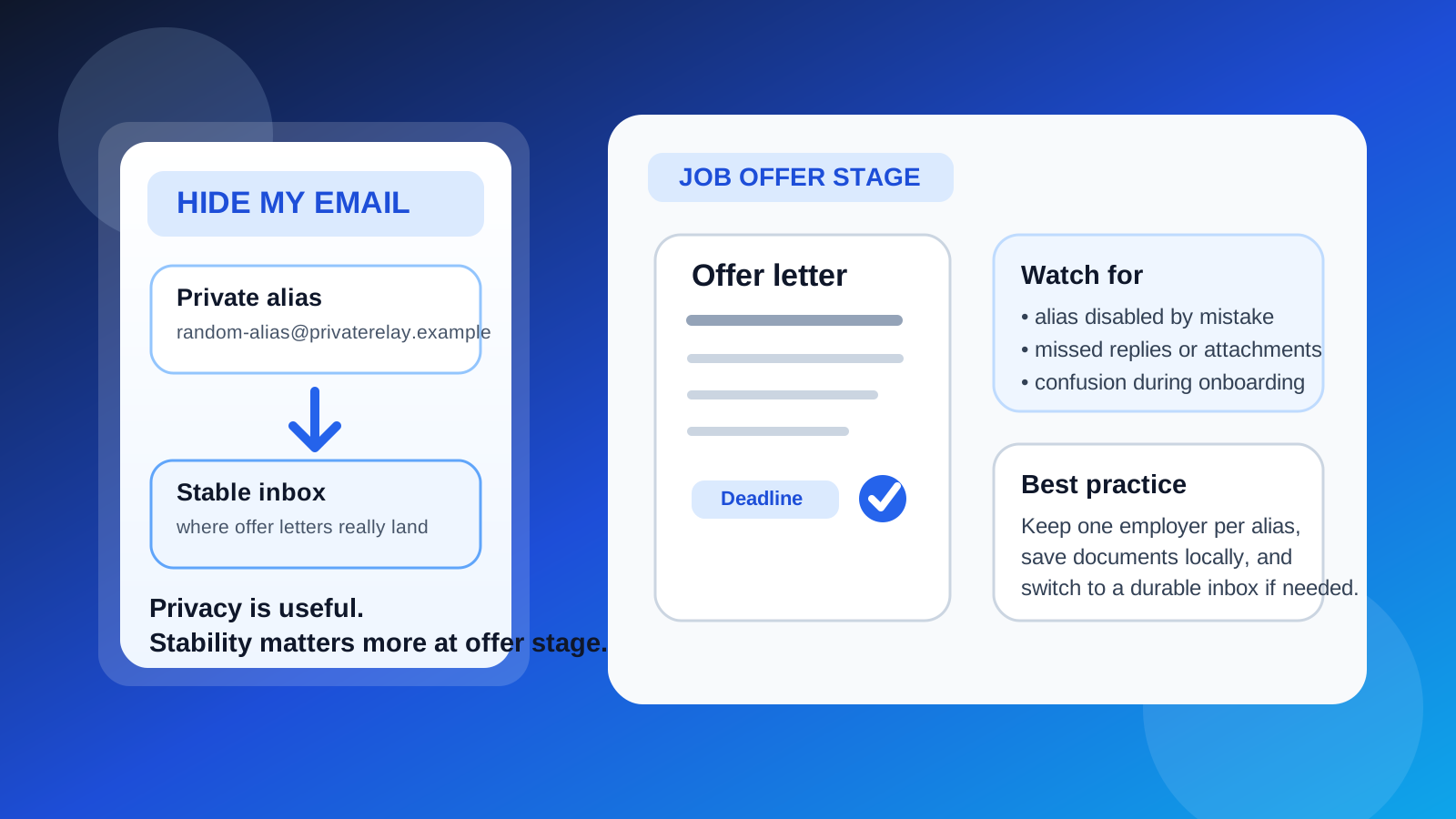
That is the practical answer behind searches for should you use Hide My Email for job offers. The appeal is obvious: you get privacy, you avoid exposing your main address directly, and you can keep job-search communication a little more compartmentalized. Earlier in the hiring funnel, that can be genuinely helpful. But once an employer is sending an actual offer, the question stops being about privacy alone. It becomes a question of continuity, reliability, and how much complexity you want sitting between you and an important employment message.
Hide My Email is best understood as a privacy layer, not a magic replacement for a trustworthy inbox. It can help shield your underlying address and keep your contact trail cleaner. What it does not do is remove the need for a stable destination mailbox, careful monitoring, and a clear plan for how you will handle replies, attachments, deadlines, and onboarding paperwork.
Why the offer stage is different from the application stage
Applications are often low-commitment. You may send dozens, many never turn into a real conversation, and some never deserve long-term access to your main inbox. That is where privacy tools shine. A little separation can keep job boards, recruiter forms, and weak leads from cluttering the address you use everywhere else.
Job offers are different. The messages arriving at this stage can include a compensation summary, benefits information, a formal offer letter, a deadline to accept, revised terms after negotiation, background-check instructions, identity-verification requests, and onboarding forms. Those are not messages you want to lose, misfile, or discover late because your setup added one more moving part than necessary.
When the stakes rise, simplicity becomes valuable. A direct well-monitored inbox is not exciting, but it is easy to trust. That matters more than ever when one missed email can delay a response or make you look disorganized.
When Hide My Email can still work for job offers
Hide My Email is not automatically a bad choice. In the right setup, it can be perfectly workable.
- You already trust the destination inbox. The alias forwards into a mailbox you check constantly and use comfortably for important communication.
- The alias is dedicated to one employer or one hiring thread. That makes the conversation easier to track and reduces confusion.
- You are not planning to turn the alias off quickly. Offer-stage communication often continues into onboarding, so the address needs staying power.
- You understand your reply workflow. You do not want to discover late in the process that replying feels awkward or confusing.
- Your goal is privacy without invisibility. You still want to be easy to reach; you just do not want your underlying address exposed everywhere.
In other words, Hide My Email can work when it behaves like a steady privacy wrapper around a dependable mailbox. If it feels disposable, experimental, or only loosely managed, it stops being a strong fit for this phase.
What makes Hide My Email attractive in the first place
1. It protects your underlying address
That is the obvious benefit. If you have been applying broadly, you may not want every recruiter form, scheduling tool, or third-party vendor tied directly to your long-term personal address. An alias gives you some distance.
2. It can keep your job search more compartmentalized
Many people want a cleaner boundary between work-search activity and the rest of their digital life. A separate alias strategy can make it easier to track which employer or service used which address.
3. It helps when you are still judging trust
Not every job lead deserves the same level of openness right away. A privacy layer can be sensible during the uncertain parts of a search, especially when the source is a job board or unfamiliar external form rather than a direct company relationship.
Where the risks start at offer stage
1. An alias is still one more layer between you and the message
The core issue is not that alias forwarding is bad. It is that job offers are too important for extra uncertainty. A direct inbox has fewer points of failure. With an alias in the middle, you need the forwarding path, the destination inbox, and your own monitoring habits to stay aligned every day.
2. Offer-stage communication is rarely just one email
Some candidates picture one offer letter and a simple yes-or-no reply. In reality, there may be several rounds of communication: follow-up questions, revised documents, start-date discussions, benefits clarifications, equipment forms, payroll setup, and reminders from HR vendors. If your alias was only meant for early-stage privacy, that original plan may stop making sense once the relationship becomes ongoing.
3. Missed attachments matter more now
Earlier in the process, losing one generic recruiter follow-up may not matter much. At the offer stage, missing an attachment, deadline, or onboarding instruction can create stress fast. Even if the system usually works, a more complicated flow is harder to trust than a direct mailbox you open daily.
4. You may create reply confusion without meaning to
Professional communication should feel smooth. If you have to stop and think about which address the reply will appear to come from, whether the thread will remain clean, or whether later messages will still land where you expect, the setup is already costing you mental bandwidth.
What employers actually care about
Most recruiters are not judging the brand name of your email tool. They care about practical outcomes:
- Can they reach you quickly?
- Do you respond on time?
- Can they send formal documents without confusion?
- Will the same address still work during onboarding?
- Does the communication feel professional and consistent?
If Hide My Email supports those goals, it can be acceptable. If it creates even minor uncertainty around them, the privacy benefit starts shrinking.
How Hide My Email compares with temporary email
This is an important distinction. Hide My Email is not the same thing as a throwaway inbox or a disposable address you plan to abandon. It is better viewed as a forwarding alias that can be part of a longer-lived setup. That makes it much more reasonable for serious communication than a classic temporary email workflow.
Still, “more reasonable than temporary email” is not the same as “ideal for every stage.” Tools like Anonibox make the most sense earlier in the funnel: low-trust signups, job-board experiments, alert subscriptions, or privacy-conscious first contact when you are not yet sure the opportunity is real. Once the employer is sending offer paperwork, many people are better served by one durable inbox that feels boring, simple, searchable, and stable.
Best practices if you use Hide My Email for a job offer
Use one alias per employer thread
Do not bounce between multiple addresses mid-process. If one alias is already working, keep the thread consistent unless you deliberately decide to move to a direct inbox.
Monitor the destination inbox aggressively
The alias is only as good as the inbox behind it. Check it often, especially when deadlines are active. Offer-stage messages can arrive outside the rhythm of scheduled interviews.
Save every important document locally
Download offer letters, benefits summaries, and onboarding files into a folder you control. Email should not be the only place those records live.
Keep the alias active long enough
Do not assume the process ends when you accept. HR, payroll, background-check vendors, and managers may keep using the same contact address after the initial yes.
Be ready to switch cleanly if needed
If the workflow starts feeling fragile, move to a direct stable email once rather than improvising in the middle of a document-heavy exchange. A short note like “For all offer and onboarding communication, please use this address going forward” is usually enough.
When you should switch to a direct inbox instead
For many job seekers, the safest move is to use privacy tools during applications and then switch to a durable direct inbox once the process becomes serious. That is especially wise if:
- you only created the alias for early-stage privacy
- the employer is now sending formal attachments or signing documents
- you are negotiating compensation and expect multiple revisions
- you are worried about missed follow-ups or vendor messages
- you want a single mailbox to carry you from offer through onboarding
This does not mean giving up privacy entirely. It just means recognizing that the offer stage rewards durability more than abstraction. You can still choose a privacy-conscious mailbox; it just should not feel temporary or delicate.
Common mistakes to avoid
- Treating offer-stage email like application-stage email. The risk profile is different.
- Assuming every privacy tool is equally appropriate for formal paperwork. Useful does not always mean ideal.
- Letting an alias expire in practice, even if not technically. If you stop watching it closely, it is already becoming risky.
- Forgetting about post-offer communication. The address still matters after the acceptance message.
- Over-optimizing for privacy while under-optimizing for stability. At this stage, reliability usually wins.
Final answer: should you use Hide My Email for job offers?
Yes, you can use Hide My Email for job offers if the alias is stable, your destination inbox is dependable, and you are prepared to keep the setup active through every follow-up that comes after the initial offer.
But for most people, the safer default is a direct durable inbox once the hiring process reaches formal offers, deadlines, and onboarding. Privacy matters, but missed offer-stage communication matters more. If you use Hide My Email, use it deliberately, keep the workflow simple, and switch to a more permanent contact point the moment the alias starts feeling like one extra thing that could go wrong.