Usually no — Facebook Messenger is not the best default channel for informational interviews because it blends personal social identity with professional outreach and gives you less control over privacy, boundaries, and first impressions than email or LinkedIn.
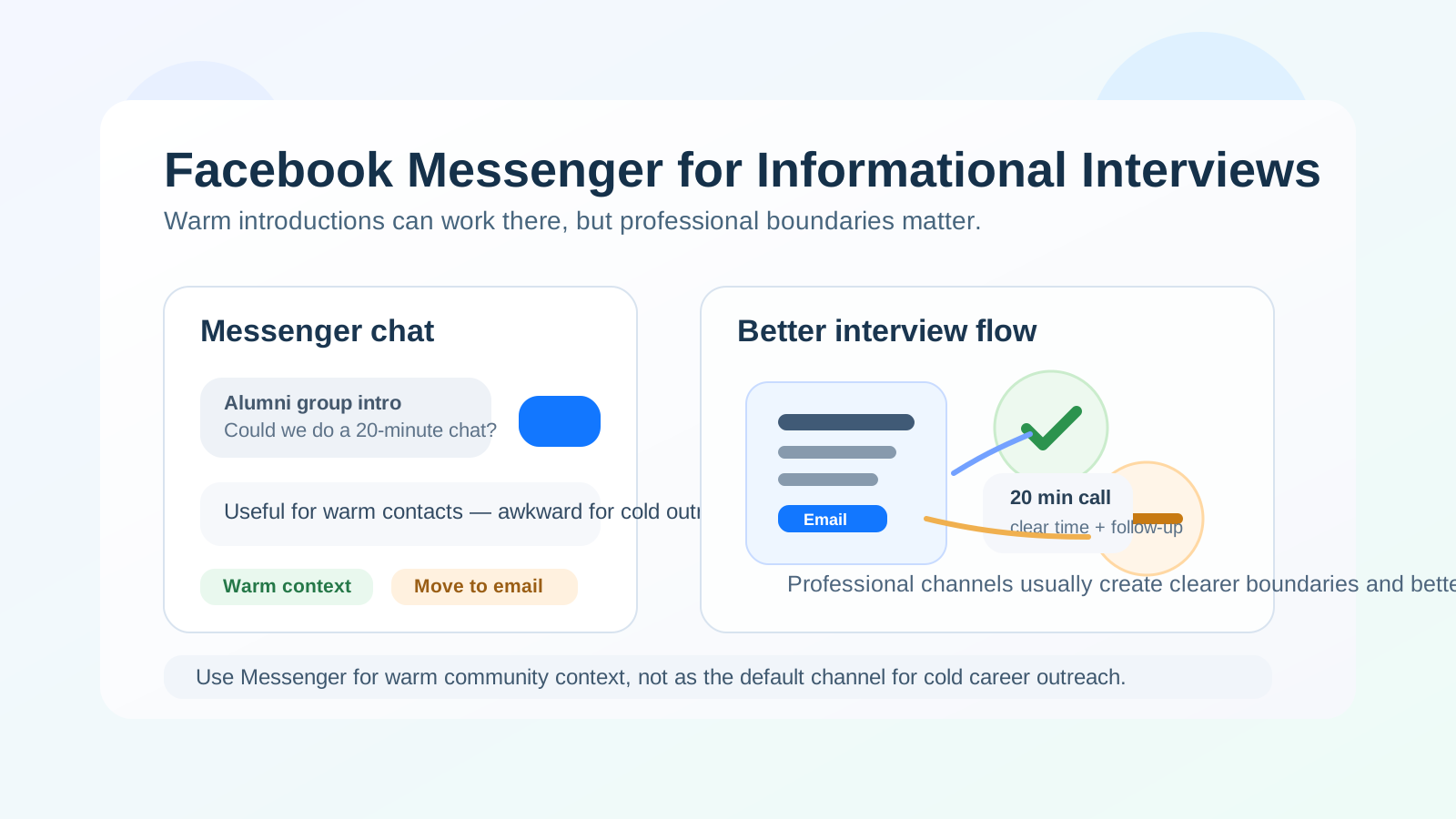
Sometimes yes — if you already know the person, share a community, or got a warm introduction through Facebook, Messenger can work for lightweight scheduling or follow-up, but it is rarely the strongest first-contact option.
Why this question comes up
Informational interviews are supposed to be low-pressure conversations. You are asking for perspective, career advice, or a better understanding of someone’s role, company, or industry. In theory, the contact method should not matter that much. In practice, it matters a lot, because the channel shapes how professional the request feels, how easy it is to follow up, and how much personal information you expose in the process.
Facebook Messenger feels easy because many people already use it socially. If you are in the same alumni group, neighborhood group, parent community, meetup page, or niche industry community on Facebook, sending a quick message can seem more natural than drafting a formal email. But convenience is not the same as good fit. Informational interviews sit in an awkward middle ground: they are friendlier than a job application, but still professional enough that your communication choices affect trust and response rates.
That is why the honest answer is nuanced. Messenger is not automatically wrong. It is just usually not the strongest first option.
Short answer: use Messenger only when the relationship is already warm
If you are reaching out cold to someone you do not know, email or LinkedIn is almost always better. Those channels are built for professional communication, easier to reference later, and less likely to feel intrusive.
If you already know the person, have mutual context, or were clearly invited to message through Facebook, Messenger can be fine for a short note. The closer the existing relationship, the less risky the channel feels. The colder the outreach, the more Messenger starts to look casual, misplaced, or overly personal.
When Facebook Messenger can work for informational interviews
There are real situations where Messenger is acceptable and sometimes even helpful.
1. You already know the person offline
If the person is a former classmate, distant colleague, family friend, volunteer contact, or someone you met at an event and already chatted with on Facebook, Messenger can be a practical way to restart the conversation. In that case, you are not forcing a personal channel on a stranger. You are using a channel that already exists between you.
2. The introduction happened inside a Facebook-based community
Some communities still organize heavily through Facebook groups. Alumni groups, local business groups, creative communities, and neighborhood entrepreneurship circles sometimes live there. If someone says “feel free to DM me,” Messenger is fair game. Even then, it works best when you quickly make the purpose clear and do not drift into an overly casual pitch.
3. You only need a lightweight follow-up after first contact elsewhere
Sometimes the actual informational interview request starts on email or LinkedIn, but a later detail gets handled through Messenger because that is where the person replies fastest. That is different from choosing Messenger as the primary outreach channel from the start. For logistics, some people genuinely prefer it.
4. The person’s public professional presence is minimal
A professional contact may not use LinkedIn much and may not publish an easy-to-find work email, but still be active in a legitimate Facebook community tied to the field you care about. In that narrow case, Messenger can be the practical path to a conversation that would otherwise be hard to start.
Why Messenger is usually not ideal
It exposes more of your personal identity than most people realize
Facebook is not just a messaging app. It is attached to a broader social profile, personal history, friend graph, photos, comments, groups, and sometimes family connections. Even if your privacy settings are decent, Messenger often creates a stronger sense of personal access than a professional email address or LinkedIn message does.
That matters during a job search or career transition. You may not want a near-stranger to see much about your personal life, political arguments, hometown network, or old tagged content before you have even had a short career conversation.
It can feel too casual for the request
Informational interviews are polite asks for time and insight. When the message lands in Messenger, especially from someone the recipient does not know well, it can feel more like a social interruption than a thoughtful professional request. That does not mean the other person will be offended, but it can lower response quality or make the ask easier to ignore.
Message requests are messy
If you are not already connected, your note may land in message requests or another low-visibility folder. That means Messenger is not always as direct as it looks. A well-written email often has a clearer path than a social message the recipient may never notice.
Boundaries blur quickly
Email naturally encourages longer, more deliberate responses. Messenger nudges conversations toward quick back-and-forth, seen indicators, informal tone, and expectation of faster replies. That can work among friends. It is less ideal when you are trying to respect someone’s time and present yourself thoughtfully.
Privacy risks to think about
Privacy is not just about data leaks. It is also about context, access, and how much of yourself becomes visible through the channel you choose.
- Profile exposure: even a quick message can lead someone into your broader social footprint.
- Friend-network visibility: mutual friends, public comments, and community ties may reveal more than you intended.
- Permanent channel access: once someone has you in Messenger, future contact is easy whether or not the conversation stays useful.
- Weaker professional separation: your career outreach becomes mixed with the same app you use for personal conversations, group chats, and everyday social life.
If your goal is to keep a job search discreet, protect your personal life, or maintain cleaner boundaries with new professional contacts, Messenger is rarely the strongest tool.
Email and LinkedIn are usually better first choices
Most of the time, informational interviews go better when you start with a channel that feels intentionally professional.
Email works well when you want clarity and control
Email gives you room to explain why you are reaching out, how you found the person, what you are hoping to learn, and how little time you are asking for. It also makes scheduling, sharing links, and preserving the conversation easier. If you are using a dedicated job-search inbox or a separate networking address, email also gives you better long-term organization.
LinkedIn works well when the relationship is weak but professional
LinkedIn is often the best middle ground for people you do not know personally but have a legitimate reason to contact. The context is obvious, the ask feels expected, and you are less likely to overshare your personal life by accident.
If you need extra separation for low-trust signups, event registrations, or one-off downloads related to your career search, a temporary inbox from a service like Anonibox can help protect your main address. But for a real informational interview, a stable professional email is usually better than a disposable one, because the relationship may continue after the first conversation.
When Messenger is a bad idea
There are situations where using Facebook Messenger is more likely to hurt than help.
- You are contacting a stranger cold.
- You are reaching out to someone senior who probably gets many requests.
- You want to look polished in a formal or conservative industry.
- You are trying to keep your job search private from your broader social network.
- You are not sure whether the person even uses Facebook regularly.
- You would feel uncomfortable if they clicked through to your personal profile.
If any of those are true, pick a cleaner channel.
If you do use Messenger, keep it professional
Sometimes Messenger really is the channel you have. If so, you can still use it well.
Start with context immediately
Do not send “Hi” and wait. Open with who you are, where the connection comes from, and why you are reaching out. People are much more likely to respond when the request is clear from the first message.
For example:
Hi Priya — we are both in the State University alumni group, and I saw your posts about moving from consulting into product operations. I’m exploring a similar shift and wondered if you would be open to a brief informational chat sometime in the next couple of weeks.
Keep the ask small
An informational interview request should feel easy to say yes to. Ask for 15 to 20 minutes, not an open-ended call. Messenger becomes even worse when the request looks vague or demanding.
Move important details to email if the conversation continues
If they agree, it is often smart to shift scheduling or follow-up into email. That creates a more stable record, reduces casual back-and-forth, and gives both sides cleaner boundaries.
Do not over-message
Messenger makes repeated nudges too easy. If someone does not reply, one polite follow-up is enough. Beyond that, you risk looking intrusive.
Messenger vs other options
Messenger vs email
Email wins on professionalism, searchability, and boundaries. Messenger wins only on immediacy and casual familiarity when the relationship is already warm.
Messenger vs LinkedIn
LinkedIn is usually better for cold or semi-cold outreach because the context is professional from the start. Messenger is more personal and more dependent on existing social comfort.
Messenger vs text messages
Texting can be even more personal than Messenger because it gives direct access to your phone number. Unless the person explicitly offered their number, text is usually the worse first-contact choice.
A practical decision checklist
Before you send a Messenger request for an informational interview, ask yourself:
- Do I already know this person, or is this basically cold outreach?
- Would I be comfortable with them seeing more of my personal social presence?
- Did the connection arise naturally through Facebook, or am I forcing the channel because it is easy for me?
- Would email or LinkedIn make the request feel clearer and more professional?
- If this conversation turns into an ongoing connection, is Messenger really where I want that relationship to live?
If those questions make you hesitate, that hesitation is useful. It usually means a more professional channel would serve you better.
Final answer
Facebook Messenger can work for informational interviews, but only in limited warm-contact situations. If you already know the person, share a real community, or were invited to message there, it may be a reasonable shortcut for an initial note or light scheduling.
For most first outreach, though, Messenger is not the best default. It exposes more personal context, creates weaker boundaries, and often feels less professional than email or LinkedIn. If your goal is to make a thoughtful impression while protecting your privacy, start with a more professional channel and use Messenger only when the relationship clearly supports it.
That approach keeps the conversation focused on career insight instead of making the contact method itself the awkward part.