Usually not as your main contact method. Discord can work for certain community-led or virtual career fairs, but most recruiter follow-up is still better on email or LinkedIn.
If a fair already runs inside Discord, use it carefully for first contact and then move serious conversations to a more stable professional channel.
That is the practical answer to should you use Discord for career fairs. It is not automatically wrong, and in some industries it may even feel normal, but it is rarely the best primary channel for long-term job-search communication. Discord was built around communities, servers, and fast-moving chat. Career fairs are usually about clear follow-up, professional context, and reliable communication after the event. Those goals overlap only part of the time.
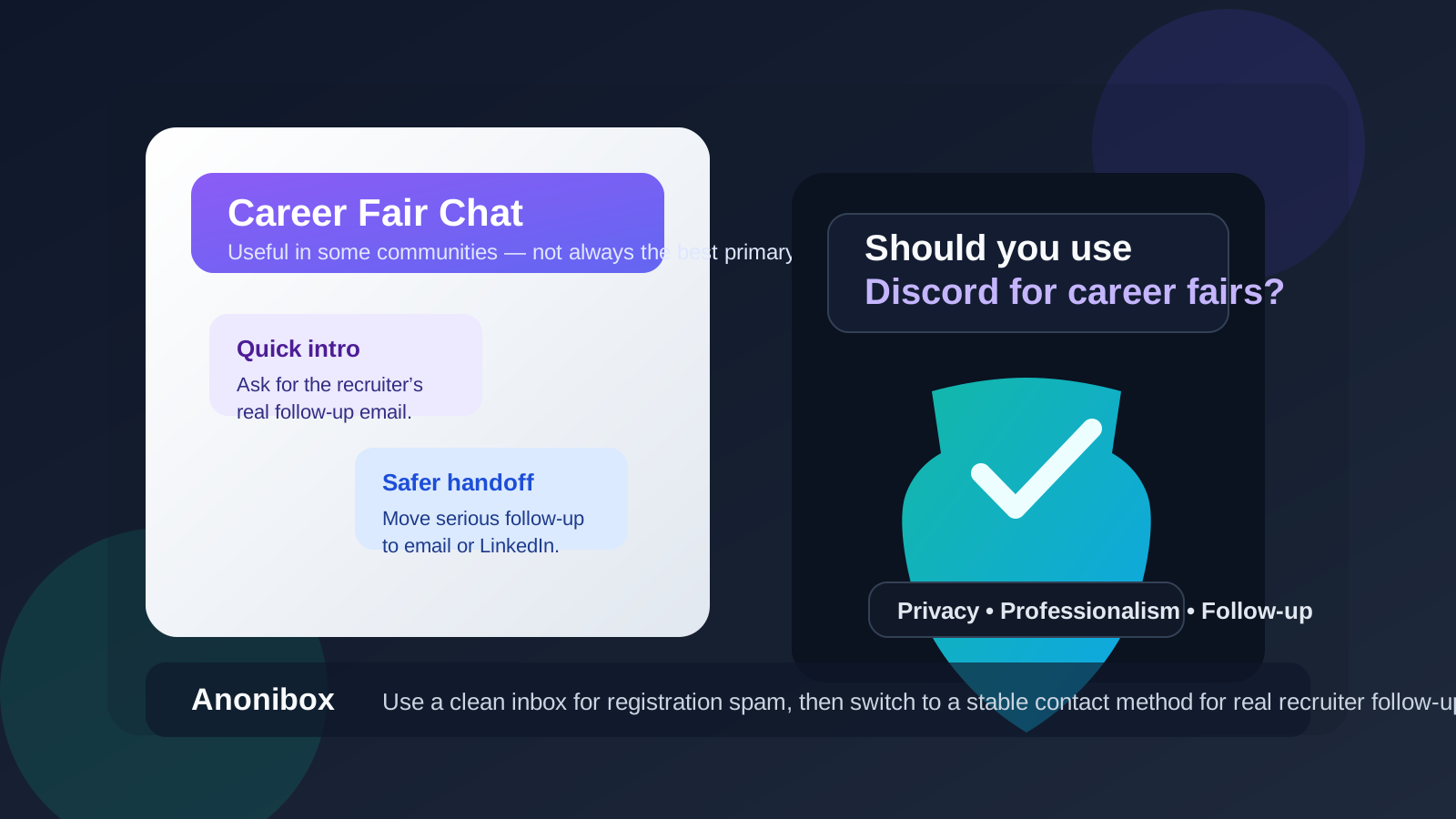
The best way to think about Discord is as a situational tool. If the employer, student club, hackathon organizer, startup community, or conference already uses Discord, you may reasonably use it for introductions, Q&A sessions, or event logistics. But if you are trying to make a strong professional impression with recruiters who expect email, applicant-tracking systems, and structured follow-up, Discord can create friction you do not need.
When Discord can make sense at a career fair
Discord is most useful when the fair itself is already built around community chat. That tends to happen in spaces like student tech clubs, gaming and esports recruiting, open-source communities, creator economy events, startup demo days, developer relations meetups, and some virtual conferences. In those environments, people may already be sharing channels, voice rooms, and event announcements inside a server.
In that context, Discord can help you:
- join live employer Q&A rooms during the event
- ask short follow-up questions without waiting for email replies
- connect with student ambassadors, community managers, or organizers
- watch for posted links to applications, office hours, or portfolio reviews
- keep event-day logistics in one place while the fair is active
So the answer is not “never.” It is more like “sometimes, but only when the event ecosystem already supports it.” Discord is strongest when it is the host environment, not when you are trying to force it into a hiring workflow that was designed for more traditional communication.
Why Discord is often a weak primary contact method
Most career fairs are not judged only by how easy it is to say hello. They are judged by what happens after the fair: interview scheduling, résumé review, recruiter notes, documentation, and follow-up. That is where Discord starts to look less ideal.
It is easy to blur personal and professional identity
Many people use Discord casually. Their username, profile photo, status text, mutual servers, or old public activity may make sense among friends but not in a recruiting context. Even if nothing is offensive, it may not be the image you want attached to a serious job search.
Recruiter visibility is inconsistent
Some recruiters will not check Discord often. Others may not allow it as a normal hiring channel at all. A message that feels fast on your side can be easy to miss on theirs, especially if they are juggling email, ATS alerts, LinkedIn, and event platforms at the same time.
Server-based contact creates privacy trade-offs
If you meet someone through a shared server, your profile may reveal more than you intended: which communities you are in, how active you are, or what parts of your identity you present in non-work spaces. That is not always harmful, but it is more exposure than a plain email introduction.
Discord is fertile ground for impersonation and scam noise
Career fairs already attract fake recruiters, suspicious links, and rushed “message me privately for the next step” behavior. Discord makes that easier because usernames can be informal, direct messages can happen quickly, and the environment feels less formal than a company email domain.
Questions to ask before using Discord for a career fair
Before you message anyone, pause and ask a few simple questions:
- Is this an official event server, or just an unofficial community space?
- Is the recruiter or organizer clearly identified?
- Will this conversation need reliable follow-up after the event?
- Does my Discord profile look professional enough for this context?
- Would email or LinkedIn make the next step smoother?
If the answer to the last question is yes, Discord should probably stay secondary. It can be useful for quick interaction, but it should not be the place where important details live for weeks.
Best practices if you do use Discord
If the event really does run through Discord, use it deliberately instead of casually.
1. Clean up your profile before the event
Check your username, avatar, status line, and bio. You do not need to make your account bland, but you do want it to feel mature and intentional. If your current profile is highly personal, switching to a more neutral presentation for the event is sensible.
2. Use a separate professional setup if needed
Some job seekers create a separate Discord account or at least a separate browser profile for career-related events so work communication does not get mixed into everyday communities. That can reduce mistakes like sending from the wrong account, exposing unrelated servers, or replying from a profile that was never meant for employers.
3. Treat Discord as the introduction, not the archive
If you have a good conversation with a recruiter, ask for the best follow-up channel before the interaction gets buried. A simple line like “Thanks — is email or LinkedIn the best place to follow up after the fair?” usually moves the conversation somewhere more durable.
4. Avoid oversharing in DMs
Do not send sensitive personal information, government identifiers, background-check details, or anything financial over Discord. Even résumé sharing is better handled with care: if you do send a link, make sure it points to a clean portfolio or document you control, not a messy folder full of unrelated files.
5. Verify the person and the opportunity
Check whether the company exists, whether the recruiter is listed on the event page or the company site, and whether the next step matches a real hiring process. Be cautious with anyone who immediately pushes you toward off-platform chats, suspicious forms, or pressure tactics.
Better alternatives for most recruiter follow-up
For most career fairs, the stronger default is still a stable professional inbox and a profile-based networking channel.
- Email: best for interview scheduling, résumé exchange, and anything you may need to search later.
- LinkedIn Messages: useful when the recruiter is active there and you want context attached to your profile.
- A separate phone number: helpful if the event leads to time-sensitive screening calls or text-based scheduling.
There is also a middle-ground privacy strategy. If a career fair registration form, sponsor download, webinar gate, or mailing-list prompt looks likely to generate a lot of follow-up spam, using a separate inbox can keep your primary address cleaner. That is one place a tool like Anonibox fits naturally. The key is to avoid confusing that early registration inbox with your long-term recruiter channel. Once a real conversation starts, you want a stable contact method you will monitor consistently.
What about virtual career fairs and student communities?
This is the one place where Discord gets stronger. If the fair is fully virtual and the organizers have structured everything around channels, role tags, and scheduled voice sessions, then refusing to use Discord at all may create unnecessary friction. In that setting, it can be perfectly reasonable to participate there, especially for engineering, gaming, creator, or community-heavy roles.
Even then, the same rule applies: keep the event interaction on Discord, but move serious next steps elsewhere. Discord is good for “Where is the employer room?” or “Can I share my portfolio here?” It is less good for “Let us manage the next three weeks of recruiting entirely in chat DMs.”
Red flags that mean you should slow down
- a recruiter refuses to provide a company email or official application link
- someone asks you to continue only on private chat apps with no company context
- you are offered a role immediately with no real screening process
- the person asks for money, gift cards, banking details, or identity documents
- the server or DM thread is filled with urgency, confusion, or inconsistent details
Those are not small warning signs. They are reasons to pause, verify, and switch to a more trustworthy channel.
A quick decision checklist
Use Discord for a career fair only if most of these are true:
- the event itself is officially hosted on Discord
- the recruiter or organizer is clearly identifiable
- your profile is presentable in a professional context
- you are using Discord for quick interaction, not long-term document-heavy follow-up
- you are ready to move real recruiting steps to email, LinkedIn, or another stable channel
If several of those points are false, Discord is probably the wrong primary tool.
Final answer
Should you use Discord for career fairs? Sometimes, yes — but usually only as a secondary channel. It can be useful when the fair is community-led, virtual, or already organized inside a Discord server. For mainstream recruiter communication, though, it is often weaker than email or LinkedIn because it creates more ambiguity around professionalism, visibility, and privacy.
The safest approach is simple: use Discord to participate in the event if the event lives there, then move valuable follow-up to a cleaner, more stable contact method as soon as possible. That keeps the convenience without letting a fast chat platform become the weak link in your job search.