Usually only if the burner email is stable for months, not truly disposable. Data broker removal services need confirmation links, account access, re-check notices, and support follow-up, so a short-lived inbox is often too fragile.
If you want privacy without breaking the process, a longer-lived burner address, alias, or separate inbox is usually a better fit than a one-time temporary email.
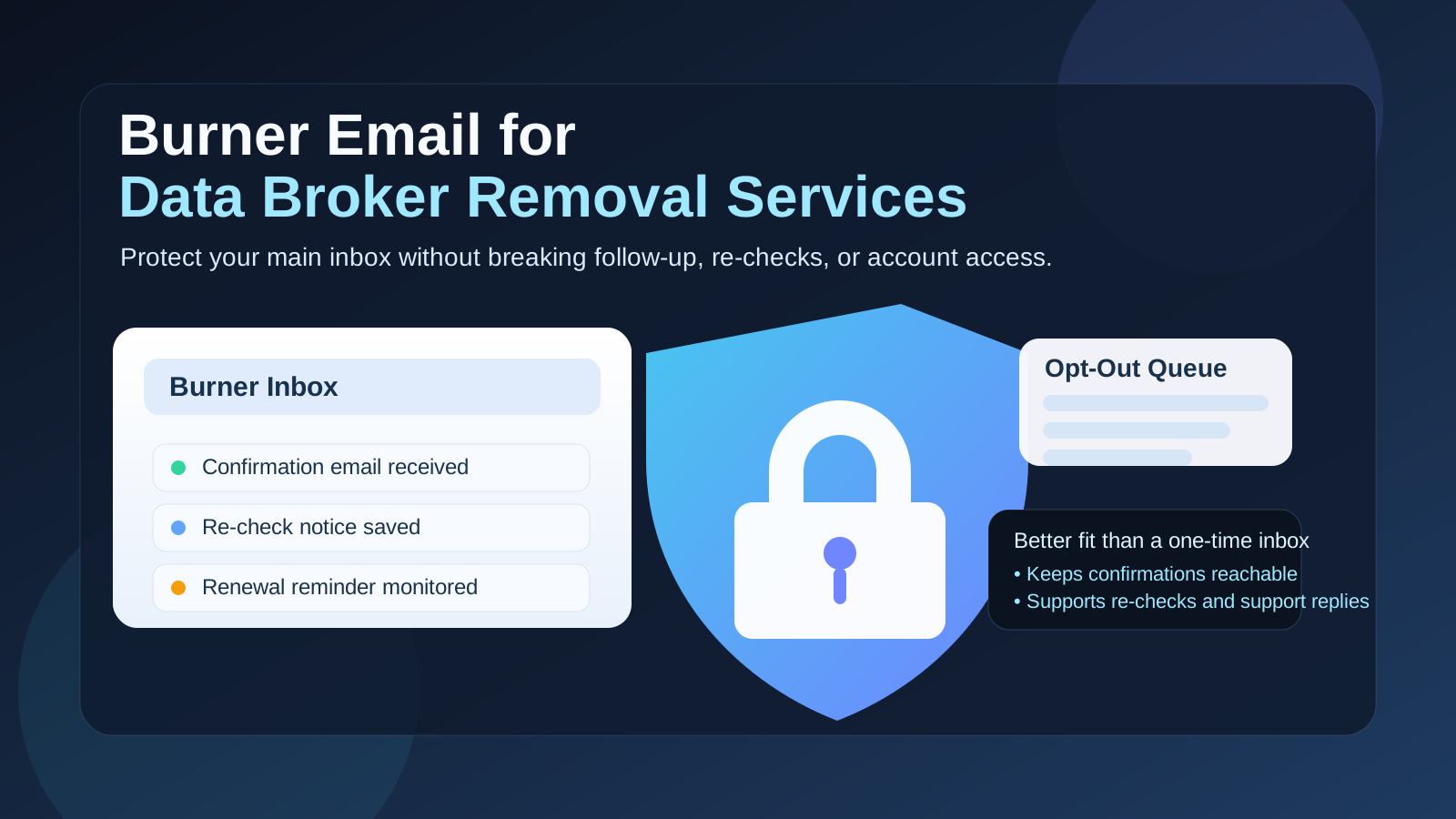
Why people think about burner email for data broker removal services
Data broker removal services promise something a lot of people want: less exposure across people-search sites, marketing databases, and public-record aggregators. Whether you use a service that sends automated opt-out requests, monitors broker reappearance, or helps manage manual removals, the process usually starts with an account and an email address.
That is where the discomfort begins. If your whole goal is reducing how widely your personal information circulates, it feels weird to hand your main inbox to yet another company in the privacy ecosystem. Even when the service is legitimate, many people do not want privacy dashboards, re-check alerts, promotional offers, identity-verification prompts, and renewal reminders mixed into their everyday personal email.
A burner email seems like the obvious answer. It creates distance between your main identity and the service, keeps your primary inbox cleaner, and makes it easier to walk away later if you decide the tool is not worth keeping. That logic is sound up to a point. The problem is that data broker removal is rarely a one-and-done workflow.
What counts as a burner email here?
People use the phrase burner email in a few different ways, and the distinction matters.
- Short-lived temporary inbox: useful for quick verification, but often too disposable for anything that needs ongoing access.
- Longer-lived throwaway account: a separate mailbox you control for a specific purpose, which you can retire later.
- Alias-based burner address: a forwarding address or masked email that protects your main inbox while still giving you continuity.
For data broker removal services, the second and third options are usually safer than the first. A privacy-cleanup workflow often lasts longer than people expect. You may need to confirm signups, review progress updates, respond to support, approve renewals, or revisit the account months later if your data resurfaces.
When a burner email helps
A burner email can absolutely be useful in this category. The key is using the right kind of burner address for the right stage of the process.
1. You want to keep your main inbox out of the vendor loop
This is the most obvious benefit. Even trustworthy privacy companies send account mail, reminders, product updates, and occasional marketing messages. A separate address keeps that activity away from your personal or work inbox.
2. You are testing the service before committing
If you are comparing a few data broker removal services, a burner email makes early evaluation easier. You can review the onboarding flow, see what the dashboard offers, and decide whether the company looks organized before tying the account to your everyday contact address.
3. You want cleaner privacy compartmentalization
Privacy work tends to sprawl. You may create accounts for broker opt-outs, freeze monitoring, identity alerts, password tools, or alias providers around the same time. Using a dedicated address for privacy cleanup creates a cleaner paper trail and reduces cross-contamination with shopping, social, and personal accounts.
4. You want an address you can retire later
If the service becomes noisy, disappointing, or unnecessary, it is easier to shut off a burner inbox or alias than to untangle those messages from your main personal mailbox. That control is a real advantage.
Where a burner email often fails
This is the part people underestimate. Data broker removal services are not like grabbing a discount code or opening a throwaway free trial. The whole value of the service depends on follow-up.
1. Re-checks and repeat removals
Your information can come back. Brokers refresh databases, acquire new records, or republish information from other sources. Many services rely on recurring monitoring and new removal cycles. If your email disappears after the first week, you can lose the trail of what was done and what needs attention again later.
2. Account recovery and login continuity
If you need to reset a password, confirm suspicious activity, or revisit a dashboard after a few months, a dead burner inbox becomes a real problem. You may still be paying for the service, but no longer able to manage the account cleanly.
3. Support conversations
Privacy services sometimes need clarification, especially when a broker listing is stubborn, duplicated, or tied to several address variants. A too-temporary inbox can break that back-and-forth right when you need it.
4. Renewal reminders and cancellation control
If the service renews, changes terms, or asks you to review progress, you want those notices to land somewhere you can still access. Otherwise a burner email can create the exact opposite of control.
Burner email vs temporary email vs alias vs separate inbox
The smartest choice depends on how serious and how long-lived the privacy task is.
Temporary email
Best for low-stakes exploration. If you only want to inspect a signup flow or read a first confirmation message, a temporary inbox can help. But for ongoing privacy cleanup, it is usually too fragile.
Burner email
Best as a middle ground when the address is separate from your main identity but still lasts long enough to handle follow-up. This is often the sweet spot for people who want distance without losing continuity.
Email alias
Often the most practical option. An alias gives you insulation, forwarding control, and easy shutdown if the address starts attracting junk. It also preserves your ability to keep receiving messages without revealing your main inbox directly.
Separate long-term inbox
Best if you expect to keep using privacy services for months or years. A dedicated separate inbox is less disposable, but more stable for renewals, re-checks, and account management.
If you already use Anonibox for quick privacy tasks, think of it as the fast end of the spectrum. It is great when you need distance right now. But if a service needs durable follow-up, a longer-lived setup is usually better than a mailbox designed to vanish.
A practical workflow that works better
If you want both privacy and reliability, use a staged approach instead of treating every privacy task the same.
- Start with a privacy-first intake address. This can be a burner account or controlled alias rather than your primary personal inbox.
- Use that address to test signup, pricing, and onboarding. Make sure the service looks legitimate and useful.
- Save any messages that matter. Keep confirmation links, support threads, receipts, and account details somewhere you can retrieve later.
- Decide whether the service is short-term or ongoing. If it is ongoing, keep the address stable. If it was only an evaluation, retire it later.
- Do not rely on a mailbox that may disappear before the cleanup cycle is finished.
This workflow gives you the privacy benefits people want from a burner email without accidentally cutting yourself off from the very service you signed up for.
What to look for before you sign up
Before using any email address with a data broker removal service, ask a few basic questions:
- Will I need this account again in a month, three months, or a year?
- Does the service promise recurring scans or only one-time removals?
- Can I still receive password resets and support replies if I use this address?
- Do I want this company to know my primary everyday inbox?
- Would an alias or separate long-term inbox give me better control than a fully disposable one?
Those questions are more useful than asking whether a burner email is “allowed.” In most cases the issue is not permission. It is whether the workflow will still hold together when the cleanup process stretches beyond the first signup.
Red flags and mistakes to avoid
- Using a one-time inbox for a paid recurring service: you may lose access to receipts, renewals, and account notices.
- Forgetting to store important confirmations: privacy dashboards often rely on a small number of critical account emails.
- Assuming every privacy company needs the same setup: some are worth a stable alias or separate inbox, others are not worth any long-term relationship.
- Mixing privacy accounts with your work email: employer-controlled addresses are a bad fit for a process that should outlast a job.
- Treating privacy tools as magic: a burner email reduces exposure, but it does not erase data broker risk by itself.
So should you use a burner email for data broker removal services?
Yes, often — but only if the burner email is durable enough to support the full lifecycle of the service. That means confirmations, account recovery, progress updates, support conversations, and future re-checks still need to reach you.
If by burner email you mean a mailbox that lasts long enough to manage the relationship and can be retired later, it can be a smart privacy move. If you mean a truly temporary inbox that may disappear quickly, it is usually the wrong fit for ongoing broker-removal work.
Final takeaway
A burner email can be a good tool for data broker removal services, but it works best when you treat it as a controlled buffer, not a vanishing shortcut. Privacy cleanup is usually a longer process than a single signup page, and the email address tied to it has to survive that reality.
If you want the cleanest balance, start with separation, preserve continuity, and choose the lightest-weight option that still lets you receive the follow-up you may need later. That gives you more control over your inbox without sabotaging the privacy work you were trying to simplify in the first place.