Usually yes, if you want a stable inbox you control for long-term privacy cleanup. A custom domain email can work very well for data broker removal services when you need reliable follow-up without tying everything to your oldest personal address.
It is a better fit than a temporary inbox when you expect months of confirmations, support replies, re-check alerts, and renewal notices, but only if the domain and mailbox are boringly reliable.
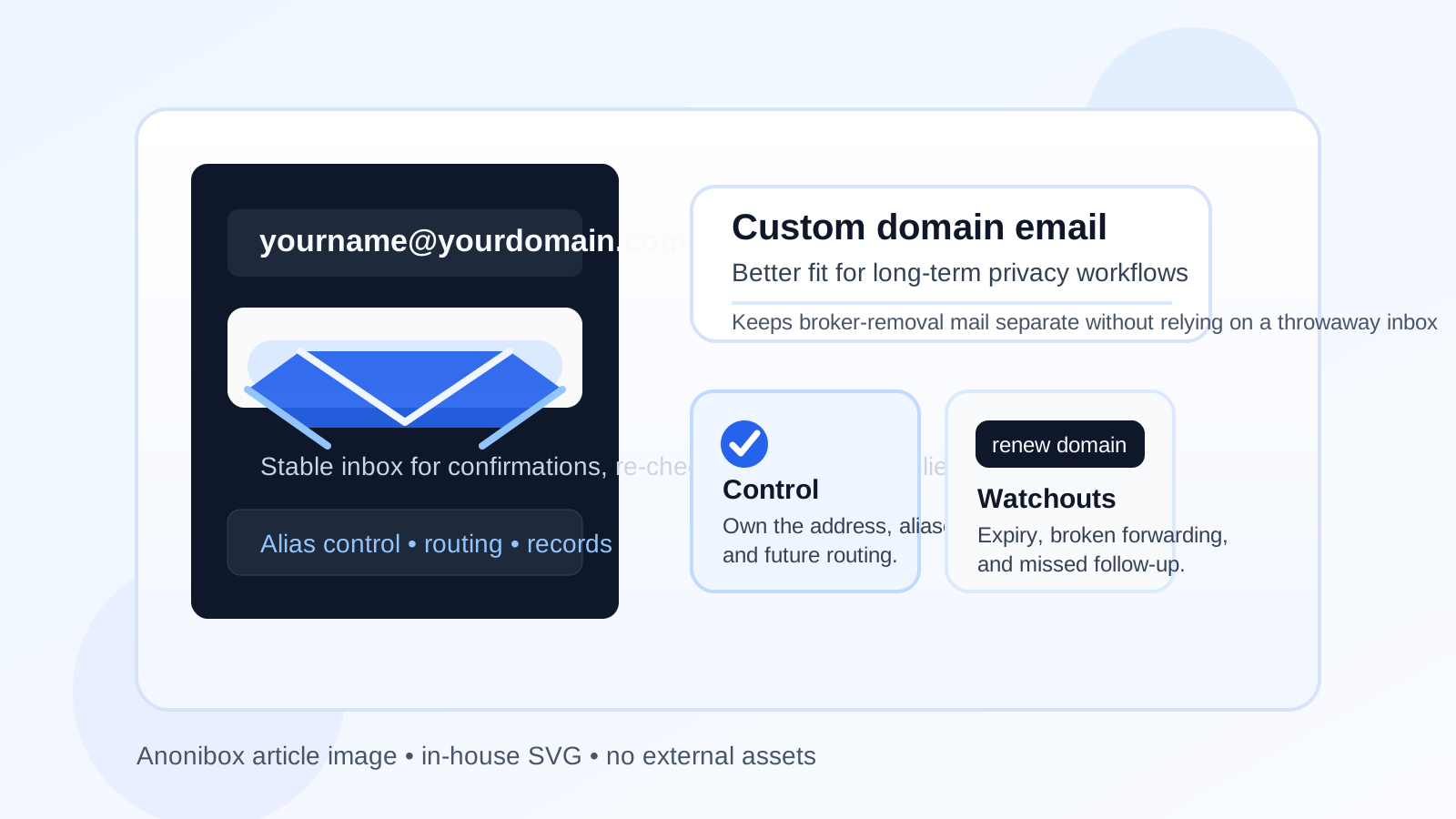
Data broker removal services are supposed to reduce the amount of personal information floating around the web. That is the goal. But the moment you sign up for one, you create a new privacy decision of your own: which email address should you attach to the account?
That question matters more than it looks. This is not like downloading a single coupon or verifying a one-time webinar registration. Broker-removal workflows can last for months. You may get account setup links, support replies, billing notices, broker-specific updates, renewal reminders, and occasional re-check messages when a record reappears. If all of that lands in your oldest personal inbox, you gain convenience but lose a clean privacy boundary.
A custom domain email sits in an interesting middle ground. It is more stable and controllable than a throwaway inbox, but more compartmentalized than using your everyday personal address. For many privacy-conscious people, that combination makes it one of the better long-term options.
Why this question comes up so often
People use data broker removal services because they want less exposure, not more. They are trying to reduce how easily people-search sites, lead brokers, and marketing databases can connect names, addresses, phone numbers, and email histories. So it is natural to hesitate before handing over a primary email address to yet another service category.
At the same time, data broker removal is usually not a one-afternoon event. Even a good provider may need to contact you more than once. Some services send progress reports. Some tell you when certain opt-outs were confirmed. Some require account access later for billing changes, renewal decisions, or support. That makes a pure disposable inbox risky, because losing the mailbox can make the whole relationship harder to manage.
That is exactly why custom domain email becomes attractive here. It gives you long-term reachability without forcing you to use the same inbox that handles family communication, shopping receipts, banking notices, and years of personal account recovery messages.
Short answer: a custom domain email is usually a good fit
If you already manage a domain or are comfortable keeping one active, a custom domain email is often a strong choice for data broker removal services. It works especially well when you want:
- a dedicated privacy mailbox you can keep for months or years,
- better control over aliases and routing,
- cleaner separation from your main personal inbox,
- a searchable record of confirmations, support replies, and renewals,
- the ability to rotate or retire the address later if it gets noisy.
What makes it useful is not that it looks fancy. It is that you control the address lifecycle. You decide where it forwards, how long it exists, what aliases it accepts, and when it should stop being used.
What a custom domain email does better than your main inbox
1. It creates a cleaner privacy boundary
Your oldest personal email address usually has history attached to it. It may be tied to years of logins, purchases, newsletters, travel accounts, and recovery settings. Even when a data broker removal service is legitimate, many people reasonably prefer not to add one more privacy-sensitive category to that same inbox.
A custom-domain address gives you separation without making you unreachable. That separation is useful on its own. It keeps privacy maintenance mail out of the place where the rest of your life already accumulates.
2. It gives you long-term control
With a custom domain, you are not just choosing an inbox. You are choosing an address space that you own. You can keep using the same address for future privacy projects, create a fresh alias for a second provider, or shut the whole setup down later if you no longer need it.
That is a big advantage over using a free inbox you do not want to maintain forever or a temporary inbox that may disappear before a provider sends an important message months later.
3. It makes records easier to manage
Privacy work gets messy when you cannot find the paper trail. A custom-domain mailbox dedicated to broker-removal activity makes it easier to answer practical questions later:
- Which service did I sign up for?
- When did the account renew?
- Did support ever respond to that issue?
- Which alias did I use with which provider?
- When was the last re-check or progress report?
That kind of audit trail is valuable, especially if you compare multiple services or revisit the decision later.
4. It can reduce spillover from a noisy provider
Even a decent service may send more mail than you want: product updates, feature announcements, upsell prompts, monthly summaries, or reminders that no longer matter. If that all lands in a dedicated custom-domain inbox, the clutter stays contained. If it lands in your main inbox, it becomes one more stream mixed into daily life.
Where a custom domain email can go wrong
This setup is not automatically the best choice for everyone. A custom domain only helps if it is stable and simple enough to trust.
1. You might let the domain expire
This is the biggest practical risk. If the domain lapses, you can lose access at the worst possible time. A broker-removal account may still be linked to that address for resets, support, or renewal notices. If you are not good at maintaining domains, choose something easier.
2. Your forwarding setup may be fragile
Some people overbuild their mail flow with forwarding chains, filters, aliases, and multiple providers. That can work, but it can also fail quietly. If important messages disappear into spam folders or forwarding breaks, you may miss exactly the messages you created the setup to preserve.
3. You may not monitor the mailbox consistently
A separate privacy inbox only helps if you actually check it. If you set it up and forget it exists, the benefits disappear. Data broker removal is a follow-up-heavy workflow, so forgotten inboxes are a real problem.
4. It is not the same thing as anonymity
A custom domain email can improve compartmentalization, but it does not magically hide your identity. Depending on how you register the domain, how you configure the mailbox, and what information you share with the service itself, the setup may still be clearly tied to you. Treat it as a control and organization tool, not a guarantee.
How it compares with other email choices
Temporary email
Temporary email is useful when you want minimal exposure for low-stakes signups, quick tests, or early research. But it is usually too short-lived for a real broker-removal account that may need password resets, support access, and ongoing updates. A sensible pattern is to use Anonibox for one-off research or trial steps, then move to a stable inbox once you decide a provider is worth keeping.
Separate Gmail or Outlook account
A separate mainstream inbox is often the easiest option. It is simple, familiar, and easy to monitor. If you do not want the overhead of managing a domain, that may be the better answer. The trade-off is that you have less control over address structure and later rotation than you would with your own domain.
Alias services
Email alias tools can be excellent for privacy because they let you generate unique forwarding addresses per provider. In many cases they are an even better fit than a single custom-domain mailbox. But if you already run a custom domain, you can often recreate some of that control with your own aliases while keeping everything under one roof.
When a custom domain email is the best choice
- You already own and reliably renew a personal domain.
- You want a dedicated privacy-project inbox that stays under your control long-term.
- You may compare more than one data broker removal provider.
- You want to create separate aliases for different services later.
- You care about keeping privacy-maintenance mail out of your oldest personal inbox.
If several of those sound true, a custom domain is probably a strong option.
When it is probably not worth the effort
- You do not already manage domains and do not want the extra maintenance.
- You are only doing a quick one-time test and may never return to the account.
- You are inconsistent about checking secondary mailboxes.
- Your setup depends on brittle forwarding or experimental rules.
- You really just need a simple separate inbox, not a whole domain strategy.
In those cases, a separate mainstream mailbox or a good alias service may be the more practical move.
A practical setup checklist
If you decide to use a custom domain email for data broker removal services, keep the setup boring and dependable:
- Use a domain you plan to keep. Do not tie a long-term privacy account to a domain you might abandon soon.
- Choose a straightforward address. Something simple and readable is better than a complicated or joke address.
- Test delivery first. Send messages in and out before using the inbox for a real account.
- Set renewal reminders. Domain and mailbox expiration is an avoidable failure point.
- Keep records outside the inbox too. Save account dates, receipts, and notes in case you need them later.
- Use aliases intentionally. If you test multiple services, separate them cleanly instead of reusing one address everywhere.
- Check the mailbox regularly. A private inbox is only useful when it stays monitored.
Final answer
Yes, often. A custom domain email is usually a smart choice for data broker removal services if your goal is long-term control, cleaner records, and a better privacy boundary than your main personal inbox can offer.
It is not the right answer if the domain is unstable, the mailbox is easy to forget, or the setup is more complicated than you will realistically maintain. But if you can keep it simple and reliable, a custom-domain inbox can be one of the cleanest ways to manage broker-removal follow-up without turning your everyday email into the permanent home for yet another privacy-sensitive workflow.