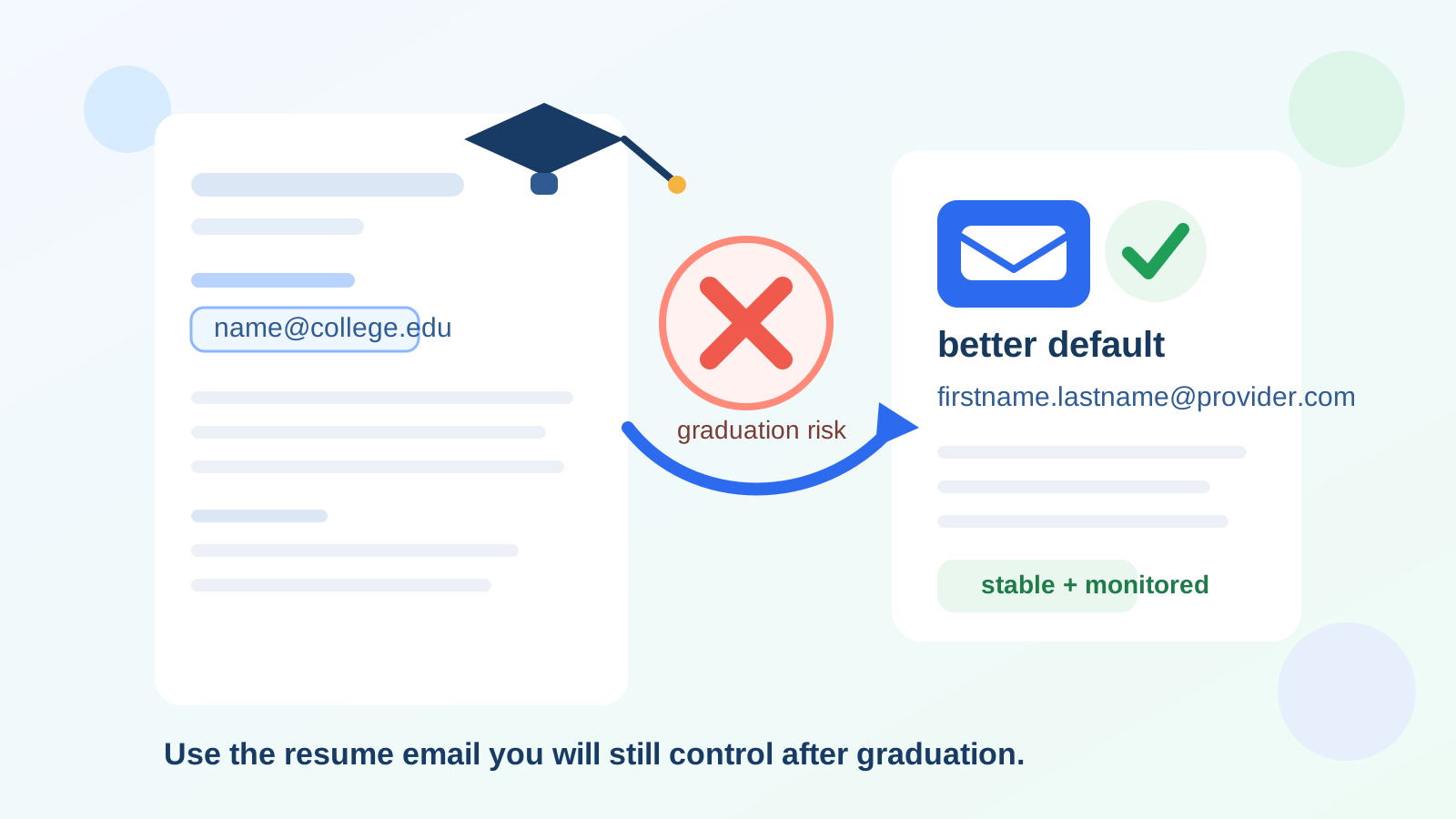
Usually, no—you should not use your college email on your resume if you are close to graduation or want the most stable long-term contact option.
A professional personal inbox you control is usually the safer choice, while a college address only makes sense in a few limited situations for current students with reliable access.
Why this question matters more than it seems
The email address on your resume is not just a line of contact information. It is the address that can be copied into applicant tracking systems, forwarded by recruiters, saved in PDF files, and revisited weeks or even months later. That means the right resume email should not only look professional today. It should still work when an employer comes back later with an interview request, a follow-up, or a second-round opening.
That is where college email becomes tricky. A university address can look credible at first glance, especially if you are still a student. But it is also tied to an institution’s rules, account-retention policies, forwarding behavior, and graduation timeline. If your access changes right when hiring moves slowly, you can miss messages at exactly the wrong moment.
Short answer: a college email can be okay for some students, but it is rarely the best long-term default
If you are a current student applying for internships, campus jobs, research roles, or early-career positions while you still have stable school-account access, a college email on your resume can work. Some employers will even see it as normal for that stage of life.
But “can work” is not the same as “best option.” For most people, especially anyone nearing graduation, job hunting off campus, or trying to build a more permanent professional setup, a personal email address you control is the better choice. The risk with a college email is not that recruiters hate it. The risk is that the account is less durable than your job search needs it to be.
When using your college email on your resume can make sense
You are still an active student with reliable account access
If you are in school now and know you will keep access for the full hiring cycle, using a college email is not automatically a mistake. This is especially true for internships, co-ops, campus recruiting, research assistant roles, and other student-oriented applications where a university affiliation is expected.
Your address is simple and professional
A clean address based on your real name is different from a messy student username or a school-generated string that is hard to read. If the address is short, clear, and easy to type correctly, it causes less friction.
The school brand is contextually relevant
Sometimes your university identity helps explain who you are at a glance. That can be useful when you are applying through alumni networks, student career fairs, faculty referrals, or roles that specifically target current students.
Even then, the question is not whether the address is acceptable. The better question is whether it is the most stable and practical option available to you.
The biggest risks of putting your college email on your resume
1. Graduation can break your contact channel
This is the biggest issue. Some schools let students keep email accounts for years. Others reduce access, remove forwarding, or fully deactivate accounts after graduation or after a period of inactivity. Those rules vary widely, and many students do not think about them until the transition is already happening.
Hiring, meanwhile, can move slowly. A company may respond a month later. A recruiter may revisit old resumes for a new opening. A manager may finally schedule interviews after budget approval. If your college account changes during that window, your resume has effectively gone stale.
2. Your resume may outlive your student status
Resumes get reused. A version you send in your final semester may still circulate after graduation. If the contact block makes you look locked to a student identity you have already moved past, it can become less helpful over time. A durable personal address ages better than a school account tied to one chapter of your life.
3. You may miss important messages if you stop checking it closely
Students often watch their school inbox carefully during classes, then gradually stop paying attention after graduation, a move, or a shift into full-time work. That is understandable, but a job-search email only works if you actually monitor it.
It is not enough for the account to technically exist. The inbox needs to be part of your real daily workflow.
4. School-managed accounts are not fully yours
Your college email is still controlled by the institution. Storage rules, login rules, retention policies, and security requirements can all change. That does not mean your school is doing something wrong. It just means the account is not as independent as one you set up and manage yourself.
5. It can make your professional identity feel temporary
A school address does not always look unprofessional, but it can make your contact details feel tied to being a student rather than to your longer-term career. That matters more once you are applying broadly beyond campus recruiting.
When a college email on your resume is usually a bad idea
- You are close to graduation and do not know exactly how long the account will remain active.
- You already graduated and are moving into a broader job search where permanence matters more than school identity.
- You are applying to experienced or off-campus roles where a personal professional identity is stronger than a student signal.
- Your school address is awkward, confusing, number-heavy, or hard to repeat over the phone.
- You rarely check the account or only look at it when something forces you to.
If any of those describe your situation, using a college email on your resume is usually more risk than benefit.
What employers actually care about
Most employers are not running a deep philosophical test on your email provider. They are looking for a few practical things:
- a contact address that works reliably
- an address that looks professional enough for a resume
- something you will still monitor later
- consistency across your resume, applications, and follow-up messages
That means a college email is not disqualified just because it ends in .edu or another school domain. But it also means the safest answer is usually the address that stays with you regardless of graduation, housing changes, campus systems, or institutional policies.
The better default: use a personal professional inbox you control
For most job seekers, the best resume email is simple, boring, and stable. It should be built around your real name, easy to type, and fully yours no matter where you study or work.
Good formats usually look like this:
- firstname.lastname@provider.com
- firstinitiallastname@provider.com
- firstname.middleinitial.lastname@provider.com
The goal is not creativity. The goal is reliability. If the inbox will still exist next year, still be checked next month, and still feel professional on any application, it is doing its job.
Should you ever keep the college email for part of the process?
Yes, sometimes. A student may still use a college address for limited contexts such as campus resources, internal student systems, university career services, or recruiting events directly run through the school. That is different from making it the main contact line on the resume you send everywhere.
A practical setup can look like this:
- use a personal professional inbox on your resume
- keep your college email active for school-specific logistics
- monitor both during the transition period if needed
That gives you continuity without losing access to student-facing messages.
Where temporary email fits in—and where it does not
This is where Anonibox can be useful, but only in the right part of the workflow. A temporary inbox can help when you want to test low-trust job boards, download resume templates, try career tools, or sign up for webinars without feeding your main inbox into long marketing sequences.
What it should usually not be is the email address printed on your resume. Whether the alternative is a college account or a temporary inbox, the same rule applies: if employers may need to reach you later, the address must be stable and closely monitored.
The best split is usually:
- resume and real applications: a long-term personal professional inbox
- low-stakes signups and noisy experiments: a tool like Anonibox
That keeps your real job-search channel dependable while still protecting your privacy around the edges.
If you already used your college email on your resume
Do not panic. This is not a disaster. Plenty of students and recent grads get interviews with school addresses. If your account is still active and you are monitoring it, you do not need to throw away your current search.
But if you want a stronger setup, now is a good time to switch. Create a professional personal inbox, update your resume, update your application materials going forward, and if possible add forwarding or close monitoring during the transition. You do not need to restart everything. You just need a better default for the next applications you send.
A quick decision checklist
Before you put a college email on your resume, ask yourself:
- Will I definitely keep access for the full hiring cycle?
- Do I know my school’s graduation and forwarding policy?
- Do I check this inbox consistently?
- Does the address look clean and professional?
- Would a personal professional inbox be more durable with almost no downside?
If you hesitate on the first three questions, a personal address is usually the better move.
Final answer
So, should you use your college email on your resume? Sometimes it is acceptable for active students, but it is usually not the strongest long-term choice. The main problem is not appearance. It is account stability, graduation risk, and whether the inbox will still be working and monitored when an employer follows up later.
For most people, the smarter default is a personal professional inbox you control fully. Keep the college account for school-specific communication if needed, use temporary inbox tools like Anonibox only for low-stakes signups, and make the address on your resume the one you can trust to stay with you through the entire job search.