Yes, you can use your college email on LinkedIn, but it is usually smarter to use an address you control long term if you want recruiter and networking replies to keep reaching you after graduation.
A college address can look perfectly fine while you are in school, yet it can create real continuity, privacy, and ownership problems once your campus access changes. For most students, the best LinkedIn email is one that looks professional, stays active after school, and is not tied to an institution that can shut it off later.
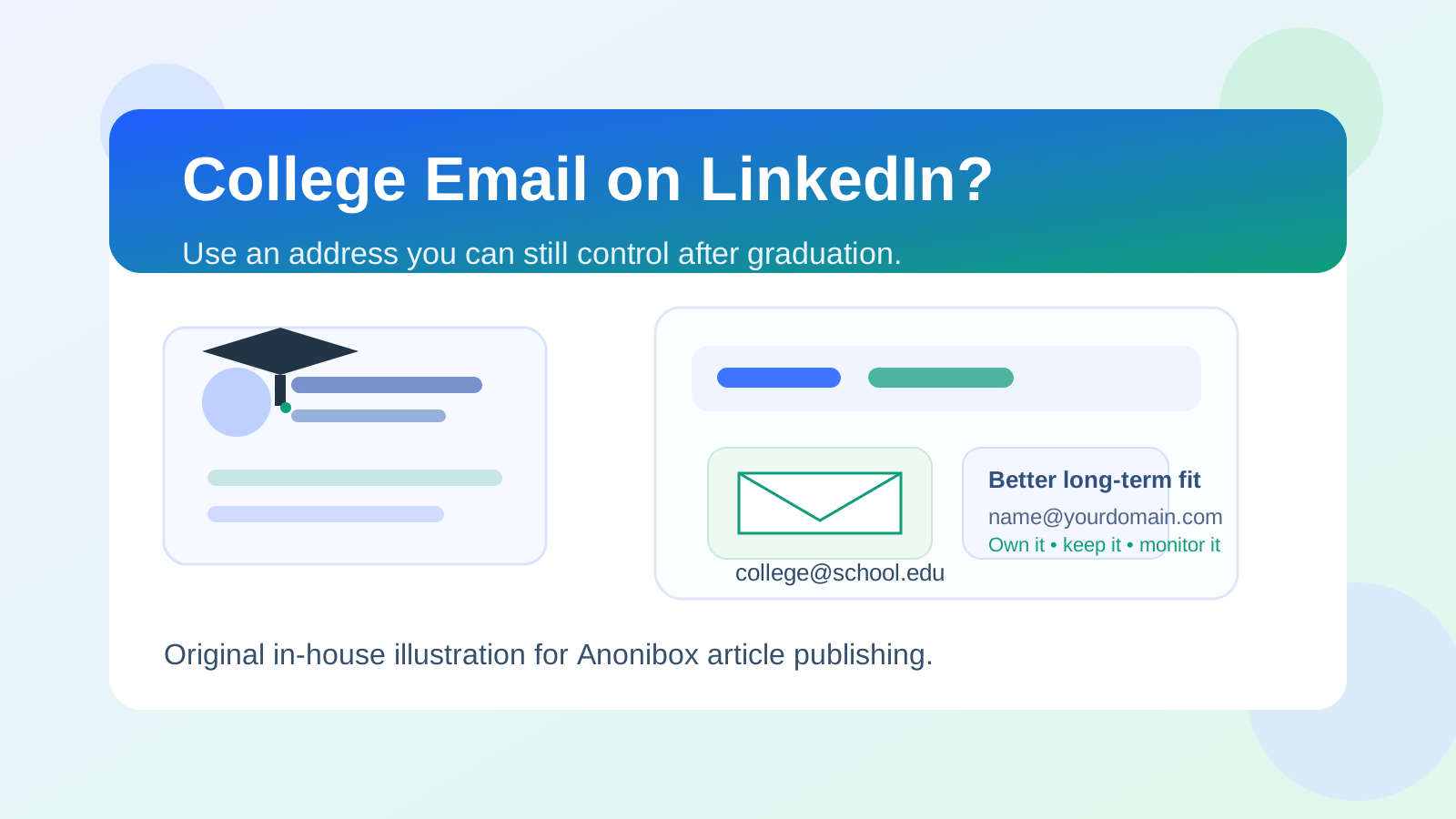
Short answer: acceptable in school, risky as a long-term default
If you are a current student, a college email on LinkedIn is not automatically a bad choice. In some situations it can even help. A school domain can signal that you are actively enrolled, make sense for campus recruiting, and match the rest of your student identity while you are applying for internships, part-time roles, or entry-level jobs.
But LinkedIn is not just a short-lived application form. It is a long-term profile that often stays active for years. That is the core issue. Your LinkedIn contact setup should still work after finals, after graduation, after a transfer, after an alumni account policy change, and after your job search evolves. Many college emails are fine for the semester and awkward for the next five years.
So the real question is not “Can I use it?” It is “Will this still be a reliable professional contact point when someone important reaches out later?”
Why students consider using a college email on LinkedIn
There are a few understandable reasons students choose their school address.
- It feels professional enough: a .edu or school domain can look cleaner than an old personal inbox with a messy username.
- It matches campus recruiting workflows: career centers, student organizations, professors, and internship coordinators may already contact you there.
- It keeps job-search messages out of your main personal inbox: that separation can feel useful when classes, bills, social accounts, and job-search traffic are all competing for attention.
- It can signal student status: that may be relevant when you are targeting internships, student ambassador roles, or university-connected opportunities.
Those reasons are real. The problem is that LinkedIn is bigger than campus life. A profile contact choice that works during sophomore year may be a weak choice once you leave the school, start freelancing, switch programs, or want outside recruiters to reach you without institutional friction.
The biggest risk: you may not control the address for long
This is the strongest argument against making a college email your main LinkedIn contact address.
Schools set their own rules. Some let graduates keep email access for years. Some disable accounts quickly. Some move students to alumni forwarding. Some keep the inbox but change storage limits, login policies, or authentication requirements. Some cut access if you withdraw, transfer, or simply age out of the system.
That means a recruiter who finds your profile six months after graduation might email an address you no longer monitor regularly, or cannot access at all. A former classmate might try to send an opportunity to an inbox that now bounces. A hiring manager could assume you are ignoring them when the real problem is that your school-controlled address is no longer your daily inbox.
LinkedIn works best when your contact details age well. College email often does not.
Privacy and control issues many students overlook
Even if your school lets you keep the address for a while, you still need to think about privacy and control.
School policies can change
You do not own the domain. The school does. That means retention rules, forwarding rules, login requirements, and account policies can change without asking what is most convenient for your professional networking.
Your academic and professional messages can blur together
One inbox for class notices, advising reminders, club announcements, group projects, internship replies, alumni networking, and recruiter outreach can get messy. Important messages become easier to miss when they land next to automated campus notices and course-related clutter.
You may expose more institutional identity than you intend
Sometimes that is fine. Sometimes it is not. A school address can reveal your affiliation more directly than you want, especially if you are quietly exploring roles away from your current program, contacting people outside your academic circle, or building a broader professional identity that is not centered on campus.
Account recovery and access are not fully yours
If your school account runs through campus IT rules, single sign-on systems, device checks, or password reset processes you do not control independently, it is not the same as owning a personal professional inbox. For LinkedIn, long-term ownership matters.
How LinkedIn is different from a resume or one job application
A lot of students think, “I used my college email on applications, so why not on LinkedIn?” The answer is that these are different surfaces.
A resume, internship application, or campus event signup often supports a specific short-term goal. LinkedIn is broader. It can attract:
- recruiters months after you apply anywhere
- alumni who want to reconnect later
- conference or networking contacts who saved your profile
- future employers long after student status stops mattering
- sales outreach and spam if your contact details become too visible
Because LinkedIn stays public-facing longer, the cost of choosing the wrong email is higher. A college inbox that is good enough for this semester may be a poor foundation for a profile that is supposed to follow your whole career.
When a college email on LinkedIn can make sense
There are situations where it is a reasonable temporary choice.
- You are actively in school and know the address will remain stable for the next year or two.
- You mainly use LinkedIn for internship recruiting or campus-adjacent opportunities right now.
- Your personal email is messy, outdated, or unprofessional-looking, and you have not created a better long-term option yet.
- Your school email is only used as the login email, not as a broadly visible public contact address.
That last distinction matters. There is a difference between using a college email behind the scenes for account access and putting it forward as your main professional contact address for the world. The second choice deserves more caution.
When it is usually a bad idea
- You are close to graduating: this is the classic moment to move away from school-owned contact details.
- You are networking beyond campus circles: if you want your identity to travel with you, use an address you own.
- You are job searching quietly while interning or working: mixing institutional access with broader career moves may not be ideal.
- You do not check the school inbox often: an address is only useful if you reliably monitor it.
- You are already seeing clutter or access friction: if it is annoying now, it will not age gracefully.
What is a better alternative for most students?
For most people, the best LinkedIn email is a separate long-term professional address you control personally. It does not need to be fancy. It just needs to be stable, readable, and appropriate for professional contact.
A good option usually looks like this:
- a name-based address you can keep after graduation
- something you check regularly
- separate enough from your most private daily inbox to absorb networking traffic
- not tied to your employer or your school
This gives you the upside of being reachable without building your professional identity on an address you may lose later. It also makes it easier to organize recruiter replies, alumni outreach, and networking follow-ups in one place.
Should you use a temporary inbox instead?
Usually not for the visible LinkedIn profile itself.
Temporary or disposable inboxes are useful for low-trust signups, gated downloads, one-off tools, and situations where you want to protect your primary email from spam. That is where something like Anonibox makes sense. It is a practical shield when you want to test a service, grab a resource, or avoid unnecessary mailing-list clutter.
But LinkedIn is supposed to be durable. People may contact you there weeks or months after they first view your profile. A short-lived inbox, or anything that looks obviously throwaway, is not a great fit for your main public networking identity. For LinkedIn, the goal is controlled permanence, not pure disposability.
A smart middle ground for students
If you are not ready to abandon your college email completely, there is a balanced approach:
- Create a separate professional email you own.
- Use that as your long-term LinkedIn contact address.
- Keep the college email active for school workflows while you still need it.
- Gradually shift resumes, portfolios, networking, and recruiter communication to the address you control.
This avoids the hard cutover problem later. Instead of waiting until graduation to scramble, you build a professional contact system that already survives the transition.
Best practices if you keep a college email on LinkedIn for now
Know your school’s retention policy
Do not guess. Check whether graduates keep access, whether forwarding continues, and whether inactive accounts are disabled.
Monitor the inbox consistently
If you use it on LinkedIn, treat it like a real professional inbox. Important messages should not sit unread for weeks.
Review what is actually visible
You do not have to expose every contact detail publicly. LinkedIn visibility settings matter. Many people are better off letting first contact happen through LinkedIn messages, then sharing email selectively.
Move away from school ownership before graduation
Do this before you need it, not after access gets messy. Transition while both inboxes still work.
Avoid using your work email instead
Students sometimes jump from a college email to an internship or employer email. That is usually not the right long-term fix either. Employer-owned inboxes have similar ownership problems.
Quick decision checklist
Before you use your college email on LinkedIn, ask yourself:
- Will I still control this inbox after graduation or a status change?
- Do I actually check it every day?
- Would a recruiter reaching out six months from now still reach me reliably?
- Am I using this because it is genuinely best, or just because I have not set up a better professional email yet?
- Would a separate long-term address give me better privacy and continuity?
If that last answer is yes, you already know the better direction.
Final answer
You can use your college email on LinkedIn, and while you are actively in school it may be acceptable. But it is usually not the best long-term choice because you do not fully control it, you may not keep it forever, and your LinkedIn profile is supposed to outlast student status.
For most students and recent graduates, the safer move is to use a professional email you personally control, keep temporary inboxes for low-trust or one-off workflows, and phase school-owned contact details out before they become a problem. That keeps you reachable for real opportunities without tying your professional identity to an address the school owns instead of you.