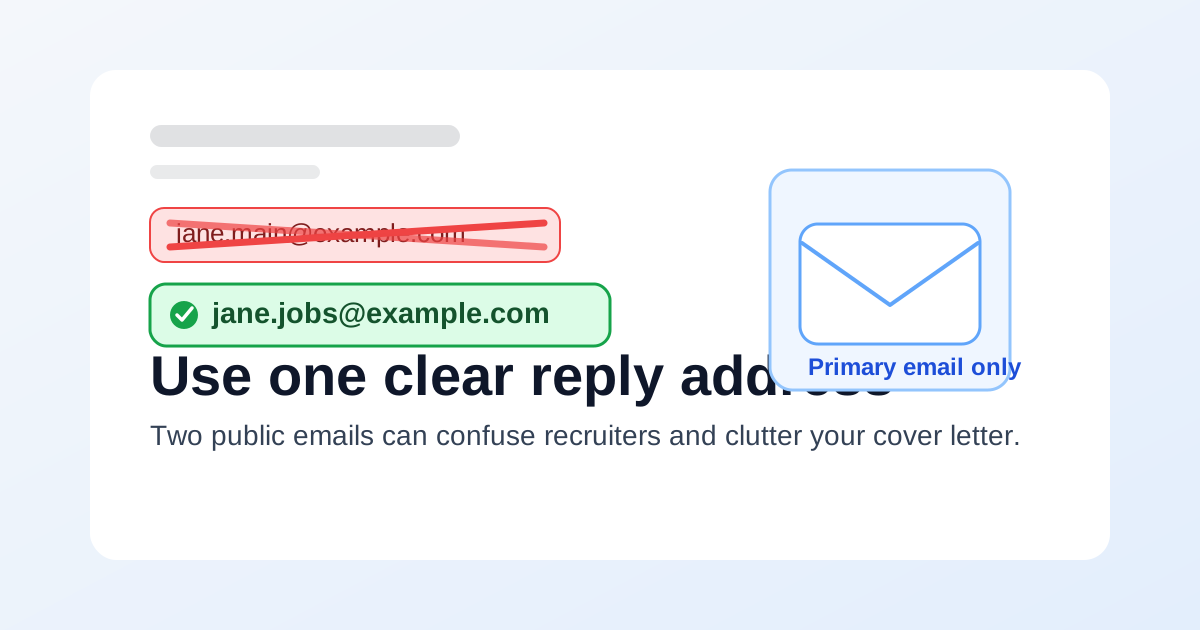
Usually no. Put one primary email address on your cover letter, not two, unless an employer specifically asks for an alternate contact.
Two email addresses usually make your contact details look cluttered and force recruiters to guess where they should reply. If you want privacy, backup access, or better inbox control, keep one clear address on the letter and handle your other inboxes behind the scenes.
Why people think about adding two email addresses
The idea is understandable. Maybe you have a personal inbox you check constantly, a separate job-search inbox you want recruiters to use, and a backup account in case one service filters messages poorly. Some job seekers also worry about missing replies if one provider sends hiring emails to spam or promotions tabs.
Others are trying to solve a privacy problem. They want one address for applications, one for networking, or one for public-facing materials and another for direct recruiter contact. If you are already using aliases, a separate job-search inbox, or a temporary email workflow for early signups, it can feel logical to show more than one option.
But a cover letter is not the place to expose all of that complexity. Its job is to make it easy for the employer to understand who you are, why you fit the role, and how to reach you. More contact choices usually do the opposite.
Why two email addresses usually hurt more than they help
1. They create unnecessary decision friction
Hiring teams move fast. When someone glances at your cover letter, they should not have to stop and ask which email is the “real” one. If two addresses are listed, different people may choose different ones. That can split the conversation, bury context, or make it harder for you to track replies.
2. They can look messy
Cover letters work best when the formatting feels deliberate and easy to scan. Two email addresses in the header can make the document feel crowded, especially when you also list a phone number, city, LinkedIn URL, or portfolio. Even if the content is strong, messy contact details can create a small but avoidable distraction.
3. They can signal uncertainty
Sometimes two emails make employers wonder whether one account is unreliable, temporary, or rarely monitored. That is not always fair, but it is a real impression risk. A single, professional, checked-often address signals confidence and clarity.
4. They do not actually solve reply problems well
If your concern is “what if I miss a message,” the better fix is forwarding, better filtering, frequent checking, or using one dedicated inbox well. Listing two public addresses shifts the burden to the employer instead of solving the underlying problem yourself.
When a second email might make sense
There are a few narrow situations where a second address is not unreasonable, but they are exceptions, not the default.
- An employer explicitly requests an alternate email for backup contact.
- You are applying in a context with strict technical constraints and know one domain sometimes blocks external replies.
- You are using a formal header block required by a school or program that specifically asks for primary and alternate contact information.
Even then, keep it simple. Label the primary address clearly and only include a second one when there is a concrete reason. Do not add it “just in case.”
The better approach: one email on the letter, better systems behind it
If you want control, privacy, or redundancy, you can get it without putting two addresses on the page.
Use one dedicated job-search inbox
This is often the cleanest option. Instead of using your oldest personal inbox or your work email, use one address that exists specifically for applications and recruiter communication. That keeps the cover letter tidy while still separating your job hunt from everything else in your life.
A dedicated inbox also makes it easier to search threads, save attachments, and notice patterns. If several employers reply at once, you are less likely to lose a message in a crowded personal inbox.
Use forwarding or aliases privately
If you want redundancy, build it on your side. Many email setups let you forward messages, monitor aliases, or route everything into one main folder. That way the employer sees one clear contact address, while you still get the backup behavior you want.
This is a much better user experience for everyone involved. Recruiters get one destination. You get flexibility in the background.
Use temporary or low-exposure addresses earlier in the funnel, not on the final letter
There is also a difference between early-stage signups and direct employer contact. If you are testing job boards, gated downloads, or low-trust listings, a separate privacy-first workflow can be smart. A tool like Anonibox can help keep early signups or risky forms away from your everyday inbox.
But once you are sending an actual cover letter to a real employer, clarity matters more than cleverness. At that stage, a stable, monitored address usually beats a disposable-looking setup or multiple visible addresses.
What employers are really looking for
Most hiring teams are not grading your cover letter based on whether you included one email or two. They are asking a much simpler question: if we want to reply, is it obvious how to do that?
That means your contact details should feel reliable, readable, and consistent across documents. Ideally, the same primary email appears on your cover letter, résumé, and application form unless there is a deliberate reason to do otherwise. Consistency reduces confusion and makes you look organized.
If the address on your cover letter is different from the one on your résumé or application portal, that can be more distracting than helpful. Two addresses on one letter only increases that risk.
Examples of what works better
Weak approach
Jane Doe
janedoe.main@email.com | janedoe.jobs@email.com | janedoe.backup@email.com
This gives the employer too many choices and no explanation for which one matters.
Better approach
Jane Doe
janedoe.jobs@email.com
This works because it is clear, professional, and obviously monitored for the purpose of the application.
Best approach when you need backup
Use one visible address on the letter, then configure forwarding or internal monitoring so you still catch replies elsewhere. The employer never has to think about your system, and that is exactly the point.
What if the application form already has your email?
If the application form already includes your email address, you usually do not need to get fancy in the cover letter. Repeating one consistent contact address is enough. Some candidates even keep the letter header minimal because the hiring platform already stores their details.
The key is consistency. If you already submitted one email through the application portal, do not introduce a second public email in the cover letter unless there is a very specific reason. Otherwise, you are creating a mismatch instead of helping.
What about privacy concerns?
Privacy is a valid reason to be careful with job-search contact information. The answer just is not “publish two emails at once.” A better privacy plan looks like this:
- Use one separate job-search email instead of your oldest personal inbox.
- Avoid using your work email for outside applications.
- Use forwarding, aliases, or filters on your side rather than adding multiple public addresses.
- Reserve temporary inboxes for low-trust forms, newsletters, or early research rather than serious employer correspondence.
That approach gives you cleaner boundaries without making your application materials harder to process.
Red flags to avoid
If you are tempted to list two addresses because you do not trust one of them to work, fix that before you apply. A cover letter should not advertise a broken communication setup.
You should also avoid using:
- an old email you rarely check
- a current work email tied to your employer
- a novelty or unprofessional address
- multiple addresses that make it unclear which one you monitor
If you would feel the need to explain the contact setup in a sentence, it is probably too complicated for the document.
A quick decision checklist
- Do I have one professional email I check regularly?
- Is that same address already on my résumé or application form?
- Am I considering two emails because of a real requirement, or just anxiety about missing messages?
- Could forwarding, aliases, or a dedicated job-search inbox solve the same problem more cleanly?
- Would a recruiter instantly know where to reply?
If your answer to the last question is anything other than yes, simplify.
Final answer
In most cases, you should not put two email addresses on a cover letter. One clear, professional, monitored address is easier for employers to use and makes your application look more polished.
If you want backup, privacy, or better organization, build that into your own workflow instead of asking the employer to sort through multiple contact options. A single visible address plus a smarter behind-the-scenes setup is almost always the better move.