Yes — you can opt out of many data brokers without giving your real email, but a stable alias or separate privacy inbox usually works better than a short-lived temporary address.
If a broker only needs a confirmation link or a simple reply, a temporary inbox can help shield your main account. If the request may take days, require follow-up, or involve identity matching, use a monitored privacy email instead.
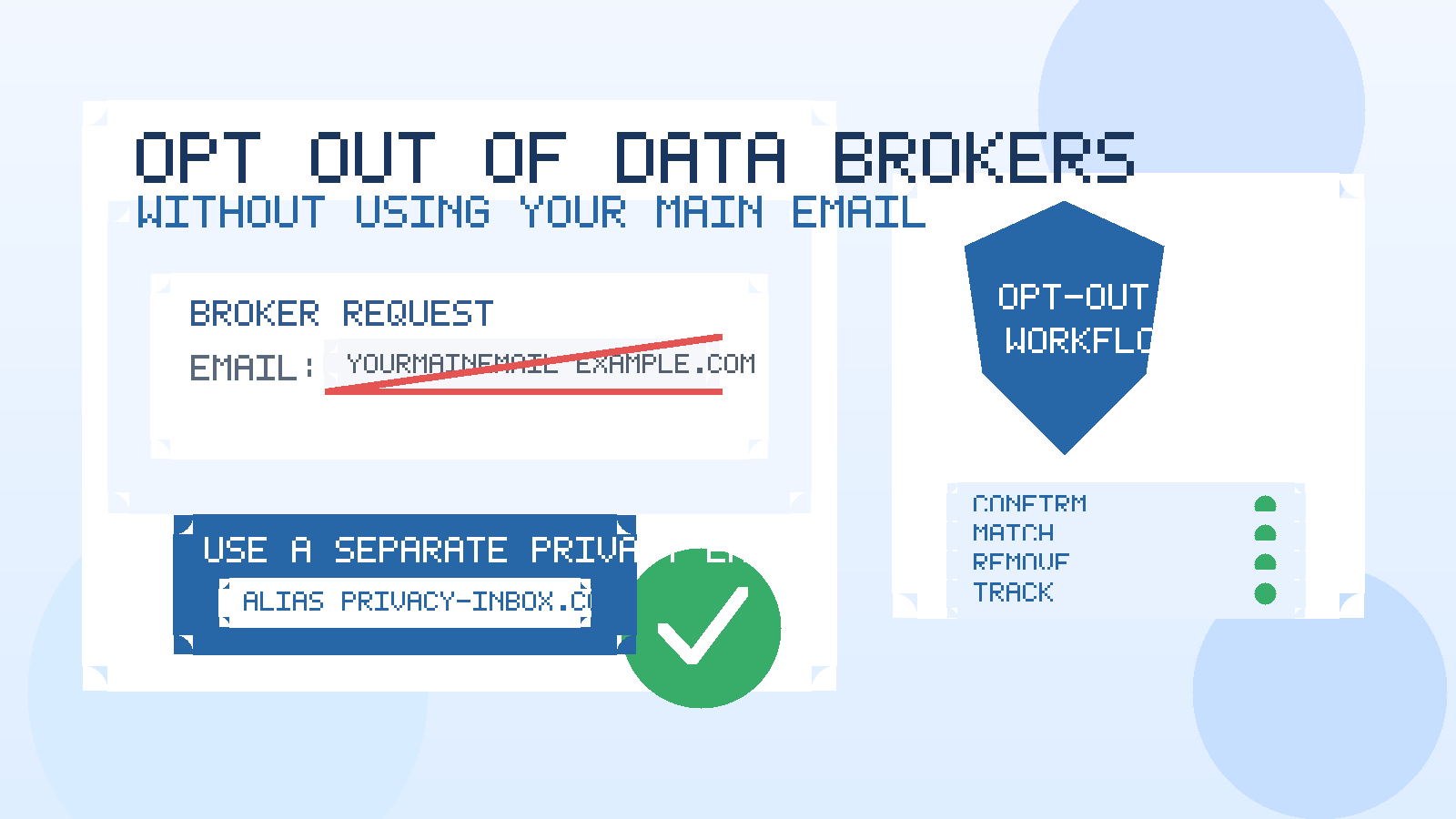
That is the practical answer, but the real value is in using the right email for the right stage. Data broker opt-outs are not all the same. Some are quick forms. Some ask for a confirmation email. Some want you to verify a listing, respond to a support message, or come back later because the removal failed the first time. If you use the wrong kind of inbox, you can either expose your main address more than you wanted or lose access before the process is finished.
This guide walks through a clean, low-drama way to handle opt-outs while keeping your primary inbox out of the blast radius.
Why people do not want to use their main email
The hesitation is reasonable. If you are trying to reduce your digital footprint, handing your everyday email to dozens of broker sites can feel backward. Your main address is often tied to shopping accounts, banking alerts, medical portals, travel bookings, and years of personal correspondence. Even if a broker is processing a legitimate removal request, you may not want that address copied into more systems than necessary.
There is also a practical problem: broker opt-outs can create clutter. Confirmation emails, case numbers, support follow-ups, renewal reminders, and occasional “we processed your request” messages can pile up fast. A separate channel keeps that work organized and makes it easier to see which requests are still open.
When a temporary email can work
A temporary inbox is useful in a narrow set of situations:
- You are checking how a broker’s form works before deciding whether to submit.
- You only need to receive a single confirmation email and the request clearly finishes right away.
- You are comparing privacy workflows and want to keep low-trust experiments out of your main inbox.
- You want a short-term shield for early testing before switching to a more durable address.
For example, if a broker sends one verification link and then immediately confirms removal, a temporary address may be enough. A service like Anonibox can be handy at that stage because it lets you avoid dropping your main email into yet another database while you test the process.
When a temporary email backfires
This is the part people underestimate. Many opt-outs are not truly one-step. A broker may email you later to confirm a match, ask you to clarify a record, send a case update, or require a second action if the original request expires. If the inbox is gone by then, you may have to start over.
A temporary address is a poor fit when:
- The broker says processing may take several days or weeks.
- You may need to reply to support.
- You want a paper trail showing what you requested and when.
- You plan to revisit the request later if your data reappears.
- The broker may send follow-up questions instead of a simple confirmation link.
In other words, the privacy win of a disposable inbox disappears if the process becomes unreliable. Losing access to a removal thread is not much of a victory.
The better default: a dedicated privacy inbox or alias
For most people, the best setup is not “main email versus throwaway email.” It is a third option: a separate, stable inbox or alias used only for privacy work.
That gives you several advantages at once:
- Your main inbox stays out of routine broker traffic.
- You still keep long-term access to confirmations and case numbers.
- You can search one place for every opt-out message.
- You can retire or filter that address later without disrupting your personal life.
A stable alias is often ideal if it forwards into a mailbox you control and you can turn it off later. A separate inbox is better if you want stronger separation and a cleaner audit trail. Either way, the goal is the same: stay reachable without overexposing your everyday address.
A practical step-by-step workflow
- Create your privacy channel first. Decide whether you are using a temporary inbox for initial testing, a stable alias, or a separate long-term mailbox.
- Keep a simple tracker. A notes app, spreadsheet, or plain text file is enough. Record the broker name, request date, address used, and whether confirmation is still pending.
- Read the form before submitting. Some brokers make it obvious whether the email is only for confirmation or for ongoing communication. That tells you whether a disposable inbox is safe enough.
- Use a temporary inbox only for low-friction cases. If the request looks genuinely one-and-done, a short-lived address can reduce exposure.
- Use a durable privacy inbox for anything that looks messy. The moment the process involves delays, support, identity matching, or repeated follow-up, stability matters more than the purity of a full throwaway.
- Save proof. Keep the confirmation email, ticket number, or screenshot of the success page. That makes repeat requests much easier if the data comes back later.
- Review the result later. Some broker data reappears. A separate privacy channel makes it easier to spot renewal or reappearance notices without polluting your main inbox.
What if the broker asks for more than an email?
Email is only one part of the privacy equation. Some brokers also ask for a phone number, address, or identifying details to locate the record they are supposed to remove. That is where people sometimes make the process either too risky or too ineffective.
The practical rule is to give the minimum information that actually helps the request work. If a broker is matching a record tied to an old city, previous address, or alternate spelling of your name, refusing to provide any matching data at all may prevent removal. But that does not mean you should casually hand over your main phone number or overshare documents where they are not necessary.
Pause and ask:
- Is this information needed for matching, confirmation, or both?
- Can I provide a narrower version instead of the full picture?
- Would a separate phone number or PO box be more sensible than my everyday contact details?
- Do I trust this site enough to continue, or would a third-party removal service or a different approach be safer?
A careful process beats a reflexive one. The point is not to use zero data at all costs. It is to avoid unnecessary exposure while still completing the opt-out successfully.
Where Anonibox fits in
Anonibox fits best at the front of the funnel: testing broker forms, receiving simple confirmation emails, and keeping low-trust privacy admin away from your primary inbox. It is especially handy when you want to see which brokers require email confirmation before you decide how to handle each one.
But it should not be treated like magic. A temporary inbox is a shielding tool, not a guarantee. If a broker’s workflow stretches beyond a quick confirmation, move to a stable privacy address you can monitor over time. That gives you both separation and reliability.
Red flags that should make you slow down
- The site asks for far more personal information than seems necessary for a removal request.
- The broker wants sensitive documents before clearly explaining why.
- The request flow is broken, confusing, or inconsistent across pages.
- The confirmation email contains suspicious links, odd sender details, or aggressive upsells.
- The company appears to make removal intentionally difficult while pushing paid products.
Those signs do not automatically mean the broker is fake, but they do mean you should proceed carefully, document what happened, and avoid defaulting to your main email just because the form is annoying.
A quick decision checklist
Before you submit an opt-out, ask yourself:
- Do I only need one confirmation email, or will I probably need follow-up later?
- Would losing access to this inbox force me to restart the request?
- Do I want this communication mixed into my main inbox for months?
- Would a stable alias or separate privacy mailbox solve the problem better than a throwaway?
If the request is simple and short, a temporary inbox may be fine. If the request is messy, recurring, or important, use a durable privacy address instead.
Bottom line
You can opt out of data brokers without giving your real email, but the smartest move is usually not a one-time throwaway. It is a controlled system: temporary email for low-risk confirmation flows, and a separate stable privacy inbox for anything that may require monitoring, proof, or follow-up.
That approach keeps your main inbox cleaner, reduces unnecessary exposure, and makes it much easier to finish the requests you start. Privacy work is tedious enough already. Your email setup should make it simpler, not more fragile.