A temp email can work for a short GoTo Connect trial if you only want signup privacy and a quick look at the dashboard.
It becomes risky once team members, phone numbers, call routing, billing, or account recovery depend on that inbox.
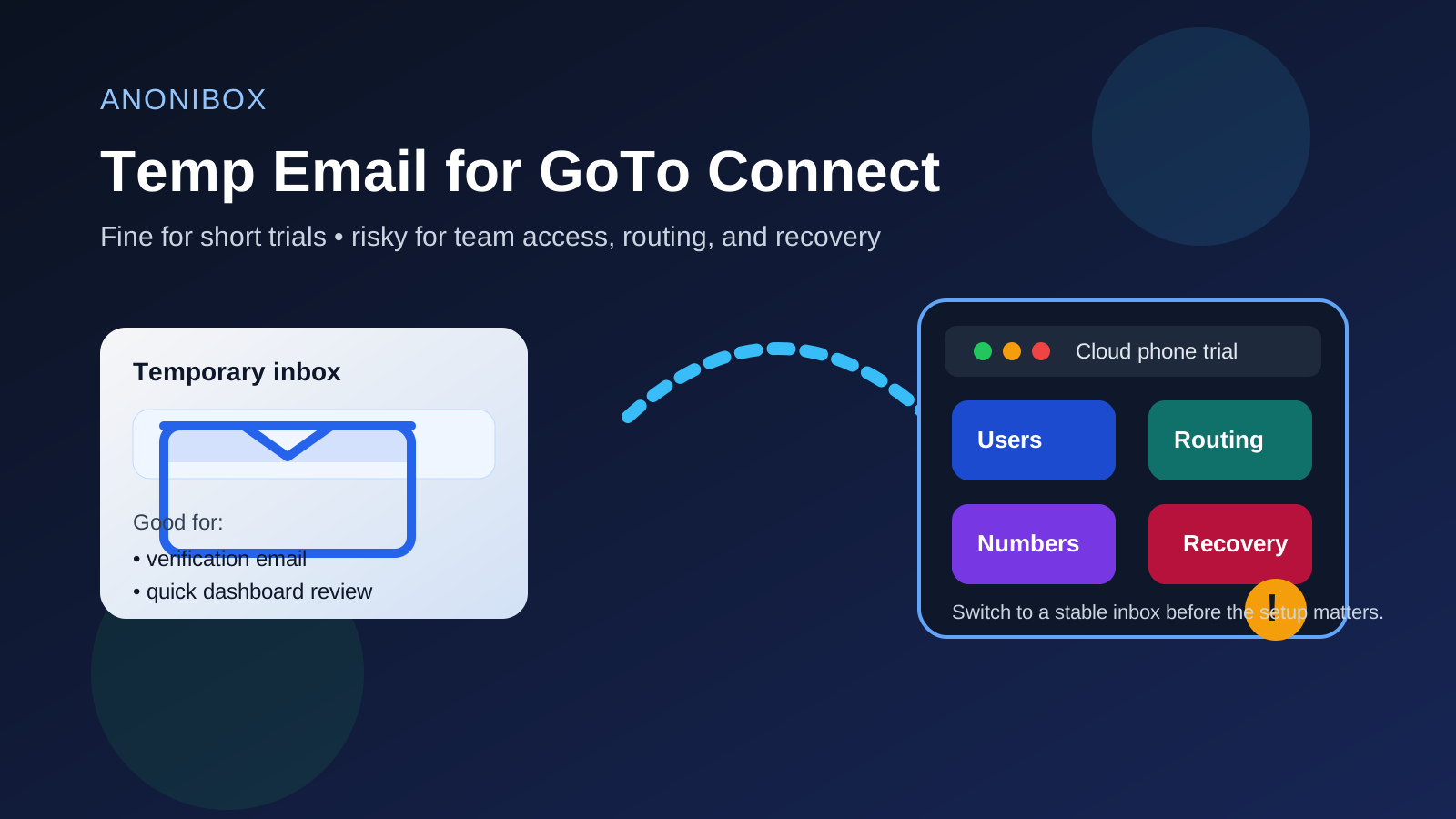
That is the practical answer. If you are comparing cloud phone systems, contact-center tools, or unified communications platforms, a disposable inbox can be useful during the very first stage of research. It lets you verify the account, view the product, and keep your main inbox out of one more sales sequence while you decide whether the platform is even worth a real evaluation.
GoTo Connect, though, is not the kind of product that usually stays a harmless one-person trial for long. Teams often start with a quick signup, then test numbers, routing, voicemail, user seats, call flows, integrations, and admin settings much sooner than expected. The more realistic the evaluation becomes, the less safe it is to leave the account anchored to a temporary inbox.
When a temp email for GoTo Connect makes sense
Using a temp inbox is reasonable when your goal is narrow, early, and disposable in the true sense of the word. You might want to confirm that the product fits your budget range, compare the interface with other phone platforms, or see whether the admin workflow feels manageable before sharing a permanent work address.
In that limited research window, a temporary email can help because it:
- Keeps your main inbox cleaner while you compare several vendors at once.
- Reduces follow-up noise from welcome campaigns, demo nudges, webinar invites, and trial-expiry reminders.
- Separates casual research from real rollout so your permanent contact details only get attached to serious shortlist tools.
- Adds a privacy buffer if you are still deciding whether you want another vendor relationship at all.
If your use case is basically, “I want to get inside, click around, and decide whether this deserves deeper testing,” a temp email is not inherently a bad idea.
Why GoTo Connect is different from a throwaway app trial
Some products are easy to test with disposable credentials because the account never holds much value. A one-off file download, a lightweight newsletter tool, or a casual consumer signup may stay low-risk. Business phone and communications platforms are different. They tend to accumulate operational value quickly.
Even during a trial, you may end up doing things that matter later:
- adding teammates or admins
- testing phone numbers or extensions
- setting up call routing and voicemail
- checking integrations with CRM or helpdesk tools
- evaluating mobile and desktop app access
- saving notes about how your real workflow would run on the platform
Once that happens, the email address on the account stops being a minor signup detail. It becomes part of ownership, continuity, and recovery.
When a temp email becomes a bad idea
A temp email for GoTo Connect becomes risky as soon as the account starts controlling anything you would care about losing, missing, or having to recover later.
1. Team access gets attached to the account
The moment more than one person is involved, the account email becomes more important. It may receive invitations, admin notices, seat changes, security alerts, and recovery messages. If that inbox expires or is no longer monitored, you create a weak point right where your team needs stability.
2. Call routing and numbers can outlive the “trial” mindset
Many teams say they are only testing, then quickly go further than expected. Someone configures a queue. Someone else experiments with forwarding. A manager wants to see how after-hours routing works. Suddenly the account contains real setup effort. Disposable email is a poor foundation for that kind of evaluation.
3. Billing notices and plan changes may start to matter
Even if you do not intend to convert immediately, trial-end notices, upgrade prompts, contract conversations, or account-limit alerts can become relevant. If those messages keep going to a temporary address, the wrong person may miss something important.
4. Recovery is where disposable inboxes fail hardest
Temporary email feels convenient when everything is working. Recovery only matters when something goes wrong: a password reset, admin lockout, ownership question, or security event. That is exactly when an expired or forgotten inbox becomes a problem instead of a convenience.
A safer way to evaluate GoTo Connect
If you want the privacy benefits without the long-term mess, use a staged workflow instead of treating the temp inbox as permanent.
Step 1: Use the temporary inbox only for initial access
If you are doing a fast first-pass comparison, use the temp address to receive the verification email and open the product. This keeps your primary inbox clean while you answer the first question: is this platform even worth serious time?
Step 2: Decide quickly whether the trial is becoming real
Ask this early, not after you have already invested setup time: are we just browsing, or are we actually testing this with realistic users and workflows? If the answer is still “just browsing,” a temp inbox may be fine for the whole experiment. If the answer is “this might make the shortlist,” switch before the account becomes sticky.
Step 3: Move to a stable team-controlled inbox before meaningful setup
Before you add teammates, numbers, routing logic, or anything operational, update the account to a durable inbox the business controls. A role-based address is often stronger than a purely personal one because it survives job changes, ownership shifts, and team handoffs more cleanly.
Step 4: Save your evaluation notes outside the inbox
Do not let trial emails become your only record of what you learned. Keep notes on pricing, admin friction, routing behavior, app quality, reporting, and integration limits somewhere your team actually controls. Then even if the early inbox disappears, your evaluation does not disappear with it.
Practical examples
Good use of a temp email
A small operations team wants to compare GoTo Connect with RingCentral and Dialpad in one afternoon. They only need to verify each trial, look at the admin layout, review pricing, and see whether the call-routing options seem promising. A disposable inbox is reasonable here because the goal is lightweight comparison, not durable setup.
Bad use of a temp email
A support team signs up, adds real users, tests live forwarding, configures voicemail, and starts sharing login responsibility, but leaves the account tied to a temporary inbox because “it was just for the trial.” That is exactly how recovery headaches happen later.
Borderline case
A company wants one admin to test the mobile app, desktop app, analytics, and routing builder over several days before inviting others. In that case, a temp inbox can work at first, but only if the team agrees to switch to a permanent address before anything becomes shared, paid, or operationally important.
What people often underestimate
People usually underestimate how quickly a communications platform becomes part of the real business. You may think you are only testing features, but the trial often becomes the place where your team first discusses extensions, routing logic, failover plans, or shared ownership. That creates real operational memory around the account.
A disposable email is good at shielding you from inbox clutter. It is bad at supporting continuity. Those are different goals, and GoTo Connect tends to demand continuity sooner than people expect.
When you should skip the temp inbox entirely
Sometimes the cleanest choice is to use a stable address from the start. That is usually smarter if:
- you already know GoTo Connect is on the serious shortlist
- multiple teammates will test it
- you plan to configure real numbers or routing
- you expect the trial could convert into a paid deployment
- you want clear ownership for security alerts and recovery
In those cases, the privacy win of a temporary inbox is usually smaller than the operational downside.
Where Anonibox fits naturally
Anonibox is most useful at the very front of the buying process. If you are comparing several communications vendors and do not want your main inbox filling up with every follow-up sequence, a temporary inbox helps keep the research stage clean. You still get the verification email and early onboarding messages, but you avoid turning casual evaluation into months of marketing noise.
The important part is knowing when to stop using it. Anonibox is helpful for first-pass comparison. It is not a substitute for a durable admin inbox once the account matters to real people, real workflows, or real recovery scenarios.
Best practices if you start with a temp email
- Keep the trial narrow. Use it for evaluation, not for semi-permanent setup.
- Switch early. Do not wait until after teammates, routing, or billing enter the picture.
- Document what matters elsewhere. Save notes outside the inbox.
- Avoid attaching ownership to throwaway credentials. If the account would be painful to lose, the inbox should not be temporary anymore.
- Treat recovery as the deciding test. If you would want password resets or security notices later, move to a real inbox now.
A simple rule to remember
If the account only needs to survive long enough for you to verify the signup and look around, a temp email for GoTo Connect can be fine. If it needs to survive staff changes, testing expansion, billing conversations, or admin problems, it needs a stable inbox.
That rule keeps the decision simple. Disposable email is for reducing noise during research. Durable email is for preserving control once the account starts to matter.
Final takeaway
A temp email for GoTo Connect is useful for short trial sign-ups and early comparison work, especially if you want to avoid adding one more vendor sequence to your main inbox while you evaluate business phone options. But it becomes a poor choice once the account is connected to team access, phone numbers, routing, billing, or recovery.
Use a temporary inbox to explore. Use a stable team-controlled inbox to operate. That is the cleanest way to protect privacy without creating avoidable account-management problems later.