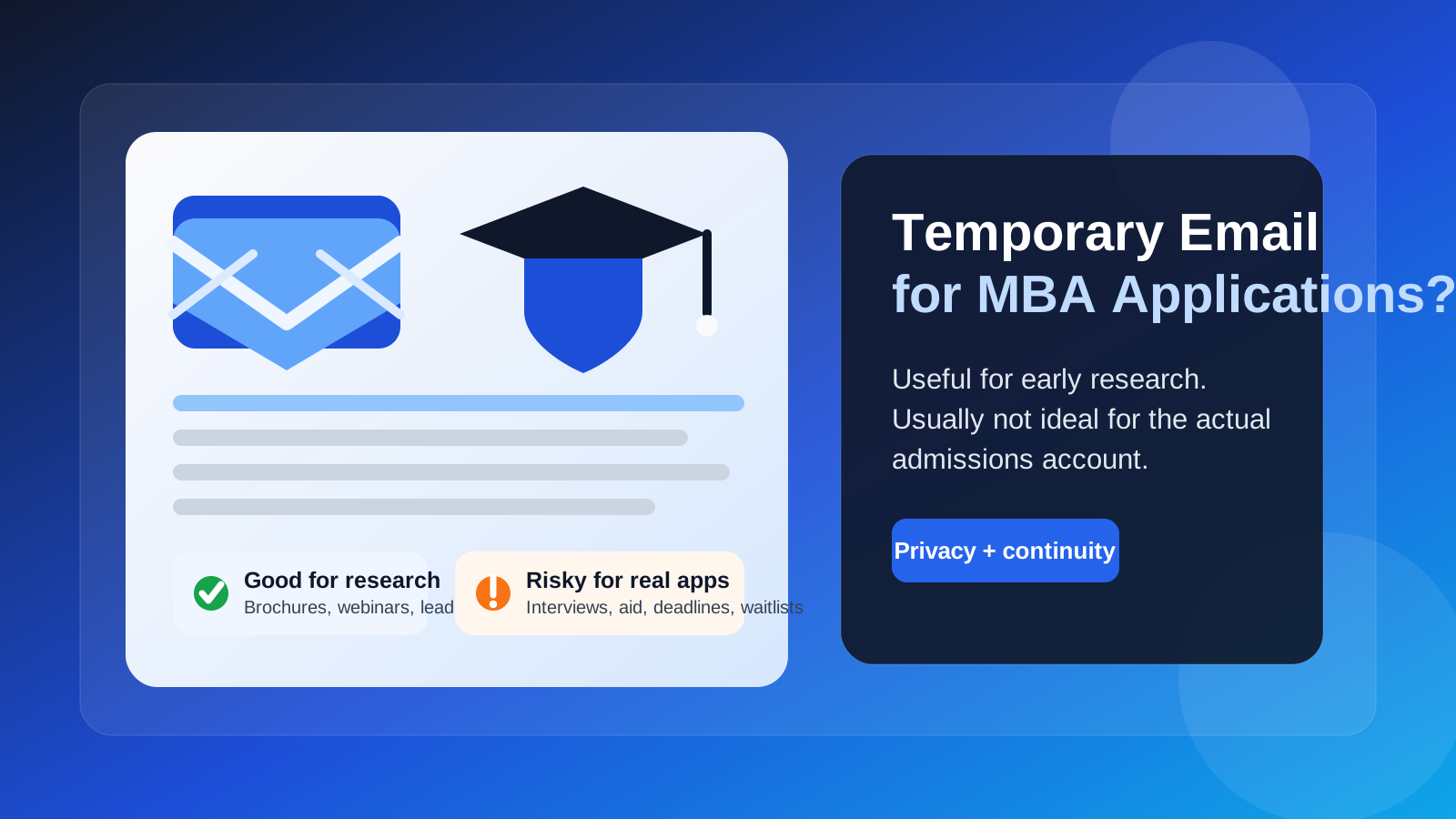
Usually no—a temporary email can be useful for MBA brochure downloads, webinar signups, and early school research, but it is risky for the actual MBA application itself.
MBA admissions often stretch across months, so you normally want a stable inbox for application portals, interview invitations, scholarship updates, waitlist movement, and deposit deadlines.
Why the idea is attractive in the first place
MBA applicants often hand over an email address long before they submit a real application. Schools, ranking sites, test-prep companies, consultants, events, webinars, and comparison guides all want contact details. That creates a predictable problem: once you show interest in business school, your inbox can fill up fast.
That is why a temporary email sounds appealing. It gives you a fast way to unlock brochure downloads, class profile PDFs, webinar registrations, and “request more information” forms without turning your main inbox into a nonstop stream of reminders, event promotions, and sales-style follow-up.
Used carefully, that instinct is sensible. The mistake is using the same short-lived inbox for the real application workflow, where continuity matters much more than short-term privacy.
When a temporary email does make sense for MBA-related tasks
A temporary email can be perfectly reasonable during the research phase, especially when you are not yet ready to give every school or third-party service your long-term contact details.
- Downloading school brochures, employment reports, and class profiles
- Registering for general admissions webinars or virtual fairs
- Testing third-party tools, forums, or calculators related to MBA planning
- Reading gated content from consultants, prep providers, or ranking sites
- Checking whether a form leads to useful information or just more marketing
In that stage, a tool like Anonibox can help you keep your real inbox cleaner while you explore programs and gather information. If a source turns out to be valuable, you can always switch to your long-term email later.
Why a temporary email is usually a bad idea for the actual MBA application
The problem is not that MBA admissions teams are unusually invasive. The problem is that the process is long, deadline-heavy, and full of messages you genuinely cannot afford to miss.
1. MBA admissions timelines are long
Many applicants interact with schools across several rounds, sometimes over many months. You may begin with school research, move into test planning, submit one round, join a waitlist, update the file, revisit scholarships, or even defer. A temporary inbox is built for short-term access. MBA admissions are not.
2. Important messages do not arrive all at once
The critical email is not always the first confirmation message. Schools may later send interview invitations, status-checker instructions, missing-document notices, scholarship prompts, deposit deadlines, or waitlist updates. Even one missed message can create avoidable stress.
3. Multiple systems may rely on the same address
Your MBA application email may end up tied to school portals, event follow-up, interview scheduling tools, financial-aid messages, and in some cases two-factor login or identity verification. That is too much to place on an address you do not fully control for the long term.
4. Recommenders and follow-up can span different stages
If you are managing recommendations, supplemental materials, or post-interview communication, consistency helps. You want one dependable inbox that makes it easy to search old messages, forward key items, and prove what you received if something goes wrong.
What is the real risk?
The biggest risk is not “someone will know I am applying to business school.” The bigger risk is losing continuity. A temporary inbox solves one problem—early inbox clutter—but creates a more expensive one if you attach it to a live admissions process.
Put simply: missing a brochure email is annoying. Missing an interview invite or deposit reminder is worse.
A better setup for privacy-conscious MBA applicants
If you want both privacy and reliability, the best answer is usually a dedicated long-term application inbox, not a disposable one.
Use one stable email just for MBA applications
Create or reserve an inbox specifically for MBA admissions. That keeps the process separate from your everyday personal mail without introducing the instability of a short-lived address.
Use aliases or filters for organization
If your email provider supports aliases, forwarding rules, or labels, use them. That gives you the sorting benefits people want from temporary email without risking the loss of a key message. For example, you can route school-specific messages into separate folders while still keeping everything tied to one permanent account.
Use temporary email only at the edge of the funnel
Temporary email is strongest when the relationship is still low-stakes: gated downloads, event signups, school-intent quizzes, consultant offers, and other exploratory forms. Once you create a real applicant account or start exchanging decision-critical information, move to your dedicated long-term inbox.
A practical MBA email workflow that actually works
- Research broadly with temporary email if you want: use it for brochure requests, list-building, and generic info sessions.
- Create a shortlist: once a school becomes a serious target, switch that relationship to your stable admissions inbox.
- Use one permanent address for every real application portal: consistency matters more than squeezing out a little extra privacy at this point.
- Save important messages outside the inbox too: store deadlines, interview dates, and portal links in a spreadsheet or task system so you are not relying on memory alone.
- Check junk and promotions folders regularly: even legitimate admissions emails can land in odd places.
This setup gives you the best of both worlds: you can shield your main personal inbox during research, but you still protect the actual admissions process with a reliable mailbox.
What about scholarship and waitlist communication?
This is exactly where temporary email becomes especially risky. Scholarship forms, fellowship details, and waitlist updates often arrive after the main application is already submitted. Some of the most time-sensitive messages in MBA admissions happen late in the cycle, not early.
If you are comparing financial packages, responding to a school’s request for more information, or deciding whether to accept a seat, you want full access to your message history. That is another reason to avoid using a disposable inbox as the core application address.
Red flags that mean you should not rely on a temporary inbox
- You are creating a real application account
- You are uploading essays, transcripts, or recommendations
- You are expecting interview scheduling or scholarship notices
- You are joining a waitlist or managing multiple round deadlines
- You may need to recover the account months later
Any one of those is enough to justify moving to a stable address.
So what should most people do?
Most MBA applicants should use two layers instead of one. Use temporary email sparingly for low-stakes discovery, and use a separate permanent inbox for the real admissions process. That gives you privacy without gambling with long-cycle communication.
If you already used a temporary email on a school form and later decide the program is a serious option, switch the contact email early—before you start relying on that inbox for anything important.
Final answer
A temporary email for MBA applications is fine for early research but usually a bad fit for the actual application. The admissions process is too long, too detailed, and too dependent on follow-up messages to trust to a short-lived inbox.
If your goal is to protect privacy, the smarter move is a dedicated long-term MBA email account, plus aliases or filters for organization. Use temporary email for brochures, events, and exploratory forms if you want—but when it is time to apply, interview, manage aid, or wait on decisions, choose an inbox that will still be there when the important message arrives.