Yes, you can use Google Voice for networking events, and for many people it is a practical way to stay reachable without giving every new contact their main personal number.
It works best when you want a separate number for follow-up texts and calls, but you still need to treat it as a convenience and privacy buffer rather than a perfect shield.
Why people ask this in the first place
Networking events create a strange contact problem. You want to be approachable, responsive, and easy to follow up with, but you do not necessarily want dozens of new people, recruiters, vendors, and event organizers to have your main personal number forever. One event can turn into a flood of “just checking in” messages, sales outreach, group invites, or cold follow-up months later.
That is why a separate number starts to look attractive. Google Voice sits in the middle between total anonymity and full personal exposure. It gives you a working phone number you control, while adding some distance between your real day-to-day number and the broader event ecosystem.
Short answer: when Google Voice is a good fit
Google Voice is usually a good fit for networking events when you want one clean number for follow-up texts, voicemail, and light screening. It is especially useful if you are:
- attending multiple networking events over a few weeks,
- sharing contact details with people you have just met,
- trying to keep job-search or career-exploration activity separate from your main personal life,
- concerned about spam calls or long-tail follow-up from event lists, or
- already using a separate email address for outreach and want the same separation for phone contact.
It becomes even more useful if your event strategy includes QR-code forms, speaker meetups, volunteer rosters, conference apps, or business-card exchanges where your number may travel farther than you expect.
What Google Voice does well at networking events
1. It gives you a separate number without forcing you to buy another phone
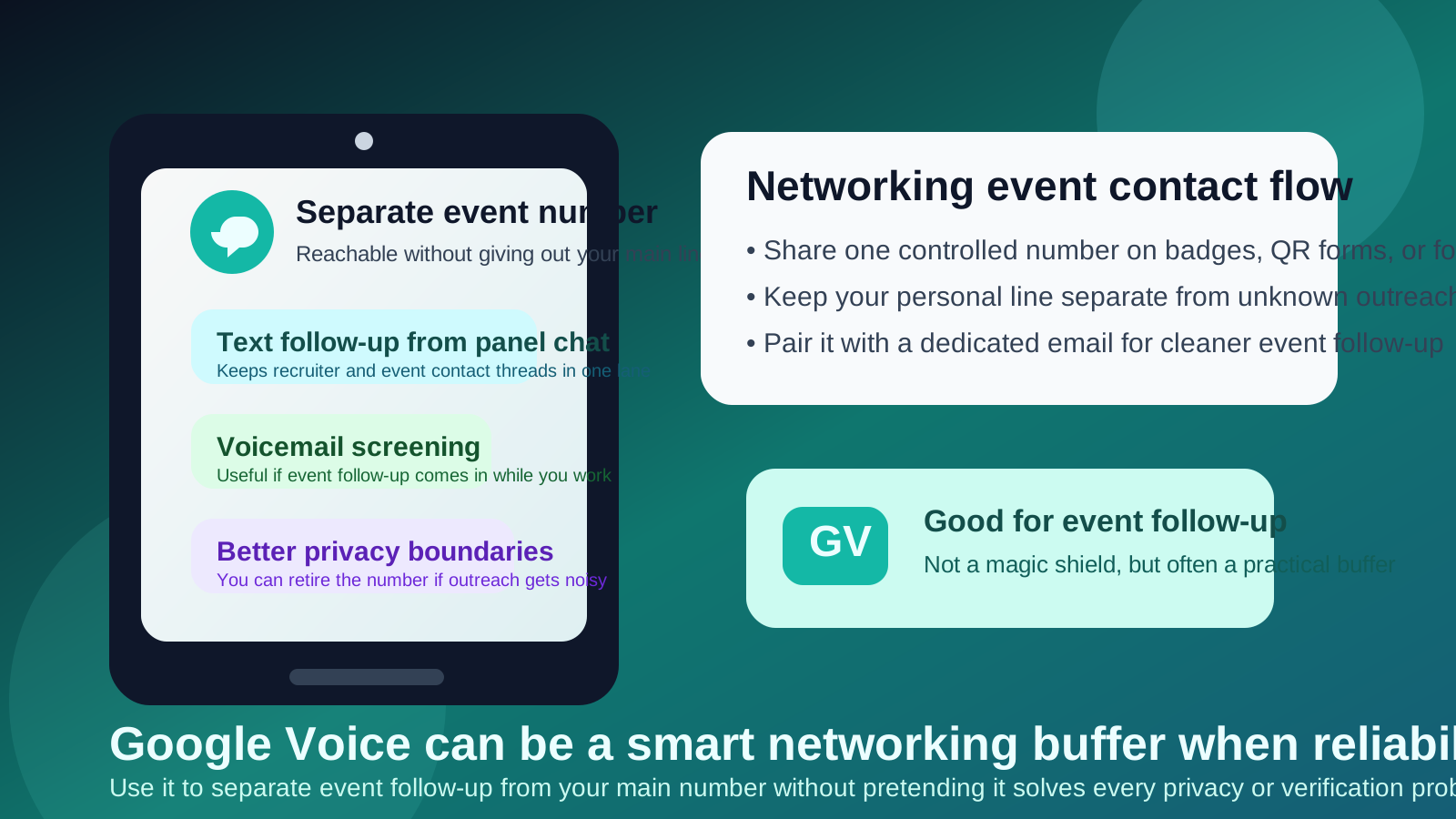
This is the main advantage. You do not need to hand out your primary mobile number just because you want to be responsive. A separate Voice number can handle initial follow-up, scheduling, and basic screening while your real number stays in the background.
2. It helps you manage event follow-up more neatly
Networking works when follow-up is fast and organized. If one number is reserved for event contacts, it becomes much easier to see which messages came from conferences, meetups, alumni mixers, community groups, or job-search events. That alone reduces clutter and makes you less likely to miss a useful reply.
3. Voicemail can act as a filter
Not every new contact deserves instant access to your full attention. A separate number lets you screen unknown calls, check voicemail on your own time, and decide which contacts are worth deeper conversation. That is useful when some people are legitimate peers and others are just adding you to a sales pipeline.
4. It supports a cleaner privacy boundary
A networking event may feel informal, but the information exchange can be surprisingly sticky. People save numbers, add them to CRM tools, forward them to teammates, or reuse them months later. A separate Voice number gives you more control if that outreach becomes noisy. If you ever need to retire or de-emphasize the number, that is easier than untangling your main personal line from years of event follow-up.
What Google Voice does not magically solve
It is helpful, but it is not magic. Using Google Voice does not make you anonymous, invisible, or immune to spam. It simply reduces how widely your primary number spreads.
It will not stop every unwanted contact
If you give the Voice number to enough people, some of them will still overuse it. The privacy advantage is that the noise lands in a separate channel rather than your main line.
It may not fit every country, device, or workflow
Availability, calling behavior, and feature support vary by region and setup. Some people also prefer the reliability of their standard mobile number for time-sensitive calls. If you depend on flawless delivery for a specific situation, test your setup before a major event instead of assuming it will behave exactly how you expect.
It is not ideal for every verification step
Some event platforms, apps, or related services may prefer or require a standard mobile number for identity checks or account recovery. That does not make Google Voice useless. It just means you should not build your entire professional communication workflow around a number you have never tested with your real use cases.
It does not replace good judgment
If someone you met at an event immediately pushes you into suspicious links, odd payment requests, or off-topic urgency, the problem is not solved by the number alone. You still need normal caution and basic verification habits.
When Google Voice is probably the best choice
Google Voice makes the most sense when your goal is controlled openness. You want real people to reach you, but you do not want your main number everywhere.
It is often a strong choice if:
- you are actively networking for a job search or career pivot,
- you expect lots of recruiter or peer follow-up,
- you are attending conferences where badges, apps, or contact forms encourage broad sharing,
- you want a voicemail and text channel dedicated to networking, or
- you already separate your outreach identity across email, calendar, and browser profiles.
For example, if you already use a dedicated inbox or alias for event signups, adding a dedicated number creates a much cleaner overall workflow. That is where Anonibox and a separate phone strategy can complement each other naturally: one keeps early-stage email exposure under control, and the other keeps your main number from becoming the default destination for every event contact.
When you might want a different option
Use your main number when trust and simplicity matter more than separation
If you are meeting a small number of high-trust contacts, or you already know you want fast direct access without another layer to manage, your normal mobile number may be the better choice. Extra separation is useful only if you will actually maintain it well.
Use email-first follow-up when phone contact is unnecessary
Not every networking event needs a phone number exchange. In many professional settings, email or LinkedIn is enough for follow-up. If someone is unlikely to call or text you, giving a phone number at all may be unnecessary.
Use a stronger separation method if the event source feels low-trust
If the event is heavily sponsor-driven, list-harvesting, or generally sloppy about attendee data, even a separate Voice number may be more exposure than you want. In those cases, an email-first approach may be the safer starting point.
How to use Google Voice for networking events without making a mess
1. Test it before the event
Send yourself a text. Leave yourself a voicemail. Make sure notifications, forwarding behavior, and call alerts work the way you think they do. Do not discover the weaknesses of your setup while a useful contact is trying to reach you from a conference floor.
2. Decide where you will share it
You do not have to use the number everywhere. You might reserve it for business cards, QR forms, speaker follow-up, and one-on-one conversations, while keeping your main number for close colleagues or established contacts.
3. Keep the voicemail professional
A simple greeting with your name is enough. If a recruiter, event organizer, or interesting contact calls, your voicemail should make you sound reachable and organized, not temporary or evasive.
4. Pair it with a dedicated email lane
If the number is for networking events, the related email should ideally also be separate from your most personal inbox. That can be a dedicated mailbox, an alias, or a privacy-friendly workflow that keeps event signups and follow-up in one lane instead of scattering them across your life.
5. Review and prune regularly
After an event cycle ends, decide which contacts deserve to move into your core network and which ones can stay in the low-priority bucket. A separate number is most useful when you actually use it to maintain boundaries instead of letting everything pile up forever.
Good etiquette still matters
Using a separate number should not make you harder to work with. The goal is controlled accessibility, not fake accessibility. If someone sends a thoughtful follow-up, answer promptly. If you promised to send a resource or make an introduction, do it. Privacy tools work best when they support professionalism rather than substitute for it.
That means:
- replying within a reasonable time,
- keeping your message tone clear and professional,
- moving strong contacts to a more durable channel when appropriate, and
- not disappearing just because the number is easy to retire later.
Red flags to watch after sharing any event number
Whether you use Google Voice or your main number, a few follow-up patterns deserve caution:
- pressure to click unfamiliar links right away,
- requests for money, payment, or “registration fees,”
- messages that are far more sales-oriented than relationship-oriented,
- contacts who refuse to identify their company or purpose clearly, or
- messages that try to push you into another platform immediately without context.
A separate number helps contain the exposure, but it does not remove the need to verify who you are dealing with.
A simple decision checklist
Before using Google Voice for networking events, ask yourself:
- Do I want a separate number for career or event follow-up?
- Am I likely to share my contact details with many new people?
- Would missed calls or texts be a serious problem if the setup is not tuned correctly?
- Is email or LinkedIn enough for this event, or do I genuinely need a phone channel?
- Do I want to keep my main personal number out of event apps, rosters, and QR forms?
If most of those answers point toward separation, Google Voice is often a sensible choice.
Final answer
So, can you use Google Voice for networking events? Yes, and in many cases it is one of the better ways to balance privacy with reachability. It gives you a working follow-up number without pushing your main personal line into every event list, badge scan, and post-conference text thread.
Just use it deliberately. Test it first, keep the voicemail professional, pair it with a clean email workflow, and remember that it is a boundary tool rather than a guarantee. When used well, Google Voice can make networking follow-up feel much more organized without making you harder for the right people to reach.