Yes — a custom domain email can be a strong choice for informational interviews if you personally own the domain, the address looks professional, and you will keep it active long enough for real follow-up.
No — it is the wrong choice if the domain is tied to your employer, a side project you may abandon, or a fragile forwarding setup that could miss replies, calendar invites, or future introductions.
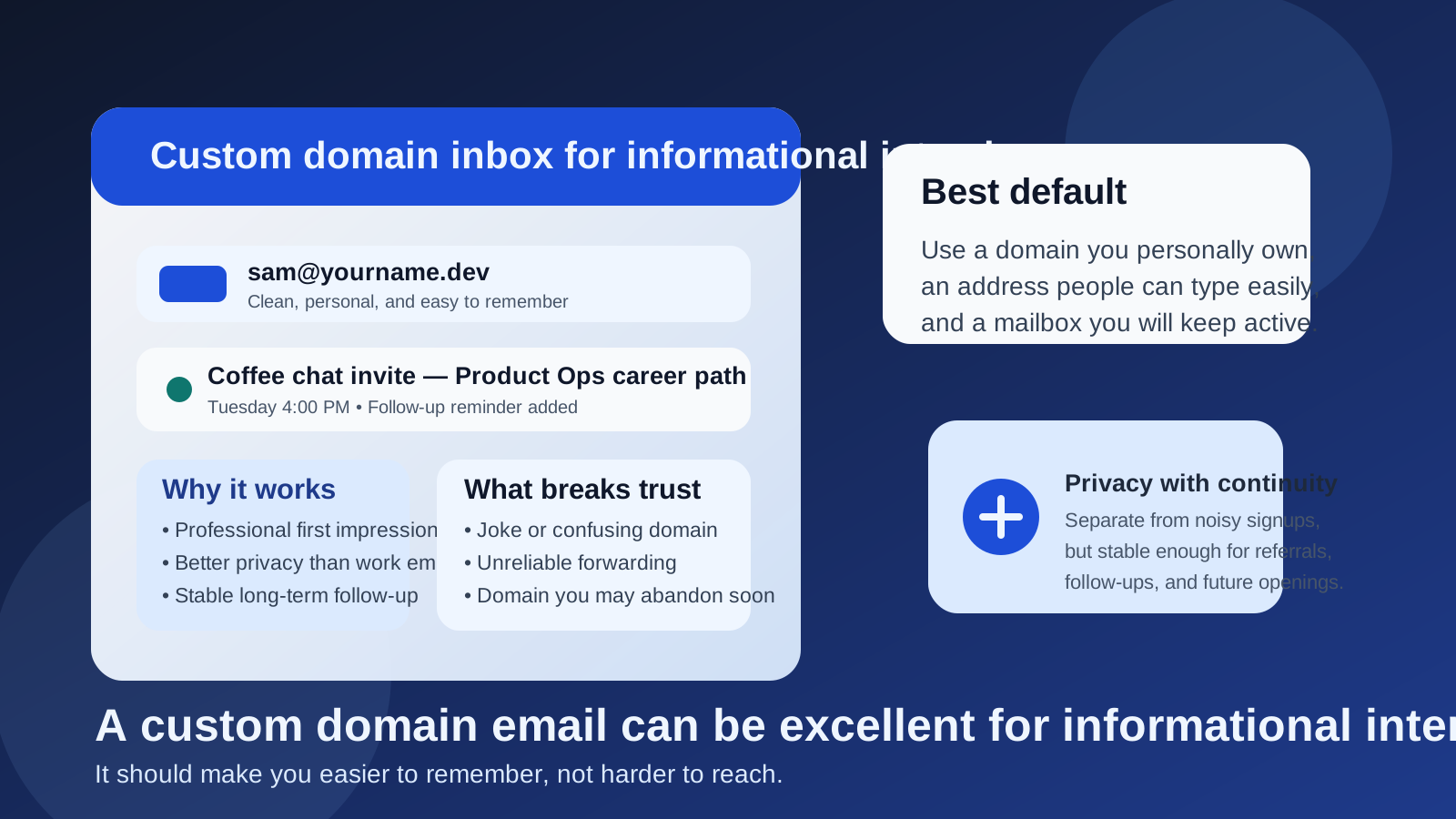
That is the real answer behind the search for should you use a custom domain email for informational interviews. Informational interviews live in an awkward middle ground. They are not anonymous signups, but they are not yet formal applications either. You are often reaching out to alumni, operators, founders, recruiters, managers, or people a step ahead of you in a career path you want to understand better. If the conversation goes well, it can turn into introductions, referrals, or a note months later saying a team has opened a role.
Because of that, your email address has to do two jobs at once. It should give you some privacy and separation from the rest of your online life, but it also needs to feel dependable enough for a real person to reply, schedule, and remember later. A good custom domain can do that beautifully. A bad one can make you look confusing, overly self-branded, or harder to reach than you intended.
Why this question matters more than people expect
Most people obsess over résumés, outreach messages, and coffee-chat questions, but the email setup underneath those conversations matters too. Informational interviews often begin with one short message, yet the value usually comes from what happens after that first exchange:
- a scheduling reply two days later
- a calendar invite for next week
- a follow-up resource list after the call
- an introduction to someone else on the team
- a future opening that appears long after the original conversation
That long tail is exactly why a throwaway inbox often falls short here. It is also why your email address should not create avoidable doubt. A custom domain can help if it gives you a clean identity and long-term control. It hurts if it makes the other person hesitate or if your own setup is unreliable.
What a custom domain email signals in an informational interview context
People rarely analyze email providers as deeply as anxious job seekers imagine. Most contacts are not grading you for choosing Gmail, Outlook, Fastmail, or your own domain. What they actually notice is simpler:
- Does the address look readable and professional?
- Does it feel like it belongs to a real person?
- Does it create unnecessary confusion?
- Will replying to it feel normal and low-friction?
A custom domain email can score well on all four. An address like hello@yourname.com or sam@yourname.dev can look thoughtful and memorable. It can also give you more control than using a work account, a school account you may lose access to, or a main personal inbox full of years of clutter.
But a custom domain also introduces risk when the domain looks too gimmicky, too salesy, too unfinished, or too closely tied to a side project that may not represent you well in a career conversation.
When a custom domain email is a good idea
1. You personally own the domain and plan to keep it
This is the biggest condition. If the domain is truly yours and you intend to renew it and monitor the inbox, a custom address can work very well for informational interviews. Stability matters more than cleverness. The best custom-domain setup is the boring one that keeps working months later.
2. The address is easy to read and type
Informational interviews are human conversations. If someone wants to forward your message or type your email manually into a calendar invite, your address should not feel like a puzzle. Short, simple, human-looking addresses are far better than long strings, extra punctuation, or unusual spelling.
3. The domain feels personal, not performative
A domain based on your name, a straightforward portfolio identity, or a neutral personal brand is usually fine. A domain that sounds like a joke, an aggressive startup pitch, or a half-abandoned side hustle can make the conversation feel less grounded.
4. You want separation without using temporary email
Many people want privacy but do not want to rely on a disposable inbox for a relationship that may continue. That is where a custom domain shines. It can give you some distance from your everyday inbox while still being stable enough for real follow-up.
When a custom domain email is a bad idea
Using a work-owned or employer-linked domain
This is usually the clearest no. If the domain is connected to your current employer, your consulting clients, or any identity you do not fully control, it is a poor fit for private career exploration. Even if nobody ever notices, you are adding unnecessary risk and overlap.
Using a domain you may stop paying for
Informational interviews can pay off later than you expect. If you might let the domain expire in three months, do not build networking relationships on top of it. A memorable address is only helpful if it still exists when someone wants to reconnect.
Using a forwarding setup you have not tested properly
Some custom-domain setups look polished on the surface but quietly break in normal use. Replies may land in spam, forwarding rules may be inconsistent, or calendar invitations may behave unpredictably. That is not just a technical annoyance. It can cost you real follow-up.
Using a domain that raises questions you did not mean to raise
If the domain sounds political, overly niche, joke-heavy, or closely tied to a specific product idea, people may wonder whether they are writing to a person or a brand. For informational interviews, that ambiguity is rarely helpful.
Custom domain email vs personal Gmail or Outlook
A normal Gmail or Outlook address is often perfectly fine for informational interviews. It is familiar, low-friction, and easy for people to trust. So the goal is not to prove that a custom domain is somehow universally better. The real question is whether it improves your setup enough to be worth it.
A custom domain is usually better than a generic inbox when:
- your main personal inbox is cluttered
- you want a cleaner long-term networking identity
- you care about controlling your address across providers
- you want privacy without looking temporary or disposable
A generic provider may be better when:
- your custom-domain setup is fragile or untested
- the domain looks odd or overly branded
- you are unlikely to maintain the domain consistently
- you already have a simple personal inbox that works well
Custom domain email vs temporary email
This distinction matters on Anonibox’s site because the two tools solve different problems. Temporary email is great for low-trust signups, gated downloads, career webinars, talent-network forms, or anything likely to create spam before you know whether the source is worth ongoing contact.
Informational interviews are different. You are usually hoping for continuity, not just one confirmation message. A temporary inbox may protect your main address, but it can also make you harder to reach later or make the conversation feel less durable than it should. In most cases, a custom domain email is a much better fit than a disposable inbox once you are talking to an actual person.
A good rule of thumb is this: use temporary email for noisy intake, and use a stable inbox for human relationships. A custom domain can be an excellent version of that stable inbox.
Best practices if you use a custom domain email for informational interviews
Choose a neutral, credible address
Keep it simple. An address based on your name is usually safest. If you use a portfolio domain, make sure it still sounds like a person someone would comfortably reply to.
Test the full workflow before you send outreach
Do not just confirm that you can send one message. Test replies, forwarding behavior, searchability, and calendar invites. If someone sends you a scheduling link or a meeting invitation, your setup should handle it cleanly.
Keep the mailbox active for the long haul
Check it regularly, even after a conversation seems finished. Informational interviews often create delayed opportunities, and those are easy to miss if you treat the inbox like a temporary experiment.
Use labels or folders for follow-up
A custom domain gives you control, but organization still matters. Keep a simple folder or label for informational interviews so thank-you notes, introductions, and future leads are easy to find later.
Avoid over-branding the rest of the experience
The point of a custom domain is to create trust and clarity, not to turn a coffee chat into a personal marketing funnel. Your signature, reply style, and subject lines should stay human and professional.
A quick checklist before you use it
- Do I fully own this domain?
- Will I keep it active for at least the next year?
- Does the address look simple and professional at first glance?
- Have I tested replies and calendar invites?
- Would this feel normal to a stranger who might forward my message internally?
- Am I choosing it for clarity and privacy, not just because it seems clever?
If most of those answers are yes, a custom domain email is probably a solid option.
Common mistakes to avoid
Treating memorable as more important than reliable
Being memorable is nice. Being reachable matters more. If you have to choose, choose the inbox that works every time.
Using the same domain for everything
If your domain is attached to a consulting business, newsletter, startup experiment, or public side project, think carefully before using it for informational interviews. The overlap may create context you did not intend.
Assuming custom means automatically more professional
Sometimes a plain Gmail address looks more trustworthy than a strange custom domain. Professionalism comes from clarity, consistency, and follow-through, not just from owning a domain.
Letting the domain lapse
This sounds obvious, but it is one of the easiest mistakes to make. If someone reaches back out six months later and the address is dead, the earlier polish no longer matters.
Final answer
So, should you use a custom domain email for informational interviews? Usually yes — if it is a domain you personally own, the address is simple and credible, and the inbox is stable enough for real long-term follow-up.
The best custom-domain setup gives you privacy and professionalism without making you harder to reach. If your domain is confusing, temporary, or technically fragile, a normal personal Gmail or Outlook inbox is often the better choice. But if you have a clean personal domain you control and actually maintain, it can be an excellent informational-interview email address.