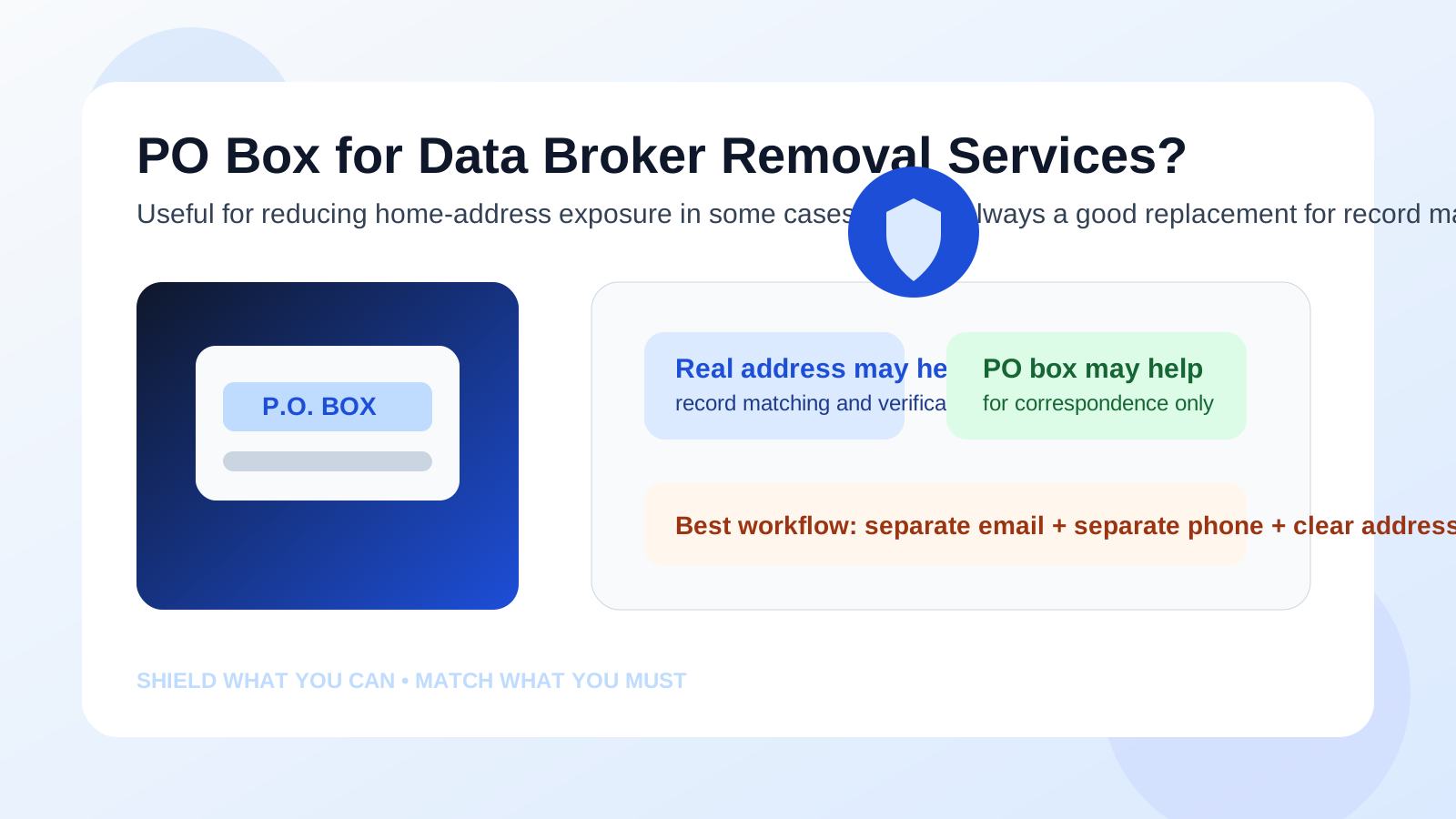
Usually not as your only address. A PO box can help reduce unnecessary home-address exposure in some data broker removal workflows, but many services still work best when they can use your real residential address to match, verify, or remove records tied to you.
If the service is asking for an address mainly for correspondence, a PO box may be reasonable. If it is asking for the address that appears in broker records, old listings, or identity checks, a PO box often makes the process less accurate rather than more private.
That is the real answer behind searches for po box for data broker removal services. People turn to data broker removal because they want less exposure, not more. So it makes sense to hesitate when a service asks for personal details like your home address. A PO box feels like a natural privacy shield. In some situations it is. In others, it gets in the way of the exact thing you are paying the service to do.
The key question is not simply “Is a PO box private?” The real question is what job the address is doing. If the address is being used to send mail or keep correspondence away from your home mailbox, a PO box can help. If the address is being used to identify the records that data brokers already have on you, then swapping in a PO box may weaken matching, create support friction, or leave records unresolved.
Why address choice matters for data broker removal
Data broker removal services often need enough information to search for you across people-search sites, marketing databases, and broker records. Those records may include combinations of your name, age range, email address, phone number, current address, and previous addresses. Your address is often one of the strongest matching signals, especially if you have a common name.
That is why the address question is more complicated than the email question. With email, a separate inbox or alias often works well because the communication channel is mostly about contact. With an address, the same field may be doing two different jobs at once:
- identity and record matching
- communication or correspondence
If you treat both jobs the same way, you can end up protecting the wrong thing while making the removal process less effective.
What a PO box can do well
1. Reduce direct exposure of your home address
If a service truly only needs a mailing address for account administration, invoices, or support correspondence, a PO box can keep your home address out of one more vendor profile. That can be worthwhile if your goal is to limit how many companies have your residence on file.
2. Create cleaner separation in a privacy workflow
Some privacy-conscious users like having separate contact layers: one email strategy, one phone strategy, and one address strategy. In that setup, a PO box can act like the physical-address equivalent of a separate inbox. It does not solve everything, but it can reduce unnecessary exposure in the parts of the workflow that are really about contact rather than verification.
3. Help when you expect paper follow-up
Some opt-out or identity-related processes still involve mailed notices, especially in edge cases, support escalations, or older workflows. If you want those communications going somewhere other than your residence, a PO box may make practical sense.
Where a PO box often falls short
It may not match the records brokers already have
This is the biggest limitation. Data brokers frequently index people by current and past residential addresses. If your removal service is trying to find listings tied to your real-world address history, entering a PO box instead can reduce confidence that a match is really yours. That matters most if your name is common or your records are spread across multiple addresses over time.
It can create confusion during verification
Some services may ask for supporting information because they need to confirm that the record belongs to you and not to someone with a similar name. A PO box does not necessarily help with that. In fact, it can slow things down if the underlying record points to a residence while the signup profile points somewhere else entirely.
It may give a false sense of privacy
A PO box can hide your home address from the service in some scenarios, but it does not erase the address data brokers already have. If the service still needs your real address to find listings or submit opt-outs accurately, using only a PO box may protect less than it appears to while making results worse.
It adds one more system to maintain
Privacy setups get messy when every layer becomes a separate account, separate number, separate box, and separate rule. If you are not organized, that complexity can backfire. The goal is better control, not a maze you stop checking three months later.
When a PO box is a reasonable choice
- the service clearly says the address is for correspondence or billing only
- you want paper communication kept away from your residence
- you already maintain a PO box and check it reliably
- the workflow does not depend heavily on residential-address matching
- you are separating contact details carefully across a broader privacy setup
In those cases, a PO box can be a sensible privacy layer. It is especially reasonable when the service is not using the address as a primary search key for broker records.
When you should probably use your real residential address instead
- the service is trying to find records tied to your current address
- you have a common name and need better matching accuracy
- you are dealing with people-search sites that heavily rely on address history
- the service asks for current and previous addresses as part of the search workflow
- support or verification would become confusing if the address does not line up
In those situations, using your real address may feel less comfortable, but it may also be the more effective option. The point of the service is to reduce exposure in broker databases, and sometimes that requires using the same identifiers those databases already use.
A better middle ground: use the right address for the right purpose
This is usually the smartest approach. Instead of treating the address field as all-or-nothing, think functionally.
If the service or form is asking for:
- a searchable identity signal — your real residential or prior address may be necessary
- a contact or correspondence address — a PO box may be fine
- both — you may need to provide each in the right field if the workflow supports it
That distinction matters because it lets you protect what can be protected without sabotaging record matching. It is the same mindset people use with email. Anonibox is useful when you want to avoid exposing your everyday inbox during low-trust signups or early comparisons, but a temporary inbox is not always the right long-term account for important follow-up. Address strategy works the same way: pick the layer that matches the actual job.
How to think about privacy without hurting results
1. Read the form labels closely
Do not assume every address field means the same thing. “Mailing address,” “current residential address,” “address used in public records,” and “billing address” can mean very different things in practice.
2. Prioritize matching when matching is the core task
If the service cannot find your records accurately, the privacy setup is not helping much. When the address is essential for record discovery, accuracy usually matters more than shielding that specific field from the provider.
3. Reduce exposure in the places that are optional
Even when you need to share a real address for matching, you can still tighten other parts of the workflow. A separate inbox, a dedicated phone number, and careful browser/profile separation may give you more practical privacy benefit than forcing a PO box into the wrong field.
4. Keep a clean record of what you used
If you provide a real address to one service and a PO box for another support-related workflow, document it. Privacy systems break down when you cannot remember which identity layer went where.
Common mistakes to avoid
- Using a PO box everywhere by default: easy to remember, but often not ideal for matching.
- Assuming a provider never needs your actual address: some removal workflows depend on it heavily.
- Ignoring previous addresses: older residential records may matter just as much as the current one.
- Protecting one field while neglecting everything else: inbox, phone, and browser habits often create more day-to-day exposure than people realize.
- Creating too many layers to manage: privacy only works if you can maintain the setup over time.
A practical decision checklist
- Is this address field for matching records or just for correspondence?
- Does the service ask for current or previous residential addresses specifically?
- Would a PO box make it harder to identify my records accurately?
- Do I actually monitor this PO box consistently?
- Would I get more benefit by protecting email and phone instead of forcing a PO box into this workflow?
If the address is central to finding your records, real-address accuracy usually wins. If the address is mostly administrative, a PO box may be a useful privacy layer.
Final answer
So, should you use a PO box for data broker removal services? Usually not as your only address. A PO box can be helpful when the service needs a mailing or correspondence address, but it often should not replace the real residential address used to find or verify the records you actually want removed.
The best approach is selective, not automatic. Use a PO box where it reduces unnecessary exposure without harming the workflow. Use your real address where record matching genuinely depends on it. Then tighten the rest of your privacy setup with separate email, separate phone, and careful account hygiene so you get the benefits of removal without creating new confusion for yourself.