Yes — in most cases, using a separate email for job applications is a smart move. It gives you better privacy, better organization, and less risk of turning your everyday inbox into a job-board dumping ground.
The best version is usually a stable inbox or alias you control, not your work email and not a throwaway inbox for serious applications. Temporary email can still help early on, but real applications usually need something more durable.
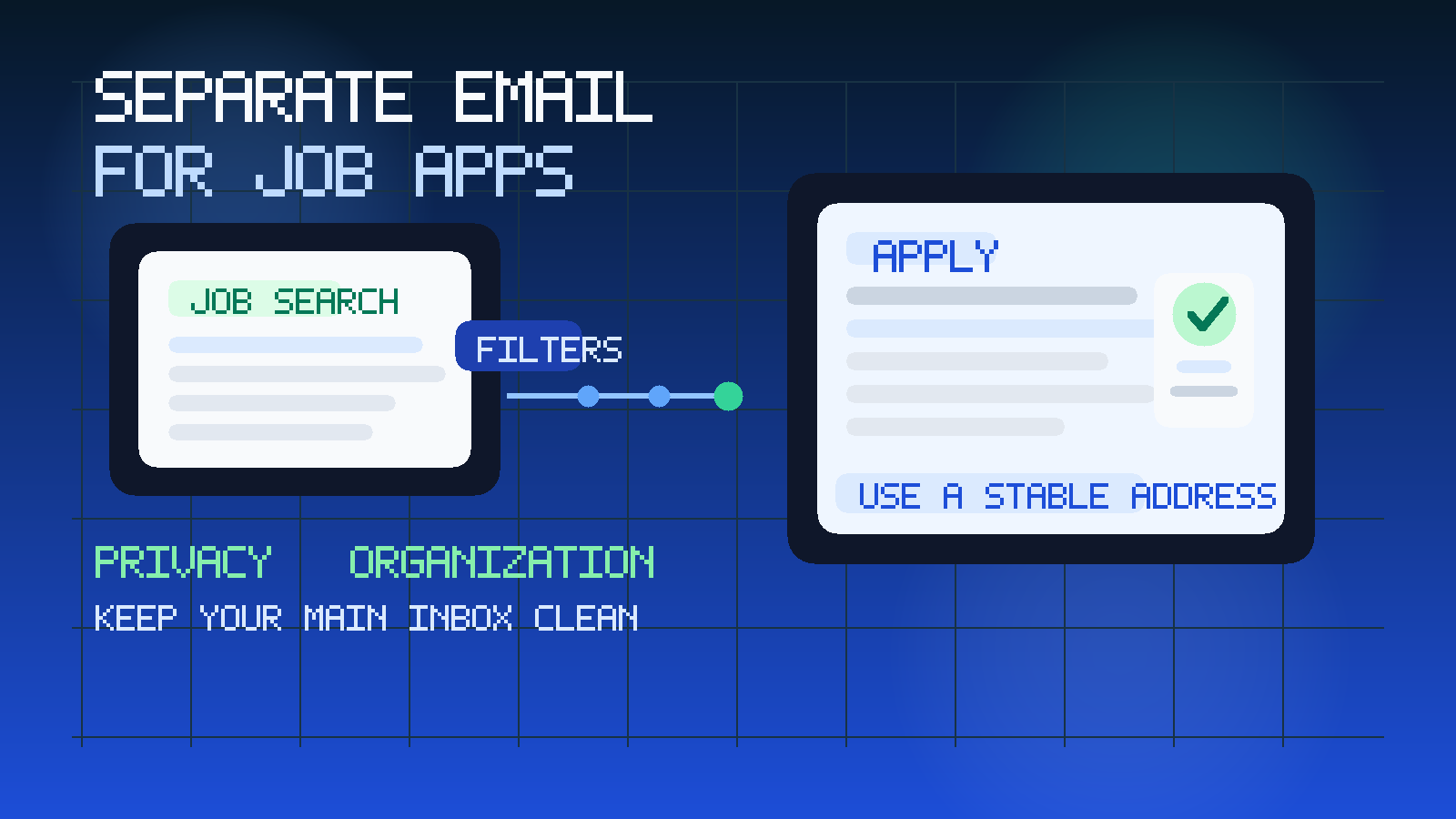
That distinction matters because job applications create more email than most people expect. Even a simple application can trigger confirmations, applicant-portal logins, assessment links, calendar invitations, recruiter follow-ups, job alerts, staffing messages, and marketing you never meant to sign up for. If it all lands in the same inbox you use for bills, family, shopping, and everything else, job searching becomes noisier and easier to lose track of.
A separate email gives you a cleaner system. It does not make you anonymous, and it does not eliminate job-search risk by itself. What it does is give you more control over where this activity lives, who gets your main address, and how easy it is to shut down the noise later. For a lot of people, that is enough to make the whole process feel more organized and less invasive.
Short answer: yes, a separate email is usually worth it
If you are applying to more than a handful of roles, using a separate email is usually the better choice. It helps you notice real recruiter replies faster, protect your primary inbox from long-tail spam, and keep your job search from bleeding into the rest of your digital life.
The important caveat is that “separate” does not always mean “temporary.” For serious applications, you want an address that is dependable for weeks or months. A separate mailbox or a professional alias is often ideal. A disposable inbox is better for early-stage testing, low-trust signups, or one-off job-board experiments.
Why a separate email helps during a job search
1. It keeps application messages from getting buried
Job searching is full of ordinary administrative messages that still matter: verification links, scheduling options, interview reminders, application-status updates, assessment deadlines, and password-reset emails for candidate portals. When those messages land in a crowded personal inbox, it is easy to miss one at exactly the wrong time.
A separate inbox creates a useful filter. If a message arrives there, it is probably related to your search. That alone makes prioritization much easier.
2. It limits how widely your main email spreads
When you apply through job boards, staffing portals, third-party applicant systems, and résumé databases, your address can travel farther than you think. Even if the original role is legitimate, the long tail of that exposure can include recruiter blasts, repeated alerts, and generic outreach months later.
A separate email gives you some distance between those systems and the address you use for everything else.
3. It makes search organization easier
If you are applying actively, organization stops being optional. A separate inbox makes it easier to use labels, folders, filters, or forwarding rules by company or by stage. That means less digging when you need to find a recruiter’s last message, the take-home assignment link, or the candidate portal invite from two weeks ago.
4. It gives you a cleaner exit later
Job-search spam often lingers after the search ends. If that traffic is tied to a separate email or alias, you can mute it, filter it more aggressively, or retire it altogether. That is much easier than trying to clean years of junk out of the main inbox you still depend on every day.
What kind of separate email should you use?
Not every separate-email setup solves the same problem. The right choice depends on how serious the application is and how much long-term communication you expect.
A dedicated personal mailbox
This is often the simplest option. It gives you a full standalone inbox for applications, recruiter replies, and interviews. If you expect a long or high-volume job search, a dedicated mailbox can be the cleanest setup.
An email alias
An alias works well if you want separation without managing a second mailbox login. The site already covers when an email alias makes sense for job applications, and for many people it is the best middle ground: stable enough for real employers, separate enough to protect the main address.
A temporary inbox
Temporary email still has a place, but mostly at the top of the funnel. If you are testing a new job board, unlocking a gated salary tool, or registering on a low-trust platform, a service like Anonibox can help you avoid giving away your long-term address immediately. That is why temporary email for job applications can be useful early, even though it is usually not the best home for ongoing employer communication.
When a separate email is especially worth it
- You are applying broadly. More applications usually means more inbox noise.
- You are using multiple job boards. Third-party systems increase the chance of long-tail spam.
- You want a confidential search. Separation helps reduce accidental exposure through previews, autofill, or mixed account habits.
- You are working with outside recruiters. Recruiter traffic can multiply quickly and become repetitive.
- You want better records. A dedicated inbox makes it easier to review which companies responded and which processes stalled.
It is also especially useful if you already know you dislike clutter. Some people can keep everything in one inbox and never miss a thing. Many cannot. A separate email is a small system change that removes a lot of avoidable friction.
When one email may still be enough
A separate email is usually helpful, but it is not mandatory for every single person. If your main personal email is already professional, lightly used, and easy to monitor, you may decide the extra separation is not worth the overhead.
The real question is not whether one inbox is theoretically possible. It is whether you can trust yourself to spot and manage job-search communication there without confusion. If the answer is yes, one inbox may be fine. If the answer is “probably” or “usually,” a separate inbox is safer.
What not to use for serious job applications
Your current work email
This is usually the clearest mistake. If the account belongs to your employer, your search activity lives on systems you do not fully control. The site already explains why using your work email for job applications creates unnecessary privacy and continuity risk.
A disposable inbox for late-stage hiring
Temporary email is great for low-stakes exploration. It is much less great when a recruiter needs to reach you next week, an applicant portal sends repeated logins, or an interview process stretches across a month. If losing access to that inbox would hurt a real opportunity, it should not be your only address for that role.
An unprofessional handle
The address does not need to be fancy, but it should be simple and credible. Name-based formats are best. Avoid joke names, random strings, or anything that looks like it came from a throwaway signup you will forget in three days.
Separate email vs temporary email: which is better?
They solve different problems.
- Temporary email is best for early experimentation, low-trust platforms, and one-off signups where long-term access may not matter.
- Separate email is best for real applications, recruiter conversations, interview scheduling, and any role you genuinely care about.
A sensible workflow is to use temporary email when uncertainty is high and switch to a stable separate inbox once the role or employer looks real. That keeps your main address protected without making you hard to reach.
A practical setup that works for most people
- Create one stable application address. Use a dedicated mailbox or a professional alias you control.
- Keep it simple. Your name or a straightforward variation is enough.
- Use filters or labels. Sort messages by company, recruiter, or stage.
- Check it daily. A separate inbox only helps if you actually monitor it.
- Use temporary email selectively. Keep it for low-trust signups, not serious hiring conversations.
- Retire or downgrade it later. Once the search is over, you can keep the inbox quiet without touching your main address.
If you want even cleaner separation, combine the separate email with a dedicated calendar or phone number. That is the same logic behind using a separate phone number for job applications: fewer personal channels exposed, less clutter everywhere else.
Common mistakes people make
- Using one address everywhere by default. This is convenient up front and annoying later.
- Overusing temporary email. Good for testing, risky for long processes.
- Checking the separate inbox inconsistently. Separation is useless if the messages still go unread.
- Switching addresses too late. Move to a stable inbox before the process gets serious.
- Focusing only on privacy and not on reliability. The best setup protects you without making you harder to contact.
Quick checklist before you apply
- Does this email look professional and easy to understand?
- Will I still control it months from now?
- Can I receive and reply reliably from it?
- Is it separate enough to keep my main inbox cleaner?
- Am I saving temporary email for low-stakes use instead of serious applications?
If the answer is yes across the board, you probably have the right setup.
Final answer: should you use a separate email for job applications?
Yes — for most people, a separate email for job applications is a smart, low-effort privacy upgrade. It helps you organize recruiter communication, protects your main address from overexposure, and makes the whole search easier to manage.
The best version is usually a stable inbox or alias you control. Use temporary email for early exploration when it makes sense, but keep serious applications tied to an address that can carry the conversation all the way through interviews, follow-up, and offer-stage communication.