Yes — for most applicants, using a separate email for trade school applications is a smart move.
It gives you a stable inbox for admissions updates, deadlines, financial-aid follow-up, interviews, and orientation details without dumping every inquiry, brochure, and reminder into your main personal email.
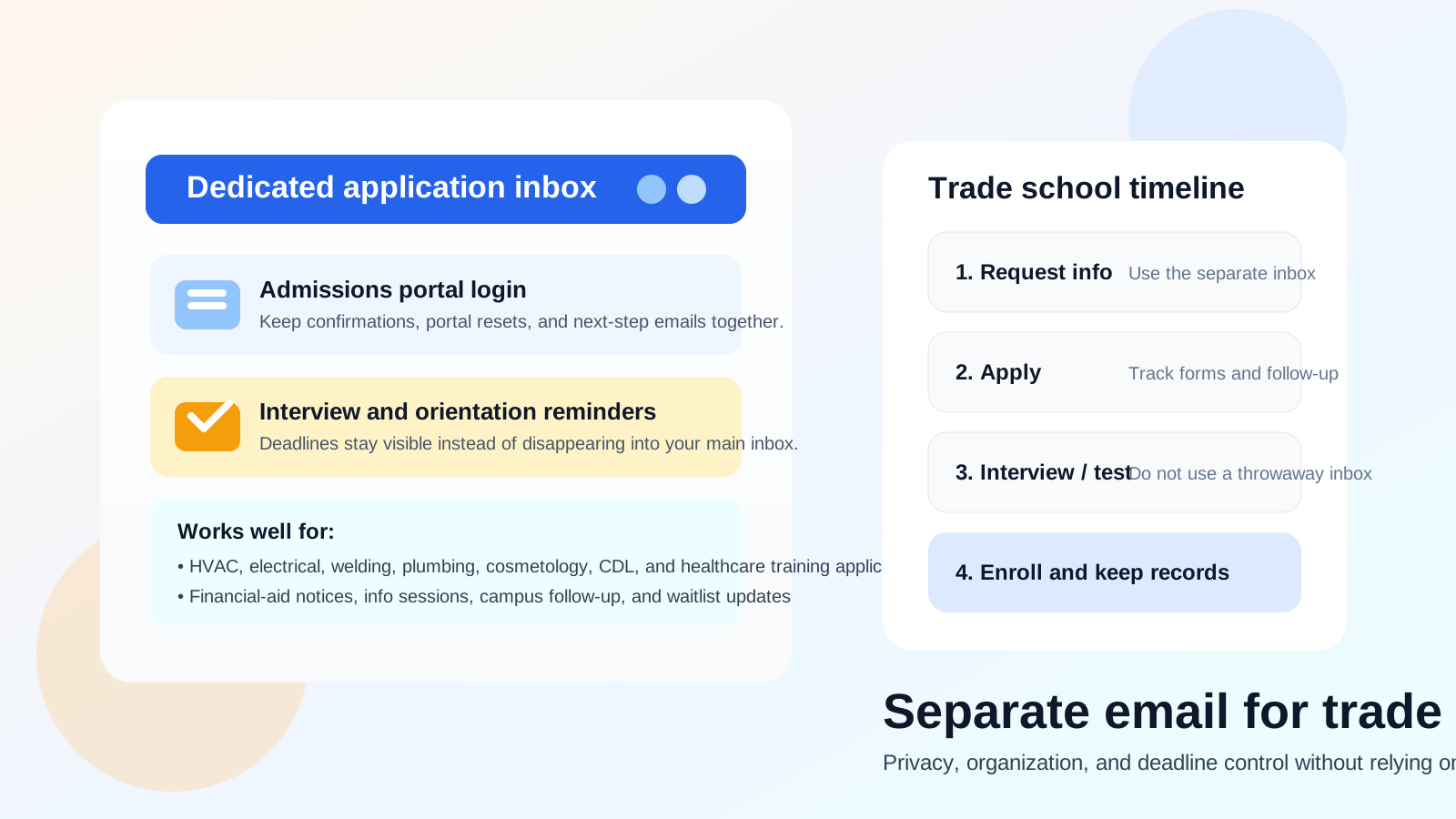
Why trade school applications create more email than people expect
Trade school applications often look simple at first. You request information, compare programs, ask about schedules, and maybe fill out one application form. In practice, the email volume can build fast. A single inquiry may trigger admissions follow-up, program guides, tuition information, campus-event reminders, financial-aid instructions, waitlist updates, placement questions, and repeated nudges to finish your application.
That is especially true if you are comparing several programs at once. Someone looking at HVAC, welding, electrical, cosmetology, CDL, plumbing, or healthcare-support training may contact multiple schools, private training providers, community colleges, and local program partners in the same week. Even when the messages are legitimate, the inbox clutter becomes real.
That is why the question matters: should you use a separate email for trade school applications? In most cases, yes. A separate long-term inbox gives you better organization and better privacy without the fragility of a burner address.
Why a separate email usually beats your main inbox
A separate application inbox solves two problems at the same time.
- It protects your main inbox from long-tail clutter. Inquiry forms, reminder campaigns, and broad school marketing do not have to live beside family mail, banking alerts, travel receipts, and everything else in your daily life.
- It keeps the application trail together. When interview invites, portal links, orientation details, and document requests all land in one place, you are less likely to miss something important.
That balance matters more than people think. The goal is not to be mysterious. The goal is to be organized and harder to overwhelm. A clean, dedicated inbox makes it easier to respond quickly, search old messages, and separate serious school communication from low-value noise.
Why a separate email is usually better than a temporary or burner address
For early low-stakes browsing, a temporary inbox can be useful. If you are only downloading a brochure, opening a one-time webinar link, or testing whether a form is worth completing, a tool like Anonibox can create breathing room. But once you move into real applications, the trade-off changes.
Trade school admissions can stretch over weeks or months. Schools may follow up later with:
- application confirmations,
- portal login instructions,
- document reminders,
- interview or assessment scheduling,
- financial-aid next steps,
- class start details, and
- orientation messages after you thought the busy part was over.
A disposable inbox is often the wrong tool for that. A separate email account keeps the privacy benefit of segmentation while still giving you continuity. That is the real advantage.
When using a separate email makes the most sense
A separate email for trade school applications is especially useful when any of the following are true:
- You are applying to more than one program. Comparing several schools creates enough email volume to justify a dedicated inbox on its own.
- You are still employed and want cleaner boundaries. Keeping training and career-transition messages out of your everyday inbox can reduce stress and make the process easier to manage privately.
- You are signing up for lots of information before deciding where to apply. Many schools use marketing-style follow-up even when the program itself is legitimate.
- You want a searchable paper trail. Tuition discussions, start dates, interview details, and required-document instructions are much easier to track when they are not buried under unrelated email.
- You expect a long cycle. Some programs reply quickly. Others take time, especially around cohort dates, seat availability, aid processing, or clinical / employer-placement coordination.
When a separate email may be unnecessary
If you are applying to exactly one well-vetted local program, you check your main inbox carefully, and you do not mind the extra exposure, your regular address may be fine. Not everyone needs extra setup.
Still, even in that simpler scenario, a separate inbox can make life easier. It is usually less about dramatic privacy risk and more about cleaner organization. Most applicants who expect more than one or two follow-up messages end up appreciating the separation.
How to set up the right inbox
If you decide to do it, keep the setup boring and dependable.
1. Use a real long-term mailbox you control
Choose an inbox you can keep for the full application cycle. This is not the place for something you might abandon in two weeks.
2. Pick a simple professional address
Use something straightforward, ideally based on your real name. You do not need to overthink branding. You just want an address that looks normal and is easy to read over the phone if needed.
3. Create a few folders or labels early
Examples might include:
- Applied
- Interviews / Assessments
- Financial Aid
- Enrollment / Orientation
- Ignore / Marketing
That tiny bit of structure pays off once several schools start replying at once.
4. Check it consistently
A separate inbox only helps if you actually watch it. If you are afraid you will forget, set notifications or forward copies into your main inbox while still keeping the dedicated mailbox as the source of truth.
5. Use the same inbox across the whole process
Do not start with one address, switch casually, then forget which schools have which contact details. Consistency reduces mistakes.
What should go into that inbox?
The separate mailbox is a good place for:
- request-information forms,
- application confirmations,
- portal and password-reset emails,
- interview or entrance-test scheduling,
- tuition and financial-aid communication,
- class-start and orientation reminders, and
- post-acceptance administrative follow-up.
In other words, use it for the whole school-application thread, not just the first click.
What to avoid
A few mistakes show up again and again.
- Do not use a work email. If you are exploring a career change or private training path, an employer-managed inbox is usually the wrong place for it.
- Do not rely on a fragile temporary inbox once the process becomes real. Early browsing is one thing; admissions follow-up is another.
- Do not let the separate inbox become an ignored inbox. Privacy is useless if it makes you miss deadlines.
- Do not assume every school lead form deserves your full personal data immediately. Share only what the stage actually requires.
A practical example
Imagine you are comparing three programs: an HVAC certificate, an electrical training program, and a welding school. In the first week you request brochures, attend one information session, and start one formal application. By the second week you are getting reminders to finish forms, a portal setup email, a request for supporting documents, and two invitations to speak with admissions staff.
If all of that lands in your main personal inbox, it competes with everything else in your life. If it lands in a dedicated application inbox, the process is much easier to manage. You can search by school name, star the messages that matter, and ignore the marketing-heavy reminders without losing the important stuff.
That is the real reason a separate email helps. It reduces friction.
Privacy and scam checks still matter
A separate inbox is helpful, but it does not remove the need for basic caution. Before replying or sending documents, check that:
- the school or training provider is clearly identified,
- the email domain matches the organization you expect,
- the program details are specific rather than vague,
- the message is asking for something reasonable at that stage, and
- you are not being pushed into strange payment, verification, or off-platform behavior.
If a lead form or promotional site feels low-trust, that is where a temporary inbox can be useful during the earliest research stage. But once you create a real applicant account, switch to the stable separate inbox you control for the rest of the process.
So, should you use a separate email for trade school applications?
Yes — for most applicants, it is the best balance of privacy, organization, and reliability.
It keeps your main inbox cleaner, gives you a dedicated place for deadlines and admissions follow-up, and avoids the risk of treating an important application process like a throwaway signup. If you are only doing light research, a temporary inbox may help at the edges. But for actual trade school applications, a separate long-term email is usually the smarter setup.
If you want the process to feel less chaotic and more controlled, this is one of the simplest improvements you can make.