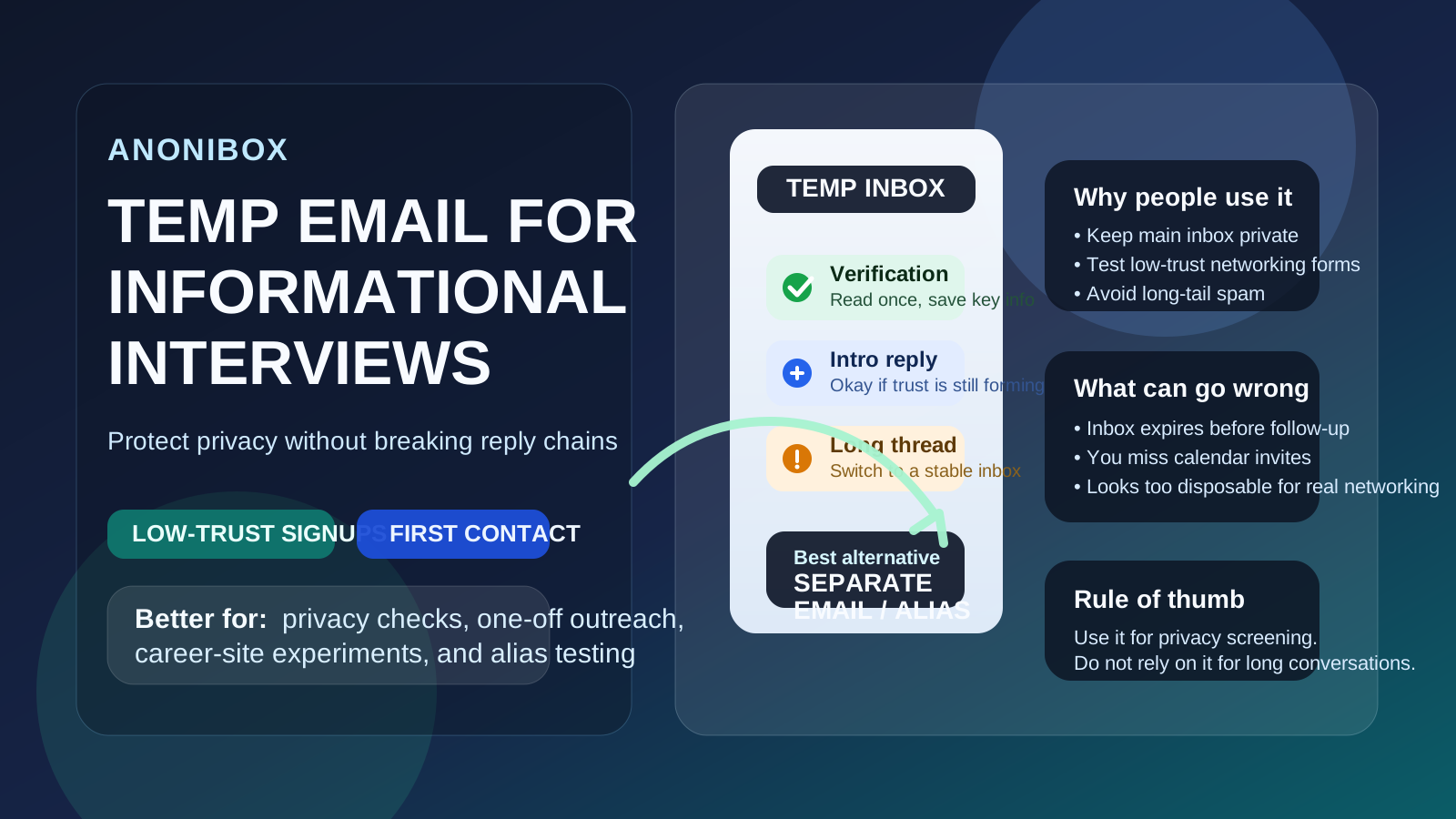
Usually, no—not as your only contact method. A temporary email can help protect your privacy during informational interviews, but a stable alias or separate inbox is usually better once you expect an ongoing reply chain.
If you only need a low-risk way to test a networking form, respond to a one-off outreach prompt, or keep your main inbox off unfamiliar platforms, a temporary address can make sense—but it should be used carefully.
Why this question matters
Informational interviews are different from formal job applications. You are not just sending one résumé and waiting for a yes or no. You are starting a conversation with a real person—often someone at a company you admire, a recruiter in your field, an alum, or a friend-of-a-friend who may reply days or weeks later.
That changes the email decision. A temporary inbox is good at shielding your main address from spam, sketchy forms, and low-trust exposure. It is not always good at supporting a professional back-and-forth that may include scheduling, follow-up questions, introductions, or future opportunities.
So the real answer is not “always use one” or “never use one.” The better question is: what stage of the informational interview process are you in, and how much continuity do you need?
When a temporary email can make sense
There are a few situations where using a temporary email for informational interviews is reasonable.
1. You are testing a low-trust networking form
Some career communities, networking directories, job boards, and event platforms ask you to sign up before you can message people or request coffee chats. If you are not sure whether the platform is worth keeping in your life, using a temporary address for that first signup can protect your primary inbox from future marketing clutter.
2. You want to separate early outreach from your main identity
Maybe you are exploring a career change quietly, networking while still employed, or reaching out in a niche field where you would rather not tie every experiment to your everyday email. A temporary inbox can give you a short buffer while you decide whether a conversation is worth continuing.
3. You are checking whether a contact path is even real
If you found a networking opportunity through a community page, conference attendee list, alumni tool, or a public profile that routes messages through a platform, a temporary address can help you verify that the contact flow works before you share the inbox you use every day.
In cases like these, a service such as Anonibox can be useful for the first step: verify the platform, receive the confirmation email, and keep your main inbox out of a system you do not trust yet.
When a temporary email is usually the wrong choice
Informational interviews work best when the other person sees you as thoughtful, organized, and easy to reach. That is where temporary inboxes start to show their limits.
1. You expect a real conversation
If someone replies with follow-up questions, asks for a better time next week, or offers to introduce you to someone else, an expiring address becomes a liability. Informational interviews often move slowly. People respond when they have time, not on your schedule.
2. You may need calendar invites or attachments
Even informal networking often turns into practical logistics: meeting links, rescheduled times, PDF guides, company resources, or a request to send your résumé later. Temporary inboxes are not ideal if you need dependable access to messages over time.
3. You want to look established and easy to trust
Most professionals will not inspect your email domain too closely, but some will notice if your address looks disposable, random, or unstable. Informational interviews rely on goodwill. You do not want your contact method to suggest that you may disappear after one message.
4. You are building a longer networking trail
The whole point of informational interviews is often what happens after the conversation: a second follow-up, a referral, a recommendation, or another introduction months later. A throwaway inbox is not built for that kind of relationship management.
The biggest risks of using a temporary email for informational interviews
Lost replies
This is the obvious one. People often answer informational-interview requests late. A contact might reply after a conference, after a product launch, or once they have a quieter week. If the inbox is gone, so is the opportunity.
Missed follow-up context
Networking conversations build on earlier messages. If you lose the original thread, you may forget what you asked, what they offered, or which angle you used when you reached out.
Lower professionalism in edge cases
A temporary email does not always look unprofessional, but it can look less intentional than a dedicated job-search inbox, a personal email you manage well, or a stable alias you control. In a competitive field, small trust signals matter.
Forwarding or platform restrictions
Some platforms block disposable domains. Others may accept them for signup but become unreliable later for notifications, password resets, or meeting updates. That friction may not matter for one click, but it matters a lot once a real person is waiting for your reply.
What is usually better than a temporary email?
If your goal is privacy and continuity, a temporary email is rarely the best long-term answer. Better options include:
- A separate email for networking and job search: You keep your main inbox clean without risking message loss.
- An email alias: You can protect your primary address while still receiving replies in a stable mailbox.
- A dedicated Gmail or Outlook account: Useful if you want clear separation and familiar tools.
- A custom-domain inbox: Overkill for some people, but strong if you want long-term control and a polished identity.
That is the key distinction: temporary email is best for screening; a separate inbox or alias is better for ongoing networking.
A practical rule of thumb
Use a temporary email for informational interviews only if you are still at the low-trust, low-commitment stage.
That might mean:
- signing up for an unfamiliar networking platform,
- checking whether a contact form actually works,
- testing whether an event organizer or community sends useful follow-up, or
- keeping your main inbox off a platform until you decide whether it is worth deeper use.
But once a real person responds—or once you are sending personalized outreach—a stable inbox is usually the smarter move.
How to use a temporary email without hurting your networking
If you decide to use one anyway, do it in a controlled way.
1. Use it only for the first checkpoint
Let the temporary inbox handle verification or the first low-risk contact path. Do not plan to keep it as the permanent home for a conversation you actually value.
2. Move promising conversations to a stable address fast
If someone replies with interest, shift the thread to a real inbox you control long term. You do not need to make it dramatic. A simple note works: “Thanks for replying—here is the inbox I monitor most consistently for scheduling and follow-up.”
3. Save important messages immediately
If you receive a useful introduction, scheduling suggestion, or resource, copy it somewhere safe right away. Temporary inboxes are fine for access, but they are weak as long-term records.
4. Avoid using disposable-looking names
Even when you use a temporary inbox, the display name matters. A clear real-name sender looks better than a string of random characters and helps the other person remember who you are.
5. Do not use a temporary email for every networking touchpoint
If every form, every event, and every outreach thread uses a different disposable address, your own process gets harder to manage. Privacy matters, but so does not creating chaos for yourself.
Red flags that make temporary email more reasonable
Sometimes caution is justified. A temporary email is more defensible when:
- the platform looks spammy or overly marketing-driven,
- you are forced to sign up before seeing whether messaging even works,
- the site has weak reputation or poor transparency,
- you suspect your information may be sold or overused, or
- you are exploring a field quietly and want to limit early exposure.
In those cases, protecting your main inbox first is sensible. Just do not confuse a privacy screen with a durable communication plan.
When you should definitely switch away from a temporary inbox
- Someone agrees to a meeting.
- You are discussing times, links, or follow-up notes.
- You are asking for introductions to other people.
- The contact may become a mentor, referrer, or hiring lead.
- You want to keep the relationship alive beyond one exchange.
At that point, a separate permanent inbox or alias is simply safer and more professional.
Quick decision checklist
Before using a temporary email for an informational interview, ask:
- Am I protecting myself from a low-trust platform, or am I trying to run a real relationship through a disposable inbox?
- Would I be upset if the reply arrived two weeks late and I lost it?
- Do I need scheduling reliability, attachments, or message history?
- Would an alias or separate email give me the same privacy with less downside?
If the answer to those questions points toward continuity, use a stable inbox instead.
Final answer
So, should you use a temporary email for informational interviews? Sometimes—but only for the earliest, lowest-trust part of the process. It can be useful for privacy screening, platform signups, and one-off testing when you do not want your main inbox exposed immediately.
For any conversation you genuinely care about, though, a temporary email is usually too fragile. Informational interviews depend on trust, reply reliability, and follow-through. In most cases, a separate email or stable alias gives you the privacy benefit you want without risking missed opportunities.
Use temporary email as a protective first layer, not as the long-term home for networking relationships.