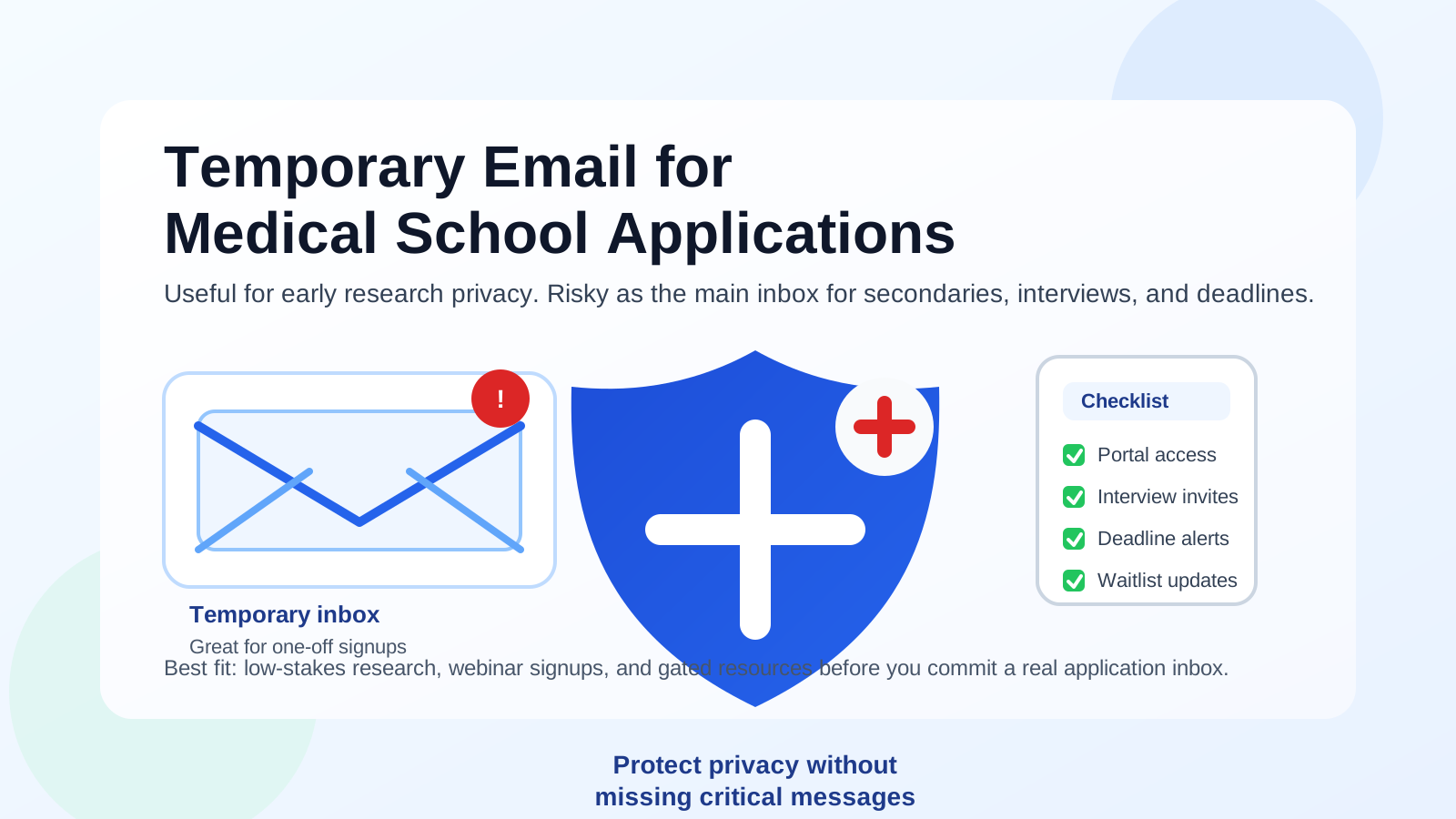
Usually no — not as the main address for real medical school applications. A temporary email can help with early research or low-stakes signups, but admissions timelines are too long and too deadline-sensitive to trust to a short-lived inbox.
If you are asking should you use a temporary email for medical school applications, the practical answer is to use one only at the edges of the process. It can protect your main inbox when you are downloading guides, joining mailing lists, or testing whether a school or premed resource will flood you with follow-up, but once secondaries, interview invites, portal resets, or waitlist updates enter the picture, a stable inbox is usually the safer choice.
Why this question matters more for medical school than for ordinary signups
Medical school applications are not one simple form followed by one confirmation email. Even before you get to decisions, you may deal with primary application services, school-specific secondaries, identity verification, school portals, deadline reminders, interview scheduling, technical notices, financial-aid communication, and waitlist movement. That is a lot of communication for one inbox to handle.
Because the process is so communication-heavy, the wrong email setup can cause two opposite problems. If you use your everyday personal inbox everywhere, it can become cluttered with marketing, reminders, and resource emails you never really wanted. But if you use something too disposable, you risk missing a message that actually matters. For medical school applications, reliability usually matters more than short-term convenience.
What a temporary email is actually good at
A temporary email is designed for short-term access. It is useful when you need to receive a confirmation link, a one-time code, or a quick follow-up without handing over your main address. That makes it a reasonable tool for low-stakes browsing around the admissions ecosystem.
For example, a temporary inbox can make sense when you want to:
- download a premed guide, checklist, or school brochure from a site you do not fully trust yet,
- register for a one-off webinar or virtual information session,
- join a mailing list to see whether a school or resource is useful before committing your real inbox,
- test a gated portal or third-party admissions tool before you rely on it seriously,
- avoid turning early-stage research into months of promotional email.
That is where a service like Anonibox fits naturally. It can help you protect your main inbox during the research phase, especially when you are sorting useful resources from noisy lead-generation pages.
Where a temporary email becomes risky
The problem starts when people try to use the same short-term tool for the actual application process. A medical school admissions cycle is simply too important and too extended for a fragile inbox to be your only contact point.
1. Medical school timelines are long
You might start with a primary application, then wait for secondaries, then wait for interview invitations, then wait again for decisions or waitlist movement. In some cases, important communication continues for months. A temporary inbox that felt convenient at the beginning may be inaccessible, forgotten, or poorly monitored by the time a real deadline arrives.
2. Important messages often arrive unpredictably
Admissions offices do not always communicate on a tidy schedule. One school may send a portal notice at noon, another may send an interview slot at night, and another may ask for one missing document on a short turnaround. If you are using an inbox built for temporary convenience, that unpredictability becomes a real risk.
3. Portal recovery depends on stable email access
Many schools and application systems use email for password resets, magic links, and account verification. If you lose easy access to the inbox you used, even a simple login issue can turn into a stressful support problem near a deadline.
4. Waitlists and financial-aid follow-up can take time
The communication burden does not end once you click submit. Waitlist updates, scholarship notices, loan paperwork, admitted-student instructions, and deposit deadlines may arrive well after the initial application work is done. That is exactly the stage when a temporary inbox is most likely to feel unreliable.
When using a temporary email can still be reasonable
There are a few situations where using a temporary email is sensible, as long as you keep it out of the core application path.
Early research
If you are still comparing schools, reading resource pages, and deciding whether a program deserves more attention, a temporary inbox can be a useful privacy buffer. You get the information you want without giving every form permanent access to your main address.
Low-trust marketing forms
Some sites around the admissions space look more interested in harvesting leads than helping applicants. If you only want a downloadable checklist, webinar replay, or newsletter sample, a temporary inbox is a practical filter.
One-off signups with no long-term value
If the interaction is clearly a one-time thing and you do not expect to need the address again, temporary email is much less risky. The key is being honest about whether it is really one-time or whether it could become the start of a longer communication chain.
When you should switch to a stable inbox
As soon as a school, platform, or application becomes real, you should move to an address you can trust for months. For most applicants, that means one of two options:
- A separate dedicated application inbox that you created specifically for medical school admissions
- A reliable email alias that forwards into an inbox you already monitor closely
Both options give you better continuity than a temporary address. They also make it easier to build filters, labels, and folders so you can find AMCAS, AACOMAS, TMDSAS, school portal, and interview emails quickly when the pressure goes up.
Temporary email vs separate inbox vs alias
If you are trying to choose the right privacy tool, the difference is mostly about continuity.
Temporary email
Best for quick, low-trust, low-stakes interactions. Weakest choice for an actual admissions cycle because access may be short-lived or inconsistent.
Separate application inbox
Usually the safest default for medical school applicants. It keeps the process organized, professional, and isolated from your personal inbox without creating the fragility of a throwaway address.
Email alias
A good middle ground if you want privacy and convenience together. An alias can hide your main address while still routing everything into a mailbox you already trust, but only if the setup is stable and tested well before deadlines matter.
For most serious applicants, the temporary option is best for research, while the separate inbox or alias is best for the real process.
A practical workflow that keeps privacy without creating risk
You do not have to choose one email strategy for every stage. A staged workflow is usually smarter.
- Use a temporary inbox for low-stakes discovery. That includes brochures, webinars, comparison tools, and random forms you are not ready to trust.
- Create a long-term application inbox before you submit anything serious. Once you know a school is on your real list, move it to a durable address.
- Keep that long-term inbox clean. Use labels or folders for primaries, secondaries, interview scheduling, financial aid, and admitted-student communication.
- Check the stable inbox constantly during active deadlines. Privacy is helpful, but responsiveness is what keeps opportunities alive.
- Do not switch addresses casually mid-cycle. Consistency reduces confusion for you and for admissions offices.
Common mistakes to avoid
Using a temporary inbox for the actual school portal
This is the biggest mistake. A portal account can become the center of your communication with a school. If the inbox tied to it is temporary, you may create avoidable recovery problems later.
Forgetting which address you used where
If you are applying broadly, track which email address is connected to each school or system. Otherwise, searching for an old message or reset link becomes much harder than it needs to be.
Optimizing for spam control over admissions reliability
Marketing email is annoying. Missing an interview invitation is worse. For real applications, the safer channel should win.
Assuming every admissions-related form deserves the same trust level
They do not. A random resource site, a webinar vendor, a school portal, and an official application service are not equal. Use stronger privacy filters for low-trust forms and stronger continuity for official communication.
A quick checklist before you use a temporary email
- Is this just early research, or is it part of a real application workflow?
- Could I still need access to this inbox months from now?
- Would missing one email cost me a secondary, interview slot, or document deadline?
- Will this address be tied to a portal or password reset flow later?
- Would a dedicated application inbox solve the privacy problem more safely?
If several answers point toward long-term importance, a temporary inbox is probably the wrong tool for that step.
Examples of good and bad use
Good use: you want to download a “how to compare medical schools” guide from a third-party site and do not want weeks of follow-up marketing. A temporary inbox is reasonable.
Borderline use: you are testing a school’s information-session signup and are not sure whether you will apply. A temporary inbox can work briefly, but switch if you decide to engage seriously.
Bad use: you submit a real medical school application, create a school portal account, and rely on a short-term inbox for secondaries, password resets, and interview scheduling. That creates more risk than the privacy benefit is worth.
Bottom line
Usually no — a temporary email is not the best main address for medical school applications. It is useful for early research, low-trust forms, and one-off signups, but the real admissions process is too long and too communication-heavy to depend on a short-lived inbox.
If you want privacy, use temporary email as a filter at the beginning, then move serious schools and official application steps to a stable separate inbox or a well-tested alias. That gives you the best of both worlds: less spam in your main mailbox and far less risk of missing a message that could affect your application.