Usually yes — Addy.io can be a very good fit for data broker removal services if you want to keep your main inbox out of the first exchange while still keeping stable access to verification emails, scan updates, support replies, and renewal notices.
It works best as a durable alias layer, not as a disposable inbox, and a separate full mailbox may still be better if privacy-management accounts become an important long-term system for you.
That is the practical answer behind searches for addy.io for data broker removal services. On paper, the email decision seems minor. In practice, it shapes how much exposure you create, how easy the account is to manage, and whether you can still find important messages months later. Data broker removal services often send more than one confirmation email. They may also send support replies, dashboard notices, scan summaries, billing reminders, renewal messages, and progress updates over time.
If you sign up with the wrong address, you create one of two problems. Either you expose a primary inbox you did not want to hand to another provider, or you use something too disposable and risk losing access to messages you later realize matter. Addy.io sits in the middle in a way that can work very well for this use case.
Why the email choice matters for data broker removal services
People use data broker removal tools because they want less spread of personal information, not more. That is what makes the inbox choice more than a housekeeping detail. If the service sees the same long-lived personal email you use across shopping accounts, old subscriptions, family logins, password resets, and years of random online activity, you are expanding exposure of one of your most persistent identifiers.
At the same time, this is not always a true throwaway relationship. Some people compare several services and quickly move on. Others keep one service for months or years. That means the account may need continuity. If you lose the confirmation thread, forget where the support replies went, or cannot find the renewal notice later, the privacy tool becomes harder to manage.
The sweet spot is usually an address that limits unnecessary exposure while still preserving reliable long-term follow-up. That is exactly where alias-based workflows become useful.
Why Addy.io fits this use case well
1. It keeps the provider from seeing your main inbox directly
The most obvious benefit is still the most important one. Instead of giving the service your everyday personal address, you give it an alias. That does not make you anonymous, and it does not create any magical privacy guarantee. But it does reduce the amount of unnecessary direct exposure of a core identifier you probably use elsewhere.
For a privacy-focused service category, that is a meaningful upgrade over casually reusing the same main inbox everywhere.
2. It is better suited to ongoing follow-up than a temporary inbox
Temporary inboxes are useful for low-commitment testing. They are less useful once the account may matter later. Data broker removal services often involve timelines that extend beyond the first click. You may need to revisit settings, confirm notices, read support messages, or check account status again later.
An alias workflow keeps the provider from seeing your main address while still giving you a durable channel for future email. That makes Addy.io much more practical than a short-lived inbox when the relationship may continue.
This is where Anonibox still fits naturally in the overall process. If you are only comparing sign-up friction or checking whether a service immediately creates a lot of marketing follow-up, a temporary inbox can be useful during evaluation. Once you decide a service is worth keeping, a stable alias setup is usually the cleaner long-term move.
3. One alias per provider keeps things organized
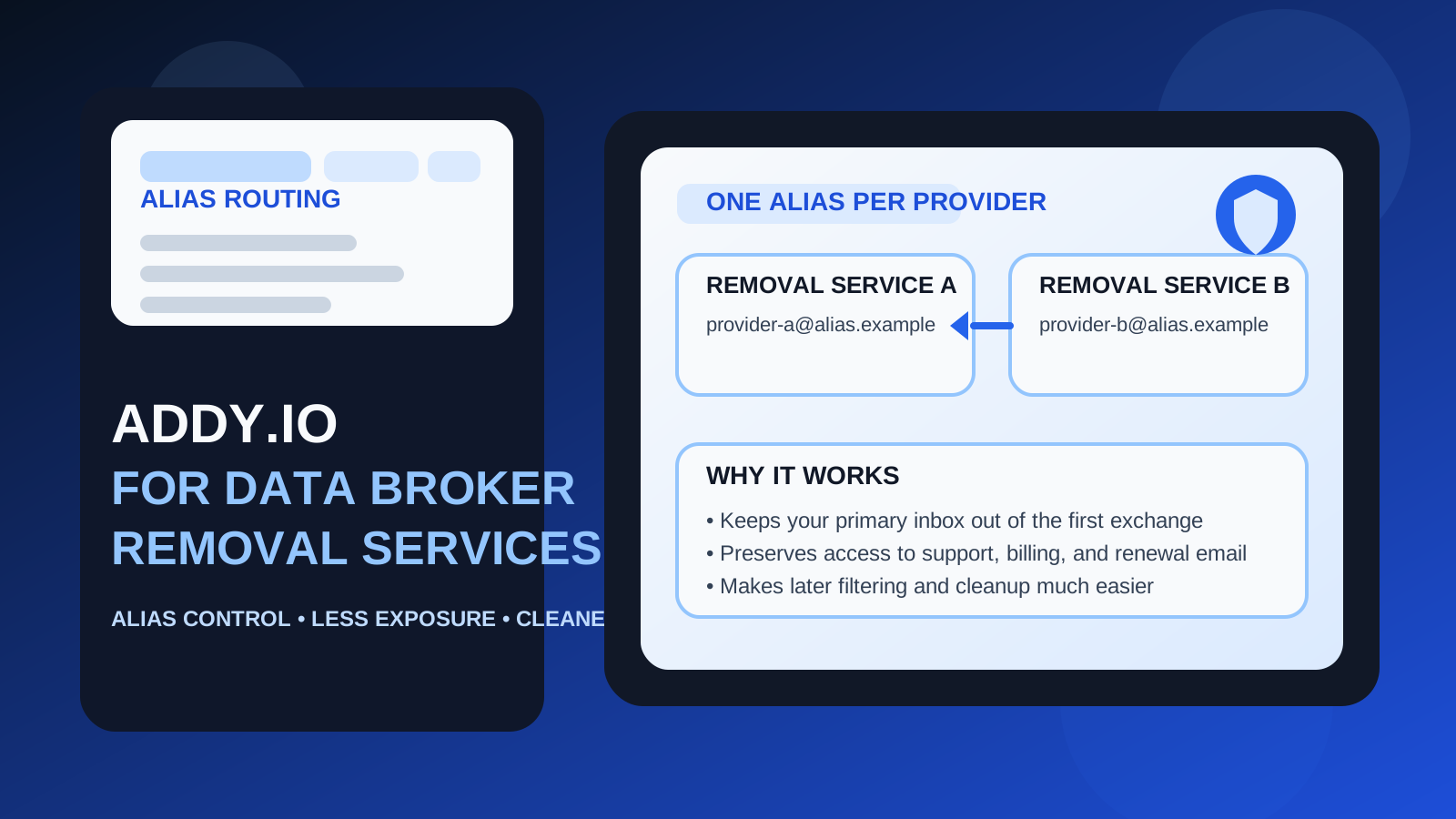
A big advantage of alias-based setups is separation. If each removal service gets its own alias, you can tell exactly which relationship produced which email. That makes inbox rules easier, support threads easier to trace, and later noise easier to diagnose.
Instead of one messy category called “privacy stuff,” you can keep a cleaner structure such as:
- one alias for provider A
- one alias for provider B
- one alias for account-monitoring notices
- one alias for future testing or comparisons
The more deliberate the routing is, the easier it is to manage the category without sending everything into your main daily inbox.
4. It can make later cleanup easier
If a service turns out to be noisy, unhelpful, or no longer relevant, an alias setup can make cleanup simpler. Instead of changing your identity everywhere, you can retire or adjust the alias strategy for that provider. That is a small operational benefit, but it matters in privacy workflows where you want control over how relationships persist.
5. It is a more realistic middle ground than “just open another account for everything”
Some people absolutely do want a fully separate mailbox for privacy services, and in some cases that is the best answer. But many people do not want to manage several full inboxes. Addy.io can be a strong middle option: more private than using a primary personal address everywhere, but lighter than opening and maintaining a completely separate mailbox from day one.
Where Addy.io can fall short
It is still an alias layer, not a fully separate mailbox
This is the main limitation to keep in mind. Aliases help shield the address the provider sees, but your messages still end up somewhere. If that destination inbox is cluttered, neglected, or badly organized, the alias system does not fix that by itself.
If you want an entirely separate environment for privacy-management accounts, a dedicated mailbox may feel cleaner and easier to reason about long term.
You still need to maintain the workflow
Alias strategies work best when you actually label messages, save important notices, and remember which address belongs to which provider. If you create aliases casually and then never organize the resulting mail, the benefit drops quickly.
It can become overcomplicated if you overengineer it
Privacy workflows are supposed to reduce chaos, not create it. If you build a maze of aliases, labels, forwards, and notes that you cannot remember six months later, the system starts working against you. The right setup is the one you will realistically maintain.
Some accounts may deserve a dedicated inbox instead
If a specific service becomes important enough that you rely on it for long-term monitoring, subscriptions, support history, and recurring renewals, it may eventually deserve its own separate mailbox rather than just its own alias. That is not a failure of Addy.io. It is just a sign that the account category became more central than it first looked.
Addy.io vs temporary email for this job
This is where people often choose the wrong tool.
A temporary inbox is excellent for quick evaluation. It helps when you want to inspect sign-up friction, collect one verification email, or avoid immediate marketing clutter while comparing providers. But disposability is also the weakness. If the account still matters later, a throwaway inbox can turn into a problem.
Addy.io is better when the goal is stable separation rather than one-time access. It lets you protect your main inbox while preserving a communication path you can still use later. For data broker removal services, that distinction matters a lot.
When Addy.io is a smart choice
- you want to avoid sharing your main inbox directly with another privacy vendor
- you still need reliable access to account email later
- you prefer one alias per provider for clean organization
- you want something more durable than a temporary inbox
- you do not want the overhead of managing a fully separate mailbox for every privacy-related service
In those situations, Addy.io is often a strong fit.
When a separate mailbox may be better
- you want all privacy-management accounts isolated in their own full inbox environment
- you expect a long support trail, recurring billing, and years of follow-up
- you manage removal services for more than one person
- you do not want important account access to depend on a forwarding-style workflow
- you already know this category is important enough to deserve its own system
There is nothing wrong with starting with an alias and later moving to a separate mailbox if the relationship becomes more permanent than expected.
How to use Addy.io well for data broker removal services
1. Use a unique alias for each provider
Do not lump several services into one shared alias if you can avoid it. Provider-specific addresses make later filtering and cleanup much easier.
2. Test the routing before signup
Send a quick message through the alias and confirm it lands where you expect. That simple check can prevent confusing account-recovery or verification issues later.
3. Create labels or filters immediately
The first welcome email is the right time to set up a folder, label, or rule. Do not wait until the inbox gets messy. Privacy workflows become much easier when the messages are organized from the start.
4. Save the messages that actually matter
Verification emails, receipts, billing notices, major support replies, and renewal reminders are worth keeping easy to find. The goal is not to archive everything forever. The goal is to avoid losing the few messages that matter.
5. Reassess if the service becomes long-term
If you are still using the service a year from now, pause and ask whether the alias setup is still the right long-term home. Sometimes the best evaluation setup is not the best permanent setup.
Common mistakes to avoid
- Using your oldest personal inbox by default: convenient, but usually more exposure than you need.
- Using a disposable inbox for an account you may keep: fine for testing, risky for continuity.
- Reusing one alias everywhere: that removes a lot of the organization benefit.
- Ignoring the destination inbox: an alias system still depends on a mailbox you check and manage.
- Making the setup too clever: a simple system you maintain is better than a perfect system you forget.
A quick decision checklist
- Do I want to hide my primary inbox from this provider?
- Will I still need access to notices, billing, or support messages later?
- Would one alias per provider make this category easier to manage?
- Am I evaluating casually, or am I opening an account I may keep?
- Would a separate full mailbox make more sense for how important this category is becoming?
If you mainly want durable separation without giving up long-term access, Addy.io is usually a very sensible choice.
Final answer
Yes — Addy.io is often a smart choice for data broker removal services. It gives you a better privacy boundary than using your primary inbox directly, while still preserving the continuity that makes these accounts practical over time.
Just keep the limits in mind. It is not a disposable inbox, not a guarantee of anonymity, and not a replacement for a well-managed destination mailbox. But if you want provider-specific aliases, lower inbox exposure, and a cleaner privacy workflow, it is one of the more practical options for this use case.