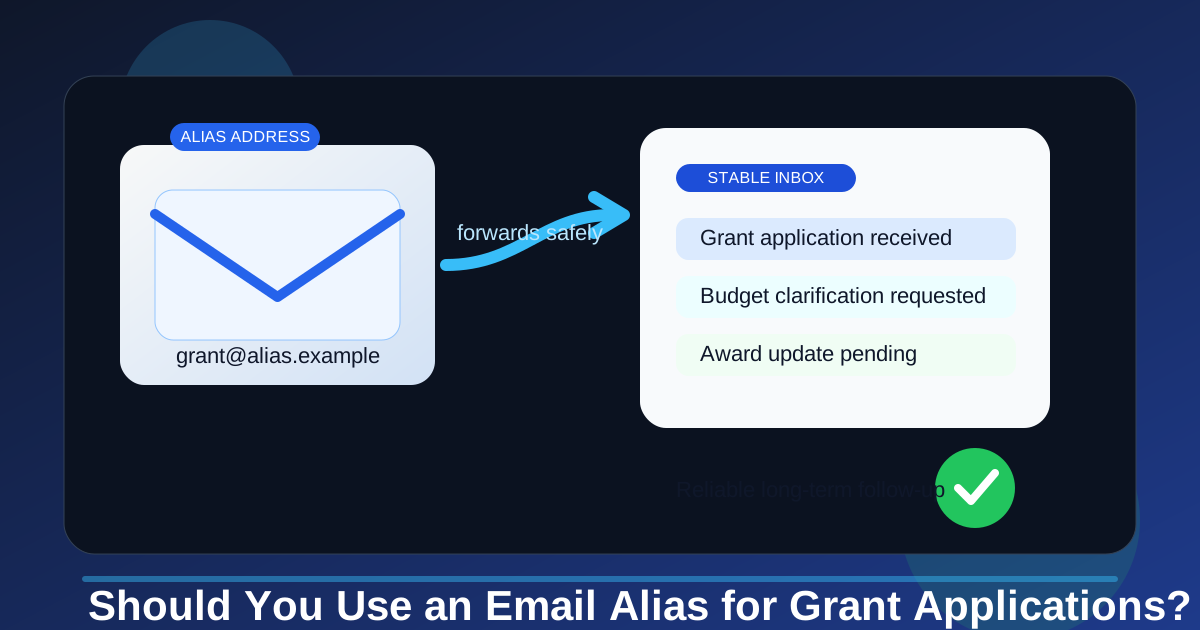
Usually yes, if the alias forwards reliably into an inbox you check often. For grant applications, an email alias is often a smarter privacy tool than a temporary inbox because grant timelines can stretch for weeks or months.
The key is simple: use an alias that routes into a stable long-term mailbox you control, not a disposable address you might lose before reviewer questions, clarification requests, or award updates arrive.
Why this question comes up
Grant applications often involve a strange mix of sensitivity and uncertainty. You may be applying for research funding, nonprofit support, artist grants, community projects, startup programs, travel grants, or education-related funding. Some opportunities are legitimate and well run. Others are noisy lead funnels, poorly organized forms, or broad calls for applications that generate follow-up you may not want tied to your main personal inbox forever.
That is why people start looking for privacy-friendly contact options. They want to stay reachable without handing their primary address to every funder, grant directory, and partner form they touch. An email alias can be a very practical middle ground.
Short answer: an alias is often a good fit for grant applications
In most cases, an email alias works well for grant applications because it gives you separation without sacrificing continuity. Grants are rarely one-click interactions. Even after you submit the application, you may receive confirmation emails, requests for revised documents, scheduling notes, finalist interviews, budget clarifications, compliance reminders, or award notifications later.
That long timeline matters. A true temporary inbox can be too fragile for something this important. A fully separate long-term mailbox also works, but it requires more setup and more inbox management. An alias often gives you the organizational benefits of a separate address while still delivering everything into the mailbox you already trust.
What an email alias actually helps with
An alias is useful because it changes the address other people see without forcing you to build an entirely separate communication habit. If your alias forwards into a dependable inbox, you can keep grant-related messages in one lane while preserving the search history, filters, and daily monitoring you already rely on.
That can help with:
- Inbox organization: grant confirmations and follow-up messages are easier to filter and label.
- Privacy: your primary address is less exposed to sponsor lists, partner mailing lists, and future promotional follow-up.
- Noise control: if one grant source becomes spammy, you have a cleaner way to trace and manage the exposure.
- Professionalism: a sensible alias can still look credible and easy to reply to.
Why an alias is often better than a temporary inbox for grants
Temporary email tools are great for low-trust signups, quick tests, and one-off forms where the main goal is avoiding long-term spam. Grant applications are usually different. They involve real deadlines, real stakes, and follow-up that may not arrive on the same day you apply.
That is the main reason an alias is usually safer than a disposable address here. With a reliable alias, you can protect your main address from unnecessary exposure while still keeping continuity. If a program officer writes back in three weeks asking for a revised budget attachment, you want that message landing in a mailbox you still monitor carefully.
Put differently: grants are closer to a long-running professional workflow than a throwaway sign-up. You want privacy, but you also want durability.
When using an email alias for grant applications makes the most sense
An alias is often a strong choice if any of these are true:
- You are applying to multiple grants and want all funding-related communication separated from your everyday inbox.
- You expect follow-up but do not want your main address added to every sponsor newsletter or partner database.
- You already have a stable inbox and just need a cleaner front-facing address for applications.
- You want to identify which directories, grant portals, or organizations generate the most future email.
- You are working with collaborators and want a dedicated application-facing address without moving your whole workflow into another mailbox.
In these cases, the alias gives you a useful layer of control without making you less reachable.
When an alias may not be enough on its own
An alias is helpful, but it is not magic. There are cases where a full separate inbox is still better.
- You need strict separation: for example, you are applying on behalf of a nonprofit, client, lab, or side project and do not want the communication mixed with personal mail at all.
- Multiple people need access: a forwarding alias into one personal inbox may not be enough if a team needs shared visibility.
- You change aliases frequently and lose track: an overcomplicated alias setup can create confusion instead of clarity.
- Your forwarding is unreliable: if the alias service sometimes delays or drops mail, do not use it for important funding deadlines.
If the grant could trigger months of follow-up, legal paperwork, fiscal sponsorship questions, or award administration, a stable dedicated inbox may be the safer long-term home.
The biggest risks to watch for
1. Forwarding failure
The biggest practical risk is not that an alias looks unprofessional. It is that the forwarding chain breaks, filters incorrectly, or sends messages to spam. Before using any alias for important applications, test it with several sample messages and attachments.
2. Using an alias that feels disposable
If the alias looks obviously temporary, oddly random, or hard to repeat accurately, it can create friction. A clean, readable alias is usually better than something that screams “throwaway.”
3. Forgetting where replies land
Some people create aliases faster than they document them. Then a follow-up arrives and they cannot remember which project, funder, or form used that address. Keep a simple record of which alias you used where.
4. Treating an alias like a guarantee
An alias reduces exposure, but it does not guarantee privacy, security, or deliverability. If a funder shares your information internally or adds you to other systems, the alias helps contain the contact point, but it does not stop every downstream use.
How to use an email alias for grant applications well
- Pick one stable destination inbox. Your alias should forward into a mailbox you already monitor reliably.
- Use a readable alias. Something clear and professional is easier for humans and forms to handle.
- Test the forwarding first. Send yourself plain-text messages, HTML emails, and attachments before using it on a real application.
- Create a grant label or folder. If everything forwards into one inbox, filtering becomes the real organizational win.
- Save critical messages early. Archive confirmations, submission receipts, deadlines, and revision requests where you can find them quickly.
- Avoid switching mid-process unless necessary. If you need to move to a different address, tell the funder before you miss something important.
Alias vs separate email for grant applications
This is the trade-off many people are really deciding between. A separate email account gives stronger segmentation. Nothing else is mixed in, and the whole mailbox can be dedicated to grant work. That is great if you run a lot of applications or handle funding professionally.
An alias is lighter and easier. You keep one dependable inbox, but you present a separate address externally. For solo applicants, small nonprofits, creators, students, researchers, and side-project founders, that is often enough.
If you expect light-to-moderate grant activity, an alias is usually a practical sweet spot. If funding work is becoming a major part of your life or organization, a full separate inbox may be worth the extra structure.
Where Anonibox fits naturally
Anonibox makes the most sense earlier in the funnel, when you are exploring funding directories, downloading resource packs, testing low-trust forms, or avoiding long-term inbox clutter from broad discovery-stage signups. That is where temporary-email-style privacy tools shine.
When you move from casual exploration to a real grant application, continuity starts to matter more. At that stage, a forwarding alias into a stable inbox is often the better fit because it keeps the privacy benefit while reducing the risk of losing an important update later.
A practical example
Imagine you are applying to five grants over two months: one local arts fund, one startup accelerator microgrant, one university-affiliated program, one nonprofit capacity-building fund, and one travel grant. If you use your main personal address everywhere, your inbox may start collecting newsletters, program announcements, survey requests, and future calls for applications from all five sources.
If you use a well-tested alias that forwards into your main mailbox, you can keep those applications organized under one label, spot follow-up faster, and still reduce how often your primary address is exposed directly. If one source becomes noisy later, you can see exactly which contact path caused it.
That is the real benefit: not secrecy, but cleaner control.
Red flags and mistakes to avoid
- Do not use an alias service you have never tested for time-sensitive communication.
- Do not assume all grant opportunities are equally trustworthy just because they look official.
- Do not use a temporary inbox for a grant that may require follow-up weeks later unless you are absolutely sure you will keep access.
- Do not make your alias so complicated that you mistype it on forms or forget where it routes.
- Do not ignore spam-folder checks after submitting important applications.
Quick checklist before you decide
- Will this address still reach me if the grant process stretches out?
- Does the alias forward into a mailbox I already check daily?
- Have I tested replies, attachments, and deliverability?
- Do I need light separation or a fully separate mailbox?
- Am I optimizing for privacy only, or for privacy plus continuity?
If you need both privacy and continuity, an alias is often the right answer.
Final answer
Yes, usually. An email alias is often a smart choice for grant applications because it helps protect your main address from unnecessary exposure while still keeping important messages flowing into a stable inbox you control.
Just make sure the alias forwards reliably, looks professional enough for real communication, and is backed by a long-term mailbox you monitor closely. For grants, that balance matters more than trying to make every application contact point fully disposable.