Usually only in narrow situations. Discord can work for recruiter outreach when the recruiter and context are already clear, but email or LinkedIn is usually the safer first-contact channel.
If you are asking whether Discord is a good default for recruiter outreach, the short answer is no for most job seekers. It can be useful in community-heavy or technical spaces, but it exposes more of your personal online identity than email and makes it easier for scammy or low-quality outreach to feel legitimate.
Why this question comes up
Recruiter outreach does not always happen through polished corporate email anymore. Some recruiters work inside startup, gaming, creator, open-source, Web3, or developer communities where Discord is already part of daily communication. If you met someone in a server, joined a hiring event in Discord, or saw a recruiter invite people to message them there, using Discord can feel normal.
The problem is that normal inside a community is not always the same thing as smart for your job search. Recruiter outreach is often the very first step in a hiring conversation. Early-stage contact is exactly where privacy, professionalism, and scam detection matter most. A convenient direct message can save time, but it can also collapse boundaries you may want to keep.
Short answer: workable in community-native contexts, weak as a default
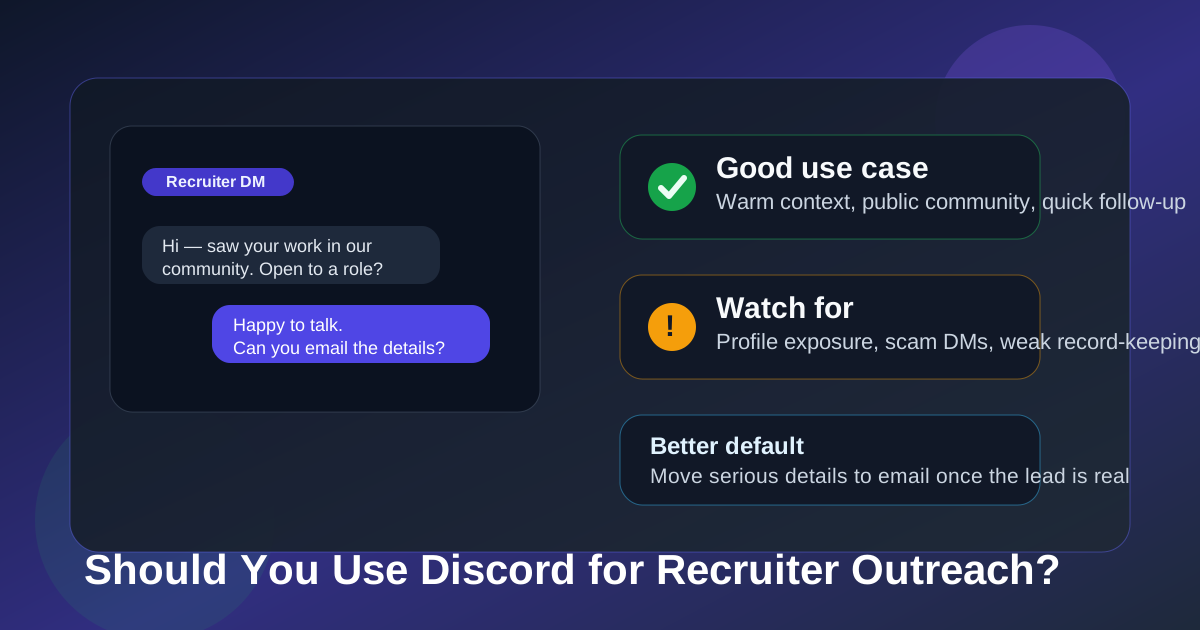
Discord is strongest when the outreach already has context. For example, maybe you and the recruiter are in the same event server, the role is tied to a community you already trust, or the conversation started publicly and moved to direct messages for quick follow-up. In those cases, Discord can be practical.
It is much weaker as a cold first-contact channel. If a stranger wants to recruit you through Discord before you have verified who they are, you lose some of the structure and distance that email naturally provides. That does not mean every Discord recruiter is fake. It means the burden of checking legitimacy shifts more heavily onto you.
The biggest privacy and professionalism risks
1. Your account reveals more than an email address usually does
A recruiter reaching out by email typically sees your name, address, and whatever you choose to include in your signature. On Discord, they may also see your username style, display name, avatar, shared servers, status habits, and the general tone of how you present yourself in online communities.
That is not automatically bad, but it is more personal. If your Discord presence is built around gaming, fandoms, private friend groups, memes, or niche communities, it may not match the impression you want to create during a job search. Even if you are comfortable with that, it is still worth treating as a deliberate choice rather than an accidental one.
2. Direct messages can feel more casual than the situation really is
Recruiter outreach often involves serious decisions: whether the role is real, whether the compensation is worth exploring, whether your résumé should be shared, and whether follow-up should continue. Discord can make all of that feel more casual than it actually is. A fast DM can blur the line between “friendly community contact” and “professional hiring conversation.”
That matters because professionalism is not just about sounding formal. It is about having enough structure to keep expectations clear. Email does that naturally. Discord does not.
3. It is easier for scams and impersonation to hide behind community context
One reason Discord deserves extra caution is that community membership can create false trust. If someone shares a server with you, references a channel you know, or uses language that sounds familiar to your niche, they may feel credible before they have earned it. Scammy recruiters and impersonators benefit from that effect.
A real company representative should still be able to verify who they are with a company domain, a traceable profile, and a role that exists outside a chat platform. If all of the trust depends on “we are both in this server,” slow down.
4. Important details are harder to manage long term
Recruiter outreach is rarely just one message. If the conversation becomes real, you may need to track job descriptions, interview times, salary discussions, portfolio links, résumé versions, and next steps. Discord is fine for quick exchanges, but it is not ideal for durable record-keeping.
Email is easier to search, easier to forward, easier to archive, and easier to revisit later when you are comparing opportunities. Discord threads can work for momentum, but they are not usually the best home for decisions that may matter weeks later.
5. Boundaries can get messy fast
Discord is built around ongoing presence. Notifications, active status, server chatter, and side conversations make it feel social by design. That can be useful in a warm community. It can also make recruiter contact spill into the same space you use for hobbies, private communities, or off-hours downtime.
If you like clear separation between your professional search and your personal online life, that is a real downside.
When Discord can make sense for recruiter outreach
There are situations where Discord is a reasonable choice rather than an obvious mistake.
- You already know the recruiter or organizer from a real community. Maybe the role came out of an event server, an open-source project, a hackathon, or a niche industry group where Discord is standard.
- The initial context is public and specific. If the recruiter posted in a jobs channel, hosted a Q&A, or invited follow-up inside that same server, a DM may be a natural continuation rather than random cold outreach.
- The message is lightweight and time-sensitive. Quick clarifications, scheduling questions, or follow-up after a live event can work well in chat.
- You plan to move serious details elsewhere. Discord is much safer when it is the bridge, not the whole hiring process.
Used that way, Discord is less a replacement for email and more a short-term convenience layer.
When Discord is a bad default
- The recruiter is a stranger with no verifiable identity.
- The role sounds vague, urgent, or too good to be true.
- You are being asked for sensitive documents, personal details, or identity verification too early.
- You want a more polished first impression with a traditional employer.
- You are uncomfortable exposing your Discord identity to hiring contacts.
If any of those apply, staying in email is usually the smarter move. A legitimate recruiter who truly wants to talk to you should be able to continue the conversation there.
How to use Discord more safely if you decide to use it
Keep email as the anchor
The easiest rule is also the most effective one: let email handle the important parts. Use it for résumés, role descriptions, interview confirmations, scheduling, and anything you may need to search later. If a recruiter first appears in Discord, move the conversation to email once it becomes substantive.
This is also where Anonibox fits naturally for earlier-stage privacy. If you are signing up for hiring communities, job-board alerts, event pages, or niche recruiting funnels and you do not want all of that traffic landing in your main inbox forever, a separate address can keep the early noise contained. Then, once a recruiter or company proves legitimate, you can decide which long-term address to use.
Review your Discord profile before job-search use
Look at your display name, avatar, bio text, linked accounts, and public-facing activity. Ask yourself a simple question: if a recruiter saw this account first, would it support the impression I want to make? If the answer is no, either clean it up or avoid using Discord for recruiting at all.
Verify identity outside Discord
If someone says they are a recruiter, confirm it independently. Check whether they have a real company email, an established professional profile, and a role that makes sense. Search the company careers page. If the opportunity is real, there should be signs of it outside a Discord message.
Do not send sensitive material too early
A résumé link may be fine. Government ID, banking details, tax forms, verification codes, or extensive personal data are not. Those requests are risky in any channel, but they deserve even more skepticism in informal chat platforms.
Move final logistics into a durable channel
If the conversation advances, get the official details into email. Interview links, calendars, take-home assignments, and compensation discussions are all easier to manage when they live in a professional channel with a clear paper trail.
Discord vs email for recruiter outreach
Email is still better for most first-contact recruiter outreach because it gives you clearer boundaries, better record-keeping, and less identity spillover. It also forces a bit more structure on the other side. A recruiter using email is easier to verify than a username in a server.
Discord wins only in narrower circumstances: when the community context is already trusted, the message is lightweight, and the conversation will soon move into a more formal channel. In other words, Discord can be useful, but it is usually better as an accessory than as the foundation.
A practical decision checklist
Before you reply to recruiter outreach on Discord, ask yourself:
- Do I know who this person is outside Discord?
- Would I be comfortable if they saw my profile as it exists today?
- Is this a real opportunity, or just a vague invitation to chat?
- Can I move the conversation to email once it becomes serious?
- Am I giving up more privacy than the opportunity is worth?
If those answers feel solid, Discord may be acceptable for a short initial exchange. If not, you do not need to force it just because the recruiter prefers chat.
Final answer
So, should you use Discord for recruiter outreach? Sometimes, but usually only when the surrounding context already makes sense. It can work in community-native industries, technical spaces, or event-based conversations where both sides already share a trusted environment.
For most first-contact recruiter outreach, though, email remains the better default. It protects your boundaries, keeps a cleaner record, and gives you more time to verify that the opportunity is real. If you do use Discord, treat it as a quick bridge into a more professional channel rather than the whole relationship. That keeps the speed of chat without giving up as much control over your privacy and job-search process.