Yes, you can use Hushmail for job applications if you want a more private inbox, and in many cases it can look perfectly professional to employers.
The real question is not whether Hushmail is “allowed,” but whether its privacy benefits outweigh the tradeoffs around recruiter familiarity, account recovery, and day-to-day convenience for your job search.
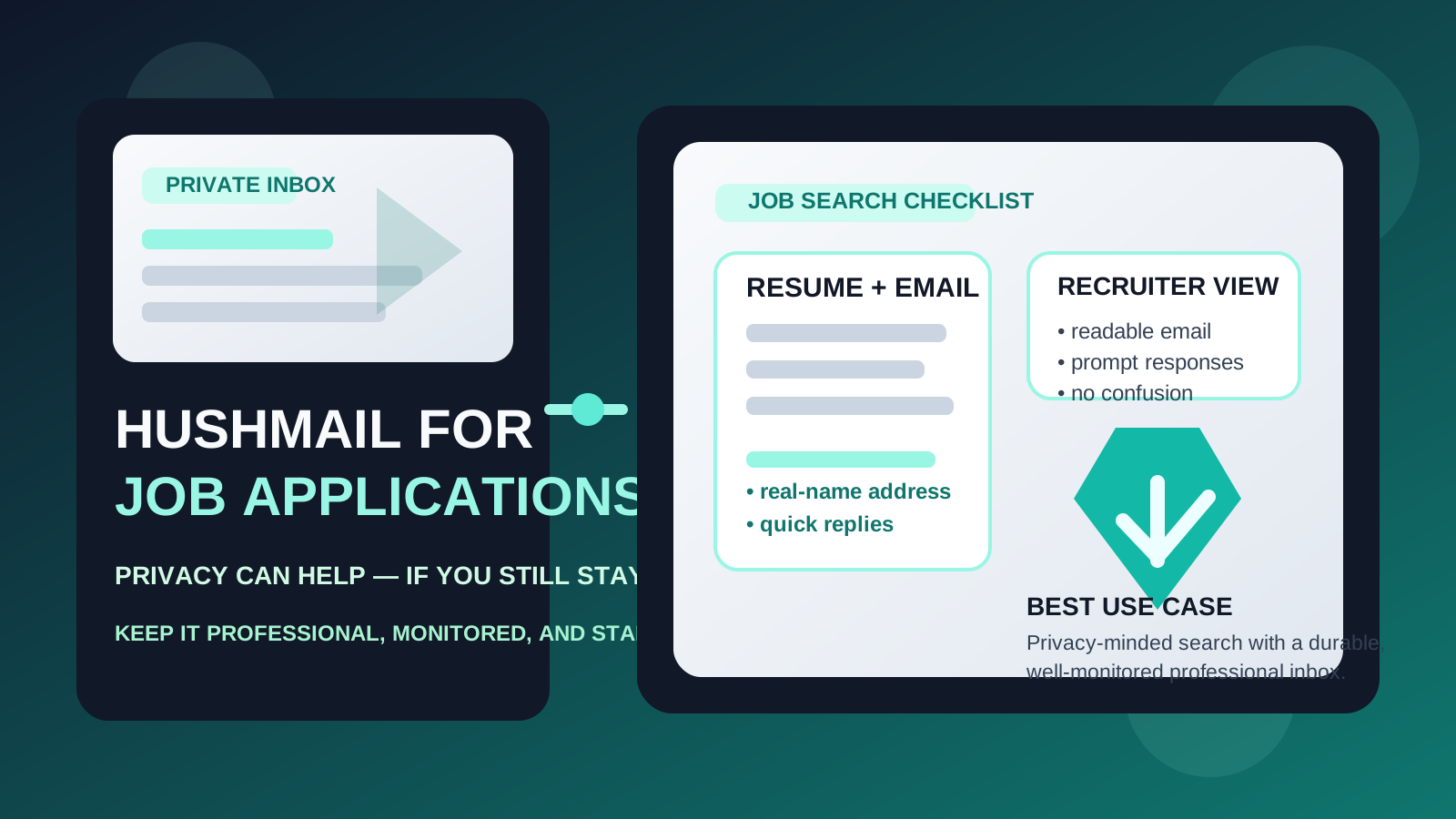
That is the practical answer behind searches for should you use Hushmail for job applications. Many job seekers want a cleaner separation between their personal inbox and their job search. Others want less tracking, less spam, or a more privacy-conscious provider than mainstream email platforms. Hushmail can help with that, but it is not automatically the best choice for everyone.
If you use Hushmail well, it can make your application process feel more organized and private. If you use it poorly, it can create unnecessary friction when recruiters need quick replies, interview logistics start moving fast, or you forget that an uncommon address sometimes makes people look twice. The goal is not to impress people with your email provider. The goal is to stay reachable, credible, and in control of your information.
What Hushmail does well for job seekers
Hushmail appeals to privacy-conscious people for obvious reasons. It gives you a more deliberate, less mass-market email setup than Gmail, Outlook, or Yahoo Mail. For a job search, that can be useful in a few ways.
It helps separate your job search from your daily inbox
One of the simplest benefits is separation. A dedicated Hushmail address can keep recruiter replies, interview invites, résumé follow-ups, and job-board alerts out of your personal inbox. That alone can make a search feel less chaotic.
It may reduce long-term inbox clutter
Once your address gets into recruiter databases, job boards, and employer talent pools, it can keep collecting messages for a long time. Using a separate address gives you more control over that stream and makes it easier to retire or reduce activity later if your search ends.
It fits a privacy-first mindset
Some candidates simply do not want all of their professional exploration tied to their main personal account. That is a reasonable preference. Job searches involve sensitive timing, salary conversations, career changes, and a lot of identity data. Keeping that activity in a separate inbox can feel safer and cleaner.
Will recruiters think Hushmail looks unprofessional?
Usually, no. Most recruiters care far more about whether your email address is readable, your résumé is strong, and your replies are prompt than which provider sits after the @ symbol. A clean Hushmail address based on your name can look perfectly normal.
For example, something like firstname.lastname@hushmail.com is generally much better than an address filled with random numbers, old nicknames, or joke phrases. The domain is less familiar than Gmail or Outlook, but unfamiliar is not the same thing as unprofessional.
What matters more is the total impression:
- Does the address look calm and intentional?
- Do you respond quickly?
- Are your messages clear and polite?
- Do interview invitations and follow-ups get handled smoothly?
If the answer to those questions is yes, the provider itself is rarely the deciding factor.
Where Hushmail can create friction
Hushmail is not a bad option, but it is also not friction-free. Job seekers should think about the practical downsides before committing to it as their primary application inbox.
1. Recruiter familiarity is lower
Most hiring teams see Gmail, Outlook, iCloud Mail, and Yahoo Mail constantly. Hushmail is more niche. That does not make it suspicious, but it can make it less instantly recognizable. In some cases, a recruiter may simply pause for half a second because it is not what they see all day.
2. A niche provider does not fix weak email habits
Some people pick a privacy-focused provider and then forget the basic job-search rules: check the inbox often, watch spam folders, reply quickly, and keep calendar invites organized. Hushmail only helps if you stay active in it.
3. It can be awkward if you rarely log in
If you create a special-purpose address and then treat it like an archive, you can miss recruiter replies at exactly the wrong time. A privacy-first inbox is still a communication inbox. If you use it, monitor it seriously.
4. Recovery and continuity still matter
Your job search may last longer than you expect. If a recruiter circles back weeks later, if a company reopens a role, or if an application portal requires a password reset, you need durable access to that inbox. Do not use any email address for job applications unless you plan to keep control of it for the whole search cycle.
Is Hushmail better than Gmail or Outlook for job applications?
“Better” depends on what you care about most.
If your top priority is familiarity and convenience, Gmail or Outlook usually wins. Recruiters know those providers, and you probably already use them heavily.
If your top priority is privacy and separation, Hushmail can be more appealing. It gives you a dedicated space for a job search without tying everything to the same inbox you use for friends, stores, subscriptions, and other personal activity.
In other words:
- Gmail/Outlook: easiest and most familiar
- Hushmail: more privacy-minded and intentionally separate
- Best choice overall: whichever one you will monitor carefully and present professionally
A recruiter would usually prefer a prompt candidate using Hushmail over a slow candidate using Gmail. Provider familiarity matters less than communication quality.
Should you use Hushmail as your only job-search email?
That can work, but a more balanced approach is often better: use one dedicated professional inbox for your search, and make sure it is a long-term address you can keep active.
If Hushmail is that inbox for you, fine. But do not create a new address just to apply for one or two jobs and then ignore it. Employers may revisit candidates later, resend interview requests, or ask you to log back into an application system. Treat the address as a stable professional channel, not a disposable experiment.
When Hushmail makes the most sense
Hushmail is often a good fit when:
- you want more privacy than your usual mainstream inbox gives you
- you want a separate professional inbox for a sensitive job search
- you are changing industries, employers, or regions and want better separation
- you are applying to roles where discretion matters
- you already use Hushmail reliably and know you will check it consistently
It can be especially sensible if you are currently employed and want a clean boundary between work, personal life, and active job hunting.
When Hushmail may not be the best choice
You may want something more familiar or simpler if:
- you rarely check secondary inboxes
- you tend to miss messages unless everything lives in one place
- you need ultra-fast, high-volume recruiter communication
- you are worried that using an uncommon provider will distract you or make you second-guess yourself
- you are tempted to use a short-term address you may not keep active
In those cases, a clean dedicated Gmail or Outlook address may honestly be the better tool. Privacy matters, but reliability matters too.
How to use Hushmail well for job applications
Use a real-name address
Keep it simple. Your name, or a close variation of it, is ideal. Avoid clever handles, unnecessary numbers, or anything that looks leftover from an old personal account.
Check it like a real inbox
If you apply for jobs with it, check it multiple times a day while you are actively searching. Interview scheduling often moves faster than people expect.
Keep your résumé and email aligned
The address on your résumé, cover letter, LinkedIn contact section, and application forms should match. Consistency reduces confusion and makes you look organized.
Watch your spam and junk folders
Important recruiter messages can land in unexpected places, especially when different HR tools, applicant tracking systems, and scheduling apps are involved. Make spam-folder checks part of your routine.
Respond in a plain, professional style
You do not need to explain why you use Hushmail unless someone actually asks. Most of the time, nobody will. Just answer messages clearly, confirm scheduling details, and keep the conversation moving.
What about using a temporary email instead?
For real job applications, a temporary email is usually much riskier than a durable provider like Hushmail. A temporary inbox can be useful for low-stakes signups, job-board testing, or early privacy experiments, but it is often a bad idea for serious applications where replies, password resets, or interview links may arrive later.
That is an important distinction. Hushmail can be a privacy-oriented long-term inbox. A disposable inbox from a service like Anonibox is better suited to lower-stakes situations where you want to protect your main address from spam or evaluate a service before committing your real contact details. For actual employer communication, durability usually matters more than maximum throwaway convenience.
Common mistakes job seekers make with private email providers
Picking privacy over usability without a plan
Privacy tools are only useful if they support your real workflow. If a provider makes you less responsive, less organized, or less reachable, the theoretical privacy win may not be worth it.
Using a half-disposable mindset
Some people create a “special” email for applications and mentally treat it as temporary, even when it is not. Then they stop checking it after a few weeks. That creates obvious problems when employers reach back out later.
Ignoring recruiter behavior
Recruiters often move quickly and sometimes send short, practical messages with scheduling links, interview times, or requests for availability. If you want to use Hushmail, make sure your setup supports quick action.
Overexplaining the privacy choice
You usually do not need to justify your provider. Let the email address quietly do its job. Professional behavior matters more than turning your inbox choice into a talking point.
A simple decision checklist
Before using Hushmail for job applications, ask yourself:
- Will I monitor this inbox every day while I am searching?
- Does the address itself look professional and easy to read?
- Do I want long-term separation from my personal inbox?
- Am I likely to need this address weeks or months from now?
- Would a mainstream provider actually make my workflow easier?
If your answers favor privacy, separation, and reliable monitoring, Hushmail can be a good fit. If your answers favor convenience and familiarity above all else, a dedicated Gmail or Outlook address may be simpler.
Final verdict
Yes, Hushmail can be a good email provider for job applications if you want more privacy and a cleaner separation between your search and your personal inbox.
It works best when the address looks professional, stays active for the full search, and supports quick, reliable recruiter communication. It works less well if you treat it like a rarely checked side inbox or expect privacy alone to improve your candidacy.
The best job-search email is the one that keeps you reachable, organized, and credible. For some people that will be Gmail or Outlook. For privacy-conscious candidates who value separation and will maintain the inbox seriously, Hushmail can absolutely do the job well.