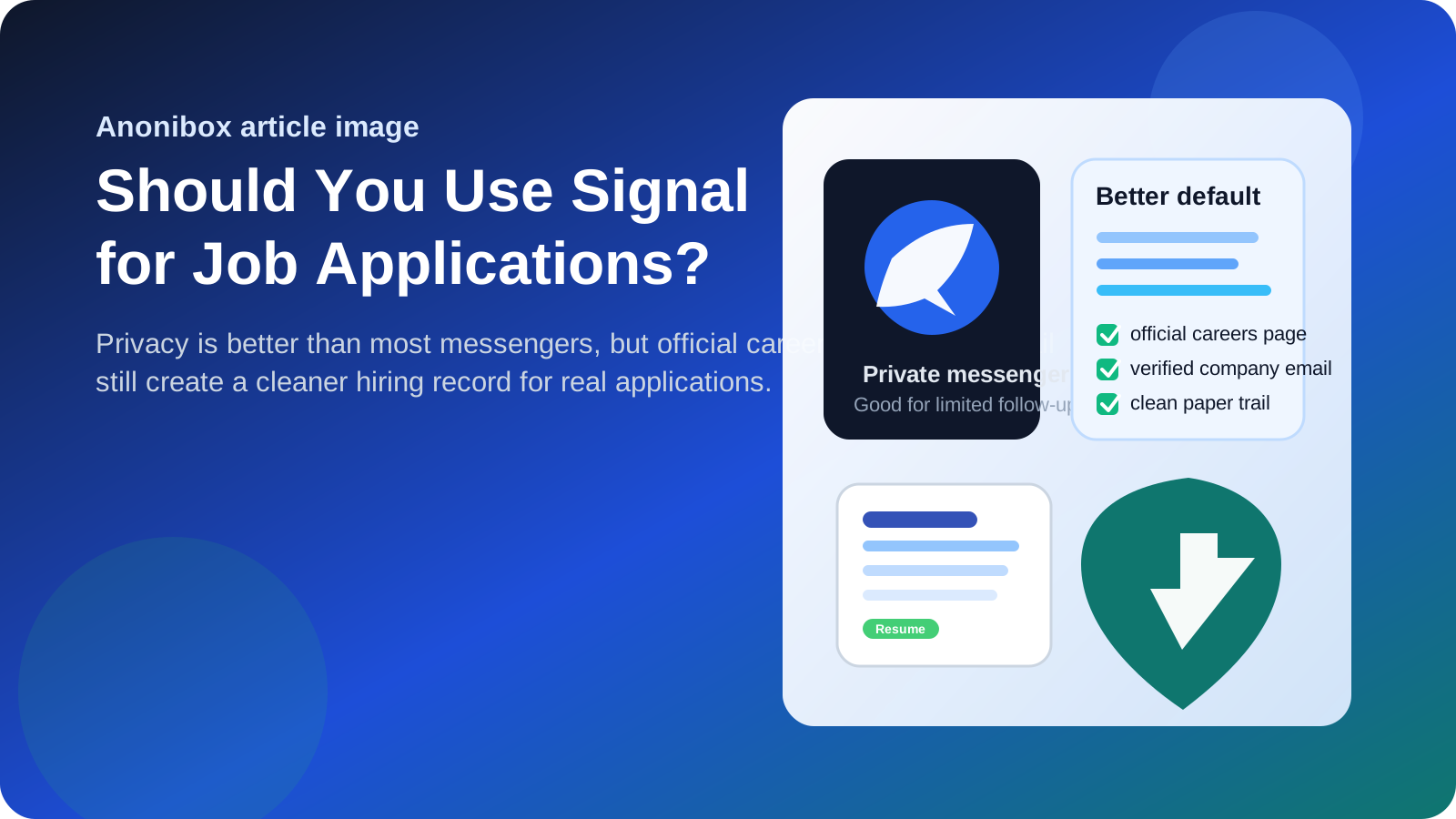
Signal is better than most messengers for privacy, but it is still usually a weak primary channel for job applications.
If a recruiter or employer is real, Signal can be fine for limited follow-up after verification; for actual applications, document sharing, and anything important, official careers pages and company email are usually safer.
That answer surprises some people because Signal has a strong privacy reputation, and that reputation is deserved in many everyday situations. If your goal is to reduce casual exposure, avoid noisy mainstream platforms, or keep conversations off less private messaging apps, Signal looks like the obvious safe choice. But hiring is not the same as ordinary personal messaging. A good job application process needs more than private transport. It also needs identity verification, a reliable paper trail, sensible document handling, and a clear boundary between serious employers and random strangers.
That is why the question should you use Signal for job applications has a more nuanced answer than a simple yes or no. Signal is stronger on privacy than many chat apps, but privacy alone does not make it the best default place to start a hiring conversation.
Short answer: better than most messengers, still not the best default
If you already know the recruiter is legitimate, the role is real, and the conversation only involves simple follow-up like scheduling or quick coordination, Signal can be reasonable. If the recruiter wants you to apply, send sensitive documents, discuss offer details, or handle the whole process inside Signal, that is usually a sign to slow down and move the conversation back toward official channels.
In other words, Signal can be an acceptable side channel after trust has been established. It is usually not the best place to establish that trust in the first place.
Why job seekers even consider Signal
People usually ask this question for good reasons. Job searching exposes a lot of personal information. Candidates worry about spam, fake recruiters, random outreach, leaked phone numbers, and the general mess that appears when multiple job boards and recruiter databases start circulating their contact details.
Signal feels attractive because it offers a few things people want:
- better privacy than many mainstream messengers
- less social clutter than apps tied to friends, family groups, and public profiles
- a cleaner boundary between serious communication and casual chatter
- more control over how directly strangers can reach you compared with public social platforms
Those are real advantages. The problem is that they solve only part of the hiring puzzle.
What Signal does well in a hiring context
It is more private than many messaging alternatives
If the only comparison is between Signal and a less private messenger, Signal usually wins. It is a better choice than handing your job search over to a random social DM channel, and for some people it feels less invasive than putting personal communication onto platforms full of profile details, status signals, or unnecessary extras.
It can work for narrow follow-up
Once an opportunity is clearly legitimate, fast messaging can be useful. A verified recruiter may need to confirm availability, send a time update, or ask a simple logistical question. Signal can handle that just fine.
It may fit some contractor or international workflows
Not every hiring process looks like a large corporate applicant tracking system. Independent recruiters, contractors, startups, and international teams sometimes mix email with secure messaging for convenience. That does not automatically make the opportunity suspicious.
But those benefits do not erase the weaknesses below.
Where Signal is still a poor primary application channel
1. It creates a weaker hiring record than email or an applicant system
Real applications benefit from structure. A company careers page or official recruiter email usually leaves a clearer record of the role, the sender, the timeline, and the requested next steps. That matters more than many people realize. If something gets confusing later, a formal paper trail is easier to search, forward, archive, and verify.
Signal messages are still chat messages. They are great for short conversations, but they are not an ideal home for résumés, assessments, interview instructions, offer details, or back-and-forth that may matter later.
2. Recruiter identity is still harder to verify in chat
Signal may be private, but privacy cuts both ways. A person messaging you there can still claim to represent a company without giving you much native proof inside the app. A company email address, public job listing, or official application portal gives you more to validate. A secure messenger does not magically make an unverified person trustworthy.
3. Your phone access still matters
Even when a messenger feels safer than SMS or other chat apps, you are still giving someone a fairly direct path into your attention. For privacy-minded candidates, that matters. Once recruiter outreach reaches your phone-based messaging layer, your job search becomes harder to contain.
4. Sensitive steps deserve a more formal channel
Documents, assessments, payroll forms, identity checks, equipment requests, offer letters, and onboarding instructions should not live only inside a private chat unless there is a very good verified reason. Serious hiring workflows need something more durable and reviewable than a messenger thread.
5. A secure app does not remove scam risk
This is one of the most important points. Signal can protect message privacy in transit, but it does not protect you from bad judgment, impersonation, or social engineering. A fake recruiter can still be fake inside a secure app. Strong encryption does not equal a real employer.
When using Signal may be reasonable
There are situations where Signal is not a red flag at all. For example:
- you already applied through the company’s official careers page
- the recruiter is independently verifiable and has also used company email
- the conversation is limited to scheduling or brief follow-up
- the role involves a contractor, startup, or international workflow where secure messaging is normal
- important documents and formal steps still move through email or a trusted portal
In these cases, Signal is functioning as a convenience layer, not the foundation of the process. That distinction matters.
When Signal should make you cautious
You should be much more skeptical if any of the following happens:
- the recruiter contacted you out of nowhere and wants to stay only on Signal
- you cannot find the role on the employer’s public site
- the sender will not identify themselves through a company email address
- they want your résumé, ID, bank details, or one-time codes in chat
- the conversation becomes pushy as soon as you ask basic verification questions
- the entire “interview” is really just fast text messages with no serious screening
Those are not Signal-specific flaws. They are scam and low-quality-process signals that happen to become easier to hide inside a chat app.
A better workflow for privacy-conscious job seekers
If privacy is your main reason for considering Signal, there is usually a cleaner way to get most of the benefit without moving the whole application process into chat.
- Apply through official channels first. Use the employer’s careers page, a trusted recruiter email, or the company applicant system.
- Separate your inbox strategy. For early-stage signups, job boards, or low-trust lead forms, many people use a separate job-search inbox. Some even use a temporary option like Anonibox for one-off verification steps before deciding which opportunities deserve their permanent contact details.
- Use a separate phone strategy if needed. If recruiter outreach gets noisy, a dedicated job-search number is often cleaner than exposing your main number everywhere.
- Reserve Signal for limited follow-up. Once the recruiter and role are verified, secure messaging can be fine for short coordination.
- Move important steps back to formal channels. Documents, offer details, interviews, and onboarding instructions should not depend on a chat thread alone.
This approach keeps the privacy mindset while preserving a better professional record.
Signal versus email and applicant systems
Email is boring, but boring is useful
Email is searchable, forwardable, and easier to archive. It supports attachments better, works across professional systems, and creates a more conventional record if there is later confusion. It is not perfect, but for job applications it is usually far more practical than chat.
Applicant systems are clunky, but they are still the real workflow
Most real employers want applications in their actual system because that is where résumé review, interview tracking, and internal handoffs happen. If a recruiter wants to skip all of that and run everything through Signal, you should ask why.
Signal is a supplement, not a replacement
That is probably the simplest way to think about it. Signal can supplement a legitimate process. It should rarely replace one.
Best practices if a recruiter asks to use Signal
- Verify independently first. Look up the company, the role, and the recruiter before you share much.
- Ask for official email. A legitimate recruiter should be able to follow up from a company domain for anything important.
- Keep the chat narrow. Use it for timing, clarifications, or lightweight follow-up rather than high-stakes steps.
- Do not send sensitive documents unless the reason is clearly legitimate and the destination is appropriate.
- Be cautious with urgency. Scammers love speed. Real recruiters can handle a few verification questions.
A quick decision checklist
Before using Signal in a hiring context, ask yourself:
- Did I already verify the company and the role independently?
- Is Signal being used only for follow-up, or for the entire application process?
- Am I being asked to share more personal information than this stage requires?
- Would the recruiter also be comfortable using company email or an official portal?
- If something went wrong later, would I wish this were documented somewhere more formal?
If those answers feel shaky, trust the friction and move the conversation back toward formal channels.
Final answer
Signal is better than most messaging apps for privacy, but it is still usually not the best primary channel for job applications. It can be reasonable for limited follow-up after you verify the employer, recruiter, and role, especially when the conversation is only about scheduling or quick coordination.
For real applications, document exchange, offer details, and anything important, official careers pages, trusted recruiter email, and structured applicant systems are still the safer default. Use Signal as a narrow side channel if the context earns it, not as a shortcut around the normal checks that protect you during a job search.