Should you use your legal name on job applications? Usually, yes—if you are filling out an official employer application, your legal name is the safest default because it reduces confusion later in background checks, payroll paperwork, and identity verification.
If the employer clearly gives you a separate preferred-name field, or you are still in earlier recruiter conversations rather than formal HR forms, you can often use the name you actually go by while making sure your legal name appears where official records require it.
This feels like a small detail, but it sits right at the intersection of privacy, identity, professionalism, and hiring logistics. Some people use the same name everywhere and never have to think twice about it. For others, it is more complicated. You may go by a nickname, a shortened first name, a middle name, or a chosen name. You may be in the middle of a legal name change. You may also have real privacy reasons for limiting where your full legal name appears during a public job search.
That is why the best answer is not a rigid always-or-never rule. The better question is: what stage of the hiring process are you in, what exactly is the employer asking for, and how much identity confusion are you willing to create in exchange for flexibility or privacy?
Short answer: use your legal name on official applications, but use the employer’s fields carefully
If an application clearly asks for your legal name, full name, or name as it appears on official records, use your legal name. That is the low-friction option. It makes it easier for the employer to line up your application with later documents if you move forward.
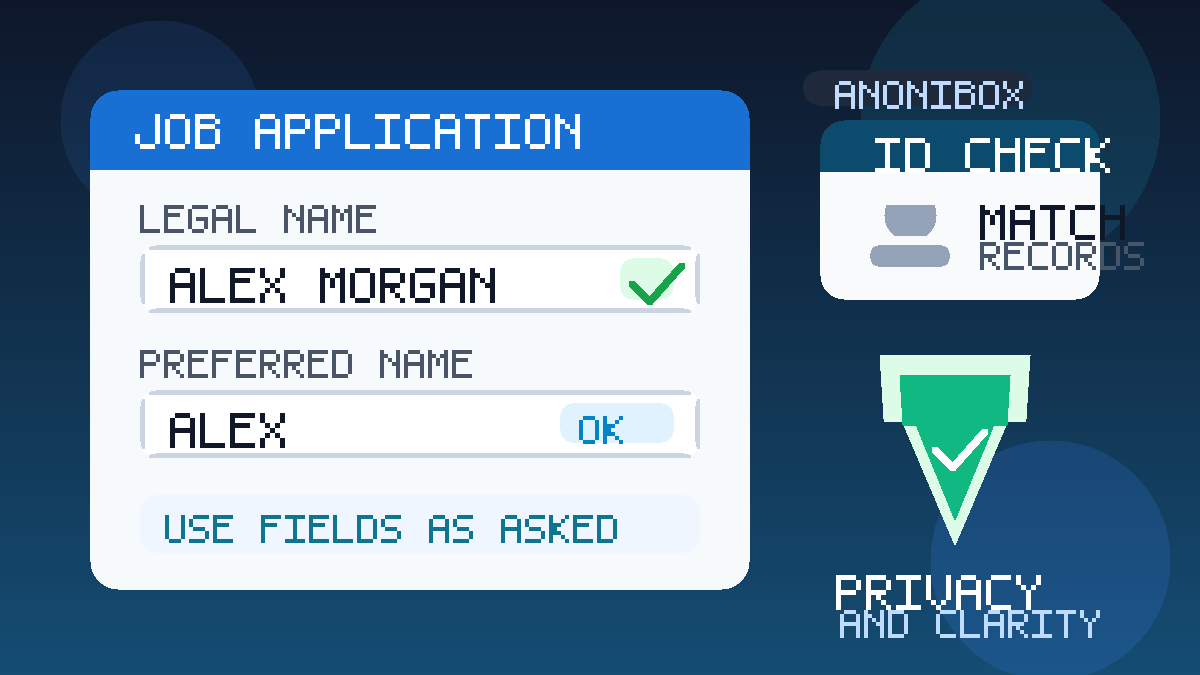
If the employer gives you both a legal-name field and a preferred-name field, use them as intended. Put your legal name where formal records belong and your everyday name where communication should happen. If the employer does not separate those fields, then you need to make a judgment call based on the role, the system, and your personal situation.
Why employers care about name consistency
Employers are not always asking for your legal name out of curiosity. Often, they are trying to avoid administrative problems later. Hiring systems are built to match résumés, interview notes, background checks, tax paperwork, onboarding records, and internal directories. If your application says one thing, your résumé says another, and your later HR paperwork uses a third variation, it can slow things down.
That does not mean every application needs your full government-style identity from day one. It just means consistency matters. The more formal the step, the more likely legal-name accuracy matters.
What counts as a “legal name” in this context?
In hiring, “legal name” usually means the name tied to your official identity documents and the name you would use for employment, payroll, right-to-work verification, and background-check records. That may or may not be the same name you use socially or professionally every day.
For example, your legal name might be “Katherine,” while nearly everyone knows you as “Kate.” Or your documents may still show an old surname while you are in the middle of updating records after marriage, divorce, or another life change. In other cases, a person may use a chosen name in professional settings while official documents still reflect something else.
The key point is that legal-name questions are usually about paperwork compatibility, not about forcing you to brand yourself a certain way in every context.
When you should usually use your legal name on a job application
1. The application explicitly says “legal name”
If the form uses those words, do not overthink it. Use your legal name. The employer is telling you how the field is meant to be used.
2. The employer’s portal is clearly formal and tied to HR records
Some systems feel less like a casual contact form and more like the front door to an applicant tracking system. If it is a direct employer portal and the form looks standardized, legal-name use is usually the safest move.
3. The role involves regulated, credentialed, or government-related hiring
Jobs in healthcare, education, finance, law, aviation, government, defense, or other regulated environments often involve credential matching. Even early inconsistencies can create avoidable back-and-forth.
4. You are close to background-check or onboarding stages
Once you are moving into identity verification, employment eligibility paperwork, reference checks, or payroll setup, accuracy matters more than presentation. That is not the stage for improvising around name fields.
When a preferred or everyday name may be appropriate
1. The employer gives you a separate preferred-name field
This is the cleanest setup. Use your legal name where required, then add the name you actually want people to use in interviews and day-to-day communication.
2. You are still in early recruiter or networking conversations
Email introductions, networking outreach, portfolio submissions, and informal recruiter conversations are not always the same as a formal application record. At that stage, using the name you actually go by is often reasonable, especially if you can clarify your legal name later when necessary.
3. The application language is general, not explicitly legal
If a form just says “name” and gives no other guidance, some job seekers choose the name they professionally use most often. That can work, but only if you are prepared to keep the rest of the process consistent and explain any difference later without confusion.
Privacy reasons some job seekers hesitate to use their full legal name everywhere
Not everyone asking this question is just deciding between “Michael” and “Mike.” Sometimes there are real privacy or safety concerns behind it.
- Name uniqueness: an uncommon legal name can make you very easy to trace across public records, old addresses, and social profiles.
- Name-change transitions: your legal documents may lag behind the name you currently use in daily life.
- Personal safety: some people intentionally limit searchable personal information because of stalking, harassment, or family-safety concerns.
- Identity and dignity: some applicants use a chosen name that better reflects who they are, even if official paperwork has not fully caught up.
Those concerns are not trivial. But they still have to be balanced against the risk of creating a mismatch that slows down a legitimate application.
What can go wrong if your names do not match?
A mismatch does not automatically destroy an application, but it can create friction in a few predictable ways.
Administrative confusion
A recruiter may not realize your résumé, application, email signature, and LinkedIn profile all belong to the same person if each one uses a different variation.
Delays in verification
Background-check vendors and HR teams often want records that line up cleanly. If names differ, you may be asked to clarify them later, which is manageable but annoying.
Lost communication
If the employer stores one name in the system while you answer calls or emails under another, you can end up missing messages or having to repeatedly explain yourself.
Avoidable suspicion
Most reasonable employers understand nicknames, preferred names, and name changes. But messy inconsistency can still make you look disorganized when the real issue is just a poor name strategy.
What to do if the application only has one name field
This is where the decision gets practical. If there is only one field and no explanation, the safest default is usually your legal name—especially for a direct employer application. Then, once you are in contact with a recruiter or hiring manager, you can politely note the name you prefer to use in conversation.
For example, you might keep the formal application under your legal name but sign emails with something like: “My legal name is Katherine Smith, but I go by Kate.” That keeps the records clean without forcing every interaction to use the most formal version of your name.
If you choose the reverse—using a preferred name in the only field—be prepared to explain the difference later in a calm, matter-of-fact way. That can work, but it leaves more room for friction.
How this differs from your résumé, LinkedIn, and job-search email
Your résumé is a marketing document. A formal application is an employer record. Those are related, but they are not identical. That is why many people feel more flexibility on the résumé than on the application itself.
The same goes for LinkedIn, portfolio sites, and job-search email. You may present yourself publicly under the name you actively use while keeping your legal name for official forms. That can be a reasonable split if you manage it carefully.
If you are also using a dedicated inbox to keep your search organized, make sure the display name on that email still makes sense next to the name on your application. If you use Anonibox for job-search newsletters, early signups, or lower-trust career tools, consistency still matters. A separate inbox can help with privacy, but it should not create identity confusion when a real employer reviews your application.
Special situations that deserve extra care
Name changes in progress
If some documents still reflect an old name, using your current legal name on official applications is usually safest. If necessary, explain the transition later when HR paperwork comes up rather than trying to hide the mismatch.
Chosen names and preferred names
If you use a chosen or preferred name, look carefully for fields that let you communicate that clearly. Many employers are much better than they used to be about separating formal identity data from day-to-day communication preferences.
Safety concerns
If using your full legal name broadly creates a real safety issue, treat that seriously. You may still need to use it for official hiring records, but that does not mean you must expose it unnecessarily across every public-facing job-search surface.
International applications
Name expectations vary by country and employer. In some places, formal identity matching may happen earlier. In others, preferred-name use may be more normal. If you are applying internationally, do not assume one rule fits every market.
Best practices for handling name fields without drama
- Read the field label carefully: “name” and “legal name” are not always the same instruction.
- Stay consistent across core materials: résumé, application, email signature, and LinkedIn should not feel like four different people.
- Use preferred-name fields when they exist: that is what they are for.
- Clarify early if needed: once a recruiter is in touch, a simple explanation usually solves the issue.
- Do not invent identities: the goal is clarity and privacy, not creating a misleading record.
- Save the most formal details for the most formal stage: official employment paperwork matters more than public-facing search materials.
A quick decision checklist
Before you fill in the name field, ask yourself:
- Is this a direct employer application or just an early networking touchpoint?
- Does the form specifically ask for a legal name?
- Is there a separate preferred-name field?
- Will a different name create confusion with my résumé, LinkedIn, or email?
- Do I have a real privacy or safety reason to limit where my full legal name appears?
If the form is formal and employer-run, legal name is usually the best answer. If the context is less formal or gives you room to distinguish between legal and preferred names, you have more flexibility.
Final answer: should you use your legal name on job applications?
Usually, yes—especially on official employer applications and anywhere that may feed directly into HR, background checks, or onboarding records. That is the simplest way to avoid confusion later.
But that does not mean your legal name has to dominate every part of your job search. If an employer provides a preferred-name field, use it. If you are still in informal recruiter conversations, the name you actually go by may be perfectly appropriate. The smart move is to balance privacy, identity, and practicality rather than treating every name field the same.
In other words: use your legal name where the records need it, use your everyday name where communication benefits from it, and keep the two aligned enough that a legitimate employer never has to guess who you are.