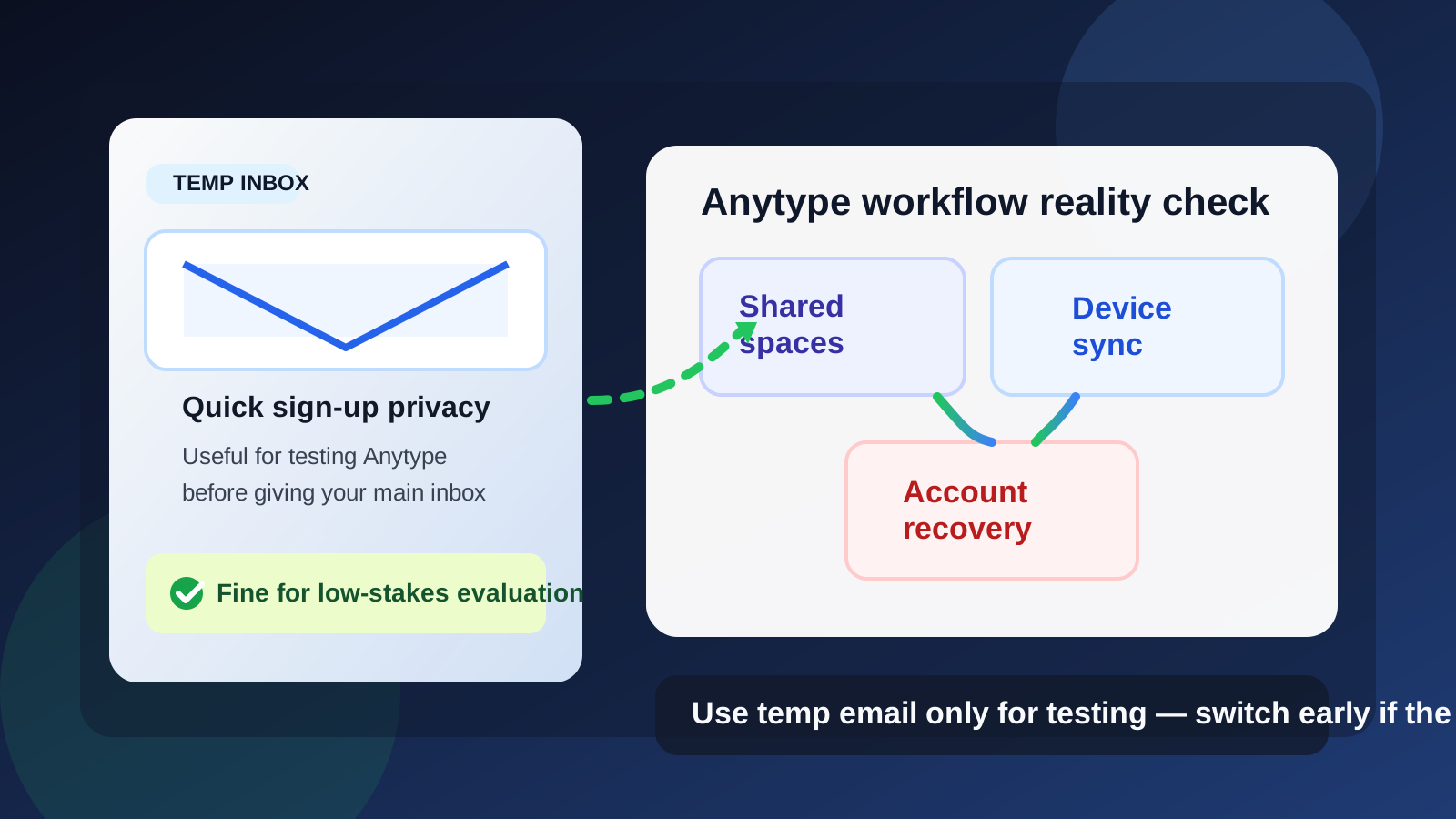
A temp email can work for Anytype sign-up privacy and quick testing, but it becomes risky once shared spaces, sync, or account recovery start to matter.
Yes, you can use a temp email for Anytype during low-stakes evaluation. No, it is not a smart long-term choice if you plan to keep important notes, collaborate, or rely on the account later.
That is the short answer most people actually need. A throwaway inbox can be useful when you are comparing note-taking tools, checking a signup flow, or keeping yet another software trial out of your main inbox. But apps like Anytype can stop being casual experiments very quickly. The minute you start building real spaces, saving useful information, syncing devices, or sharing work with other people, the email on the account stops being a small detail and becomes part of the account’s long-term stability.
If you are thinking about using a temp email for Anytype, the real question is not just whether the signup works. The better question is how far you expect the account to go. Early privacy is one thing. Reliable recovery, continued access, and a durable workflow are something else.
When a temp email for Anytype makes sense
There are a few cases where using a temporary inbox is perfectly reasonable.
- You only want to test the signup flow: maybe you just want to see how quickly you can get inside the app and whether the onboarding feels worth your time.
- You are comparing multiple tools: if you are evaluating Anytype alongside Obsidian, Logseq, Standard Notes, Notesnook, Capacities, or another knowledge app, a temp inbox can keep trial emails compartmentalized.
- You want less inbox clutter: verification emails, welcome sequences, product updates, and feature announcements add up fast when you test several apps in the same week.
- You are privacy-conscious during early exploration: some people simply do not want every product test tied to their main personal email from the first click.
In those situations, a temporary inbox can be practical. You get the confirmation message you need, you take a look around, and you decide whether the product deserves a deeper setup. For that stage, a tool like Anonibox fits naturally: it lets you test without immediately feeding another long thread of messages into your primary inbox.
Why Anytype becomes a bad match for a throwaway inbox later
The problem is not the first login. The problem is what happens after you decide the app is actually useful.
Anytype is not the kind of tool people use once and forget. It is closer to a personal workspace, a notes system, and sometimes a collaboration environment. If you start building a serious setup, the account can become important faster than expected.
1. Your notes and spaces stop being disposable
It is easy to begin with “I’m just testing this” and then slowly move real information into the app. A few ideas become project notes. A few project notes turn into a real structure. Suddenly the account is not a throwaway experiment anymore.
Once you care about what is inside the account, the login email matters more. If the email attached to the account is fragile, inaccessible, or short-lived, your whole setup becomes more fragile than it needs to be.
2. Shared spaces and collaboration raise the stakes
If you use Anytype with shared spaces, invites, or collaborative workflows, a disposable inbox gets even riskier. Team-style tools and shared knowledge setups work best when account ownership is stable. You do not want access to invites, confirmations, or important account messages tied to an address that may disappear or become inconvenient later.
3. Sync matters more than signup privacy after the trial phase
Early privacy is helpful, but ongoing access is usually more important once you start syncing between devices. The more your workflow depends on moving between desktop, laptop, phone, or tablet, the less sense it makes to leave the account attached to an email address you do not control long-term.
4. Recovery problems always show up late
This is the classic temp-email mistake. Recovery does not feel important on day one because nothing has gone wrong yet. It only becomes important when you forget a password, replace a device, need to confirm ownership, or come back to the app after a break. That is when a throwaway inbox turns from a convenience into a liability.
The real trade-off: privacy now vs continuity later
People usually choose temporary email for a sensible reason: they want to limit exposure. That is fair. Your main inbox is already crowded, and not every product trial deserves a permanent relationship with it.
But privacy is not only about giving out less information. It is also about maintaining control. If you cannot receive an important message later, cannot recover the account smoothly, or cannot confirm ownership when you need to, you have not necessarily protected yourself. You may have just moved the risk from spam to account fragility.
For Anytype, the balance is simple. A temp email can be good at the top of the funnel. It becomes weaker the moment the account starts carrying real value.
A better setup for most people
The best privacy approach is usually not “always use your main inbox” and not “always use a disposable inbox forever.” A staged setup works better.
Stage 1: use a temp email only for quick evaluation
If you want a low-commitment look at the product, temporary email is fine. Use it to verify the account, inspect the interface, and decide whether Anytype even belongs in your shortlist.
Stage 2: switch to a stable inbox once the account feels real
If you start saving useful notes, setting up a real workspace, or planning to keep the app installed, move the account to an address you actually control long-term. That does not have to be your oldest personal email. A separate permanent inbox or alias dedicated to productivity tools is often the cleanest compromise.
Stage 3: treat durable tools like durable accounts
Once an app becomes part of your daily system, the account should be recoverable, monitored, and easy to maintain. Your login email should support that reality rather than undermine it.
Temp email vs separate permanent email
This distinction matters more than most people realize.
- Temp email: good for quick verification, spam control, and early product testing.
- Separate permanent email: good for tools you may keep but do not want mixed into your oldest or busiest inbox.
- Main inbox: good if you already trust the app, do not mind centralizing messages, and prefer simplicity over compartmentalization.
For Anytype specifically, the second option is often the sweet spot. You still protect your main inbox, but you avoid the long-term instability that comes with a disposable address.
Good use cases for a temp email here
- Checking whether the interface makes sense for your workflow
- Testing a signup and welcome flow before you commit
- Comparing several knowledge or note tools in the same week
- Keeping one more trial out of your primary inbox
- Exploring the app with no intention of storing anything important yet
Bad use cases for a temp email here
- Building a real notes system you expect to keep
- Creating spaces you care about long-term
- Using the account across several devices
- Relying on shared spaces or collaboration
- Depending on email for recovery or important account notices later
That is the clean line. If the account is still disposable, a temporary inbox may be fine. If the account is no longer disposable, the inbox should not be disposable either.
What to do if you already used a temp email for Anytype
If you already signed up with a throwaway inbox, you do not need to panic. The important thing is to decide whether the account is still just a test or whether it has become part of your real workflow.
If it is still just a test
You may not need to do anything. If you only clicked around, created a few sample items, and do not plan to keep using the account, the temp email probably did its job.
If you want to keep using the account
Change the email as soon as you can, while you still have access. Do it before you build more value into the account, add more devices, or start sharing anything important.
If the inbox is already gone
Your options may be narrower. Try the normal login path first, check whether you can still reach account settings, and use any official recovery route the product provides. But this is exactly the situation you want to avoid by switching earlier rather than later.
Common mistakes people make
Keeping “temporary” setups for too long
People often mean to test a product for a day and then end up using it for months. The throwaway setup does not feel risky until the account already matters.
Forgetting that email is part of account security
Email is not just for marketing. It is also part of verification, ownership, recovery, and support communication. Treating it like an unimportant detail is where many avoidable problems begin.
Assuming privacy always means disposable
Sometimes the smarter privacy move is segmentation, not disposability. A separate inbox you control is often better than a true throwaway address for tools you may actually keep.
Waiting until something breaks to fix the email
Updating your email before the account becomes important is easy. Fixing it after you have a recovery problem is much harder.
A quick decision checklist
Before you use a temp email for Anytype, ask yourself:
- Am I only evaluating the product, or do I think I might keep it?
- Will I care about what I put inside this account next month?
- Will I use shared spaces, collaboration, or multi-device sync?
- Would I be frustrated if I could not receive an important recovery message later?
- Would a separate permanent inbox solve the privacy problem better than a disposable one?
If your answers point toward ongoing use, switch to a stable inbox early. If your answers point toward a short experiment, temp email is still a reasonable tool.
Final answer
Use a temp email for Anytype only if you want short-term sign-up privacy, a quiet trial, or a fast way to test the app without giving up your main inbox right away.
Do not keep using one if shared spaces, sync, collaboration, or account recovery matter. Once the account becomes real, the email attached to it should become real too. That gives you privacy during evaluation without making a useful workspace harder to trust later.