Yes — a temp email for BoldSign setup can be a sensible way to verify signup, test sample signature requests, and compare the product without giving another vendor your everyday inbox immediately.
No — it becomes a bad idea once BoldSign is tied to real agreements, reusable templates, billing, team ownership, or any workflow you may need to recover later.
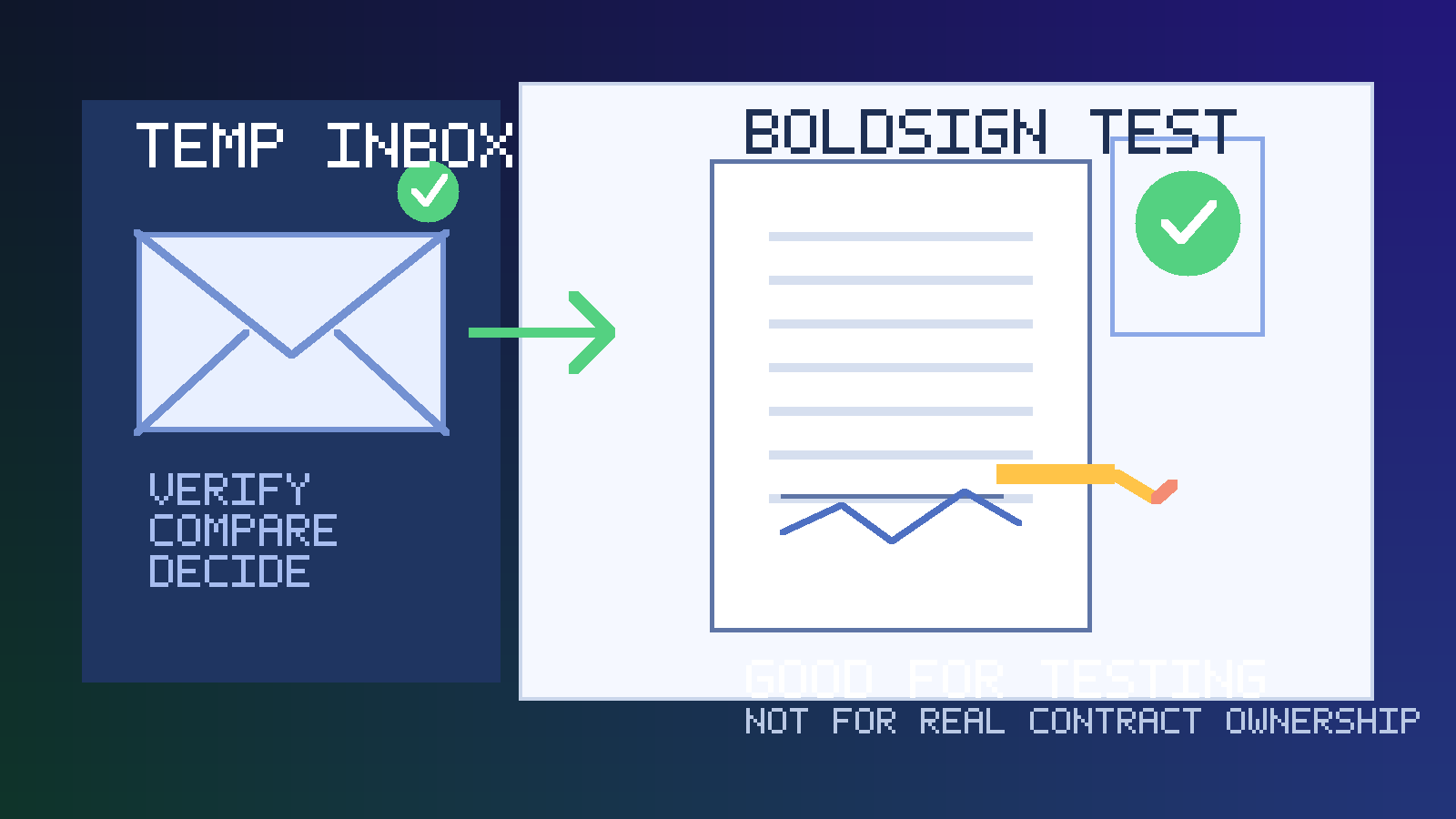
That short answer is the practical one. E-signature tools sit in an awkward middle ground: they are easy to trial casually, but they can become business-critical faster than many other SaaS products. You might only need one inbox to click a verification link, review onboarding messages, and send a harmless sample document during evaluation. But once the account starts holding live documents, shared templates, signer notifications, or admin settings, the email behind it matters a lot more.
That is why people search for terms like temp email for BoldSign, burner email for BoldSign, or disposable email for BoldSign. They want a clean way to evaluate the tool without inviting long-term sales or product email into a primary inbox before they are sure the platform is worth adopting. Anonibox can help with that early-stage privacy problem. The important part is knowing where the safe testing window ends.
Why people use a temp email for BoldSign in the first place
Most people are not looking for a workaround so much as a cleaner trial process. When you compare e-signature tools, every vendor wants some version of your email before you can really look around. That can lead to a stack of welcome emails, setup nudges, demo prompts, reminder messages, and follow-up outreach from platforms that may never make the shortlist.
A temporary inbox helps because it lets you:
- verify the account quickly without using the inbox tied to your everyday work
- compare multiple signing tools cleanly with less inbox clutter
- separate evaluation from adoption so your final decision is based on workflow fit, not email fatigue
- reduce early-stage exposure when you are still deciding whether the vendor deserves long-term access to your real contact details
For a short test, that is reasonable. The mistake is assuming the same inbox strategy should stay in place after the account becomes useful.
When a temporary inbox makes sense for BoldSign
A temporary address is most useful when your goal is clearly exploratory. In practice, that usually means one or more of the following:
- you want to see how quickly you can get from signup to the first test document
- you are comparing BoldSign with DocuSign, PandaDoc, Acrobat Sign, Dropbox Sign, or similar tools
- you only plan to send sample files to yourself or teammates during evaluation
- you want to inspect reminder emails, signer notifications, and the basic signing flow before committing further
- you are trying to keep another wave of sales and onboarding messages out of a long-lived inbox
In those situations, a temp inbox is functioning like a privacy buffer. It gives you access to the trial while keeping the relationship lightweight until you know whether BoldSign fits your real workflow.
When a temp email becomes risky instead of useful
The risk changes as soon as the account starts holding business value. An e-signature platform is not just another newsletter signup. Once you move beyond casual testing, the inbox connected to the account may become the path for account recovery, signer notifications, permission changes, billing updates, template ownership, and team invitations.
That means a disposable inbox is a poor long-term fit when:
- real contracts or customer-facing documents are involved
- your team is sharing templates or approval workflows
- the account will be tied to billing or subscription management
- you may need reliable access weeks or months later
- audit history, compliance review, or internal accountability matter
At that point, the goal is no longer “keep the trial quiet.” The goal is “make sure the right person or team can always access and manage the account.” A throwaway inbox is simply the wrong tool for that job.
What makes e-signature accounts different from lower-stakes trials
Some SaaS trials are easy to abandon with no real consequence. E-signature tools are different because the account can become part of an operational chain very quickly. Even a small team may start depending on notification emails, signing reminders, document status updates, shared templates, and admin alerts within a day or two of testing.
That creates a simple rule:
Use temp email for evaluation convenience, not for ongoing ownership.
If you remember that line, most of the confusing edge cases become easier. The more the account starts to matter, the more permanent the email behind it should be.
How to test BoldSign safely with a temporary inbox
1. Generate the inbox before you sign up
Create the temporary address first so the whole evaluation stays isolated from your normal work inbox. If you are using Anonibox, treat that inbox as a short-lived trial container, not a permanent identity.
2. Keep the test limited to low-risk actions
Use the account for harmless trial tasks: verify signup, review onboarding, send a sample request to yourself, inspect reminder timing, and compare the interface with other tools. Avoid using sensitive live documents during this phase.
3. Save the messages that actually matter
During the first test, you usually only need a few things: the verification email, maybe one or two setup messages, and any notes that help you evaluate the workflow. Capture what is useful instead of letting the entire experiment sprawl across your main inbox.
4. Judge the product by the workflow, not the email sequence
What matters most is not how many follow-up messages the vendor sends. What matters is whether BoldSign handles the work you care about. For example:
- How easy is it to prepare and send a signature request?
- Can recipients understand the flow without extra explanation?
- Are reminders, status updates, and document steps clear?
- Does the interface feel reliable enough for repeated business use?
- Would your team actually want this tool connected to live contracts?
5. Switch to a permanent inbox before the account becomes real
If BoldSign makes the shortlist, move the account to a stable monitored address before you rely on it. That transition should happen before important templates, shared team access, or customer-facing documents depend on the account.
Signs it is time to switch away from temp email
If any of these are true, the disposable phase is probably over:
- you are sending real contracts instead of test files
- other teammates need access or admin roles
- the account will hold reusable templates, branding, or approval settings
- you care about long-term retrieval of signing records or notifications
- billing, renewals, or plan management are starting to matter
Once those conditions appear, keeping a temporary inbox attached is no longer privacy-smart. It is operationally brittle.
Common mistakes people make with a burner email for BoldSign
- Using a temp inbox for a production account. This is the biggest one. Temporary email is fine for testing and bad for long-term ownership.
- Forgetting that account recovery matters. A signing platform is easy to create and much harder to manage later if the email behind it disappears.
- Testing with real documents too early. Keep the evaluation phase low-risk until you know the platform is staying.
- Letting the trial silently become the real account. Teams sometimes start with a quick experiment and then never migrate the account properly.
- Confusing privacy with permanence. A temporary inbox protects your main inbox during evaluation, but it is not a substitute for a controlled long-term business identity.
A simple decision checklist
Before using a temp email for BoldSign, ask yourself:
- Am I only evaluating the product, or am I already relying on it?
- Will this account stay personal, or will teammates need access?
- Could losing access to the inbox cause workflow problems later?
- Am I testing with harmless samples, or with real documents?
- Do I want short-term privacy, or do I actually need long-term account stability?
If your answers point to a short evaluation, a temporary inbox is reasonable. If they point to real operational use, move to a permanent monitored address.
Final verdict
A temp email for BoldSign is useful when your goal is to test signup, sample requests, notifications, and overall workflow fit without committing your main inbox too early. That is the privacy-friendly use case, and it is a perfectly sensible one.
It stops being sensible once BoldSign is handling real agreements, shared templates, billing, or team ownership. At that stage, the inbox behind the account should be stable, monitored, and intentionally managed. Use Anonibox or another temporary inbox strategy to keep early evaluation tidy, then switch to a permanent address before the platform becomes part of real contract operations.
That gives you the best of both worlds: less inbox clutter during testing and far less operational risk once the tool starts to matter.