A temp email for Broadly can work for a short early trial when you only need signup verification and the first onboarding messages.
It becomes risky once live customer messages, review requests, saved contacts, or team access start depending on that inbox.
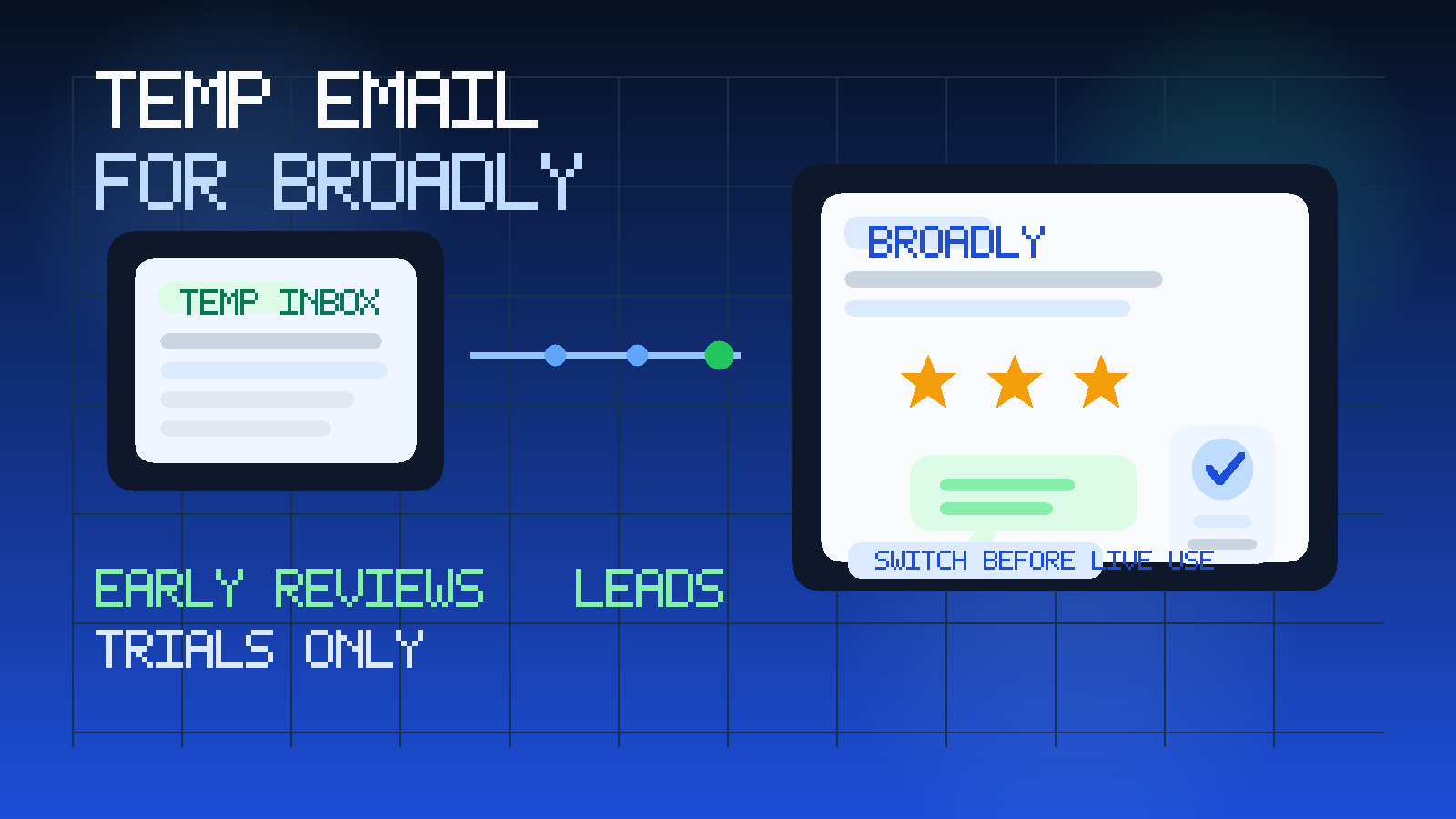
That is the practical answer. If you are only checking whether Broadly belongs on your shortlist, a temporary inbox can keep your main address out of another vendor nurture sequence while still getting you through account verification and early setup. If the product starts holding real business conversations, review workflows, or teammate access, the disposable inbox stops being a convenience and starts becoming a weak point.
Broadly sits in a category where inbox continuity matters quickly. It is not just a dashboard you open once and forget. The platform is built around reviews, lead capture, messaging, and customer follow-up for local businesses. That makes a temp inbox useful during the research stage but risky once the account starts acting like part of a real operating workflow.
If you are comparing Broadly with adjacent tools like Podium, Birdeye, NiceJob, or GatherUp, the same general rule applies: use temporary email for the first look, not for long-term account ownership. A service like Anonibox helps at that early stage because it lets you verify access without turning every software curiosity into months of email clutter.
Why someone would use a temp email for Broadly
People rarely look for a temporary inbox because they want to hide forever. Usually they just want cleaner evaluation. A single Broadly trial can trigger confirmation emails, welcome sequences, demo nudges, setup tips, feature highlights, and repeated follow-up from sales or customer-success teams. That is normal vendor behavior, but it can get noisy fast when you are comparing several local marketing or review tools in the same week.
A temp inbox creates a buffer between exploration and commitment. You still receive the messages required to activate the trial, but you do not immediately attach your long-term work inbox to a tool you may abandon after one afternoon of testing.
That makes the most sense when:
- you want a quick first look before booking a sales call
- you are comparing several local-business platforms at once
- you want to avoid long nurture sequences from tools that may never make the shortlist
- you are evaluating on behalf of a business and want exploratory signups separated from the main operations inbox
- you are still deciding whether Broadly fits your workflows at all
In those cases, the inbox is just the key to the front door. It gets you into the product without forcing an immediate long-term contact commitment.
What you can safely evaluate during an early Broadly trial
A short trial can still tell you a lot if you focus on product fit instead of treating the account like production software too early.
1. Review workflow design
You can usually tell pretty quickly whether the review-request flow feels sensible. Is the interface clear? Do prompts and automation ideas look practical for a real local business? Does the product make review generation feel straightforward or overly busy? These are fair questions to answer during a trial without making the inbox behind the account permanent.
2. Lead-capture and messaging flow
Broadly positions itself around reviews and leads, so pay attention to how the lead-handling or messaging experience is structured. You do not need to run live customer traffic through it on day one. You just need to see whether the workflow looks understandable, whether the handoff feels organized, and whether the platform seems realistic for your business or client setup.
3. Onboarding clarity
Trial software reveals a lot through onboarding. Are the first steps obvious? Does the platform explain what comes next in plain language? Are you being guided toward a real setup or just toward a demo request? Those signals matter when you are comparing tools.
4. Dashboard and reporting feel
Even in an early trial, you can judge whether the layout makes sense. A local business owner, office manager, or agency teammate should be able to understand where reviews, messages, settings, and summaries live. If the structure feels confusing while everything is still simple, that friction probably will not improve once the account becomes busier.
5. General suitability for your type of business
Different local tools feel better or worse depending on the business model. The early trial is a good time to ask whether Broadly looks aligned with how your team actually handles reviews, customer communication, and local lead flow. That question matters more than any one email sequence.
Where a temp email for Broadly starts becoming risky
The danger is usually not the verification email. The danger begins when the account becomes operational in a way that depends on continuity.
Live customer messages
If the platform starts collecting real customer conversations, web chat messages, text-based leads, or inbox-style replies, the address tied to the account matters more. If access recovery, notifications, or ownership flows lead back to a temporary inbox, you have created an avoidable failure point.
Review requests and reputation workflows
Once you are preparing real review outreach or ongoing reputation activity, a throwaway inbox is the wrong foundation. Missed notices, recovery friction, or unclear ownership may be acceptable during a test. They are not acceptable when the account starts touching real customer-facing work.
Saved contacts and long-term setup
The more time you invest in configuring the account, the less “temporary” it really is. If you would be frustrated or delayed by losing that inbox, that is already a sign the setup has outgrown temporary email.
Team access and shared ownership
As soon as teammates, managers, franchise locations, or agency partners need dependable access, the account should live behind a durable monitored address. A disposable inbox is a weak ownership anchor for something more than one person needs to trust.
Support, billing, and recovery
Serious evaluation often turns into pricing questions, support replies, implementation planning, and account changes. Those conversations belong in a stable inbox your business actually controls, not in a mailbox that existed only to get through the signup screen.
A safer staged workflow
If you want the privacy benefit without creating future cleanup, the best move is a staged approach.
- Create the temporary inbox before signup. Keep the whole first-pass evaluation separate on purpose.
- Use it for verification and early onboarding only. Let it catch the welcome email, setup prompts, and first product-tour messages.
- Evaluate the workflow, not the vendor email campaign. Judge the product by clarity, usefulness, and fit.
- Save any important links or notes outside the inbox. Temporary email is a filter, not a permanent records system.
- Switch to a permanent monitored address before real usage begins. If Broadly makes the shortlist, move account ownership before live messages, review requests, or teammates depend on it.
This is where Anonibox fits naturally. It is good for that front-end screening stage where you want access without committing your long-term inbox to every tool under consideration.
How to know when it is time to switch away from the temp inbox
If you are unsure whether the temporary address has already outlived its safe role, ask a few simple questions:
- Would losing access to this inbox slow down meaningful work?
- Are real customer messages or leads now tied to the account?
- Are review requests, alerts, or account notices becoming important?
- Do teammates or partners need stable ownership?
- Would password recovery be a real problem if the temp inbox disappeared?
If the answer to any of those is yes, the account has probably moved beyond the stage where disposable email is the right tool.
Common mistakes to avoid
- Using the temp inbox for too long: it is helpful for access, not ideal for ongoing ownership.
- Running live customer communication through a trial-style setup: that creates avoidable continuity risk.
- Forgetting to save important onboarding details: even early-stage evaluation produces links and notes worth keeping.
- Letting vendor follow-up dictate your judgment: a strong nurture campaign is not the same thing as a strong product fit.
- Treating temporary email as a security guarantee: it helps with inbox hygiene and privacy, but it does not solve every account-management problem.
Final takeaway
A temp email for Broadly makes sense when you only need a clean way to verify the trial, review the onboarding flow, and decide whether the platform deserves deeper evaluation.
It becomes a bad long-term choice once live messages, review requests, saved contacts, or shared team access start to matter. Use temporary email for the first look, then move serious finalists to a permanent monitored inbox before the account becomes operational. That keeps your evaluation cleaner without building real business workflows on a throwaway address.