A temp email for Crowdsignal is useful when you want to test signup, email verification, or a one-off survey workflow without tying your permanent inbox to every experiment.
It is a bad long-term choice for live surveys, shared team access, response notifications, or any Crowdsignal account you may need to recover later.
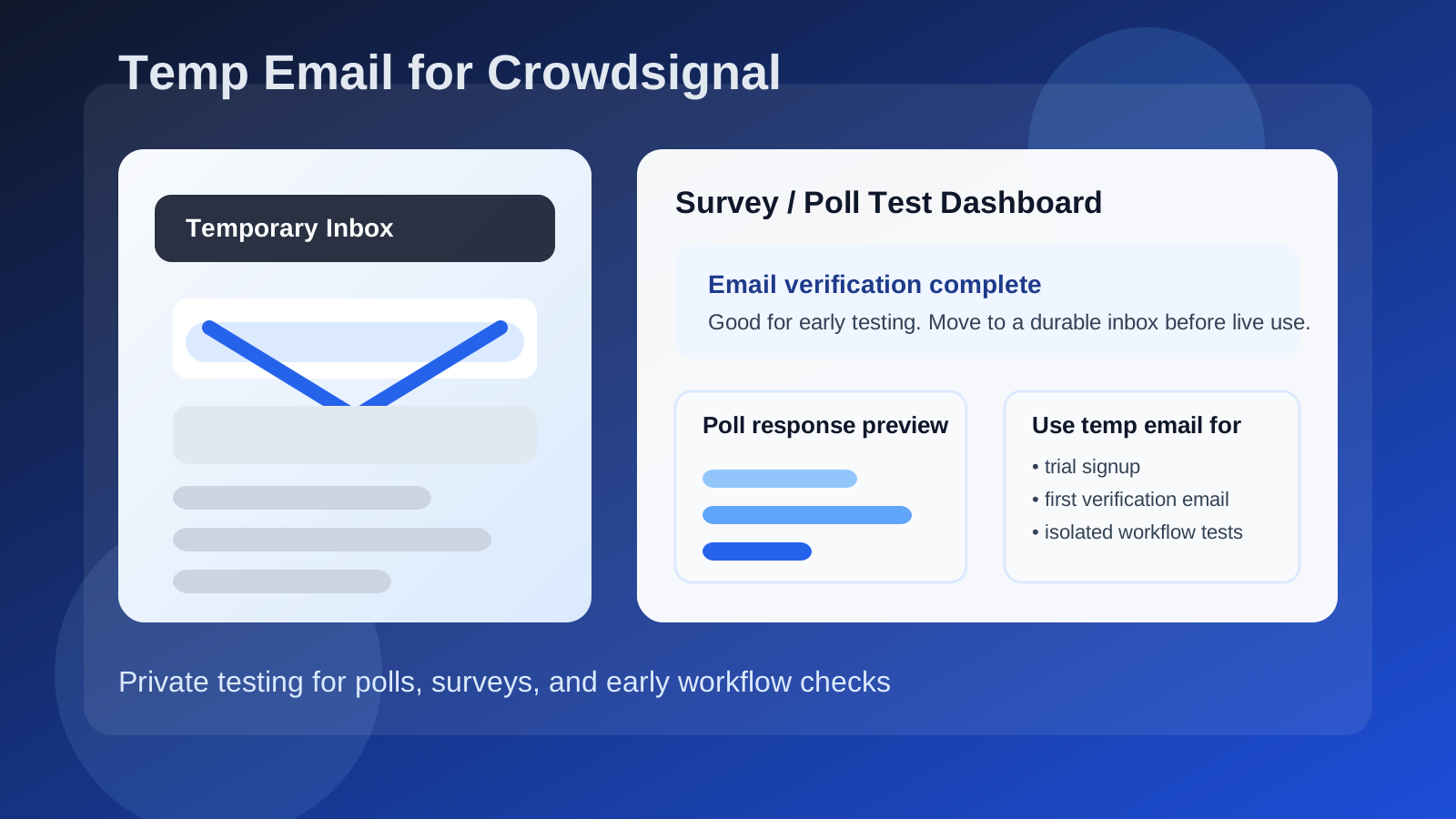
That short answer matters because Crowdsignal sits in an awkward middle ground. It can be used for simple polls, lightweight feedback forms, quizzes, and survey experiments where a throwaway inbox feels convenient. But the moment a project starts collecting real responses, involves colleagues, or becomes part of ongoing customer, community, or research work, the convenience of a temporary address starts to create risk.
If you are only evaluating the product, comparing tools, or testing how signup and notifications behave, a separate inbox can be sensible. If you are launching something you may need to monitor next week, next month, or after a password reset, a durable address is usually the smarter move.
When a temp email for Crowdsignal makes sense
There are a few situations where using a temporary inbox is practical rather than reckless.
- Early product evaluation: You want to see how account creation, email verification, and the basic dashboard feel before committing a real work address.
- One-off testing: You are checking whether polls, surveys, or quiz flows behave the way you expect and do not want every trial attached to your main inbox.
- Notification sampling: You want to confirm what the first emails look like before deciding whether the tool belongs in your normal workflow.
- Inbox isolation: You already use separate addresses for vendor trials and want Crowdsignal testing to stay in that same lane.
In those cases, a temporary inbox works a bit like a sandbox. It lets you verify the account, receive the first messages, and inspect the experience without inviting long-term promotional mail into your everyday email setup.
Why people reach for temporary email in survey tools
Survey and poll platforms often look low-risk at first. You sign up, create a test form, maybe send yourself a sample response, and think, “Why not keep this lightweight?” That instinct is reasonable. Many people do not want to hand over their main email address just to explore another SaaS dashboard.
There is also a privacy angle. If you test multiple form or feedback tools in the same week, each one may send onboarding messages, feature updates, webinar promos, upgrade prompts, and reminder sequences. Using a disposable inbox can keep that evaluation noise contained while you compare options.
That is where a service like Anonibox can fit naturally: it helps you separate quick experiments from your real inbox. The key is treating the temporary address as a testing tool, not as permanent account infrastructure.
Where a temp email for Crowdsignal becomes risky
The risk starts when the account stops being disposable even though the inbox still is.
1. Live response monitoring
If you publish a real survey, poll, or quiz, email messages can become operational rather than optional. You may need alerts about new responses, ownership changes, or important account events. A temporary inbox is easy to lose track of right when those messages become meaningful.
2. Team access and shared ownership
As soon as coworkers, clients, or collaborators are involved, the account should live behind an address someone can reliably access later. Disposable inboxes are poor foundations for shared responsibility. If the original address disappears or no one remembers how it was handled, the project becomes fragile.
3. Password resets and recovery
Account recovery is one of the biggest practical problems. A temporary inbox can feel harmless on day one and painful on day thirty. If you forget a password, need to confirm a security action, or have to verify ownership after a long gap, the short-lived address may no longer help you.
4. Long-running campaigns or customer feedback programs
Ongoing feedback collection deserves stable contact details. Even if Crowdsignal is only one part of a broader workflow, the account behind that workflow should not depend on an inbox you created for convenience during a ten-minute trial.
A good workflow if you want to test Crowdsignal privately
You do not have to choose between total exposure and total caution. A better approach is to use a temporary inbox only for the evaluation phase, then switch to a durable address before the survey matters.
- Create the temporary inbox first. Keep the experiment separate from your normal work or personal mailbox from the start.
- Use it only for setup and early verification. Confirm the account, inspect the first emails, and test the interface.
- Run a small internal test. Create a sample poll, survey, or quiz and submit a few dummy responses so you understand the basics.
- Save any information you truly need. If there is a useful setup link, billing note, or settings reminder, store it somewhere durable.
- Move to a real inbox before launch. If the survey will collect real responses or stay active, shift ownership to an email address you will still control later.
This keeps the privacy benefit without turning the disposable email into a hidden single point of failure.
What counts as “safe enough” testing?
Using a temp email for Crowdsignal is usually most defensible when the project is clearly temporary too. Examples include:
- comparing Crowdsignal against another survey platform
- checking whether the editor fits your workflow
- testing what verification and welcome emails look like
- running an internal mock poll that will never be reused
- learning the product before deciding whether your team even wants it
In all of those cases, the account is disposable because the project is disposable. That alignment matters. Problems usually appear when people keep using the same setup after the context changes.
When you should switch to a permanent email immediately
Some use cases are strong signals that you should not stay on a throwaway inbox for long:
- Real respondents are involved. If actual customers, members, readers, or research participants will submit data, treat the account like production infrastructure.
- You need continuity. If you expect to reopen the survey later, export results later, or compare future responses, use a durable address now.
- Another person may inherit the project. Shared or transferable workflows need stable contact ownership.
- The account will connect to other tools. The more a survey tool becomes part of a larger stack, the less sense a disposable inbox makes.
- You may pay for it. Anything tied to billing, renewals, or plan changes deserves an inbox you can keep.
Common mistakes people make
The most common mistake is confusing “easy to create” with “safe to keep.” Temporary inboxes are easy to spin up, which makes them great for quick isolation. But that same low-friction setup can trick people into leaving them attached to accounts that slowly become important.
Another mistake is assuming that if the survey itself is simple, the account behind it is simple too. Even a short poll can become important if it is linked in a newsletter, shared by a client, or used to collect public responses. Once that happens, access and recovery matter more than the convenience of avoiding a few marketing emails.
A third mistake is failing to document the switch. If you test with a disposable inbox and later migrate to a permanent address, make sure the real owner knows where the account lives now. Hidden transitions cause just as many headaches as hidden disposable signups.
A practical middle ground for privacy-conscious teams
If your goal is privacy rather than throwaway behavior, the best compromise is usually a separate durable inbox, not a fully temporary one. That gives you distance from your primary personal or shared mailbox without sacrificing recovery and continuity.
For example, you might use a dedicated testing or vendor-evaluation address for survey tools, forms, and feedback products. That approach keeps promotional mail out of your core inbox while preserving long-term control. It is often a better fit than a purely disposable address once a tool survives the first round of evaluation.
In other words:
- Temporary inbox: best for early curiosity, quick testing, and isolated verification.
- Separate durable inbox: best for ongoing tool evaluation and low-risk operational use.
- Main work inbox: best for production ownership, billing, and anything business-critical.
Final answer: should you use a temp email for Crowdsignal?
Yes, if you are only testing Crowdsignal and want to protect your main inbox from trial-stage noise. No, if the account will hold real survey work, important notifications, shared ownership, or any responsibility you may need to recover later.
The cleanest rule is simple: use a temporary inbox for disposable testing, then move to a durable address before the project becomes real. That gives you the privacy benefits of a tool like Anonibox without accidentally building a live survey workflow on top of an email account you cannot count on.
Used that way, a temp email for Crowdsignal is a smart filter. Used as permanent account plumbing, it is usually a short-term convenience that creates long-term friction.