Yes — a temp email for GMass can make sense if you only want to verify the account, take a first look at the workflow, and decide whether the tool belongs on your shortlist.
No — it is a poor long-term choice once the setup starts touching a real Gmail sender, campaign history, reply management, or anything you would actually care about keeping.
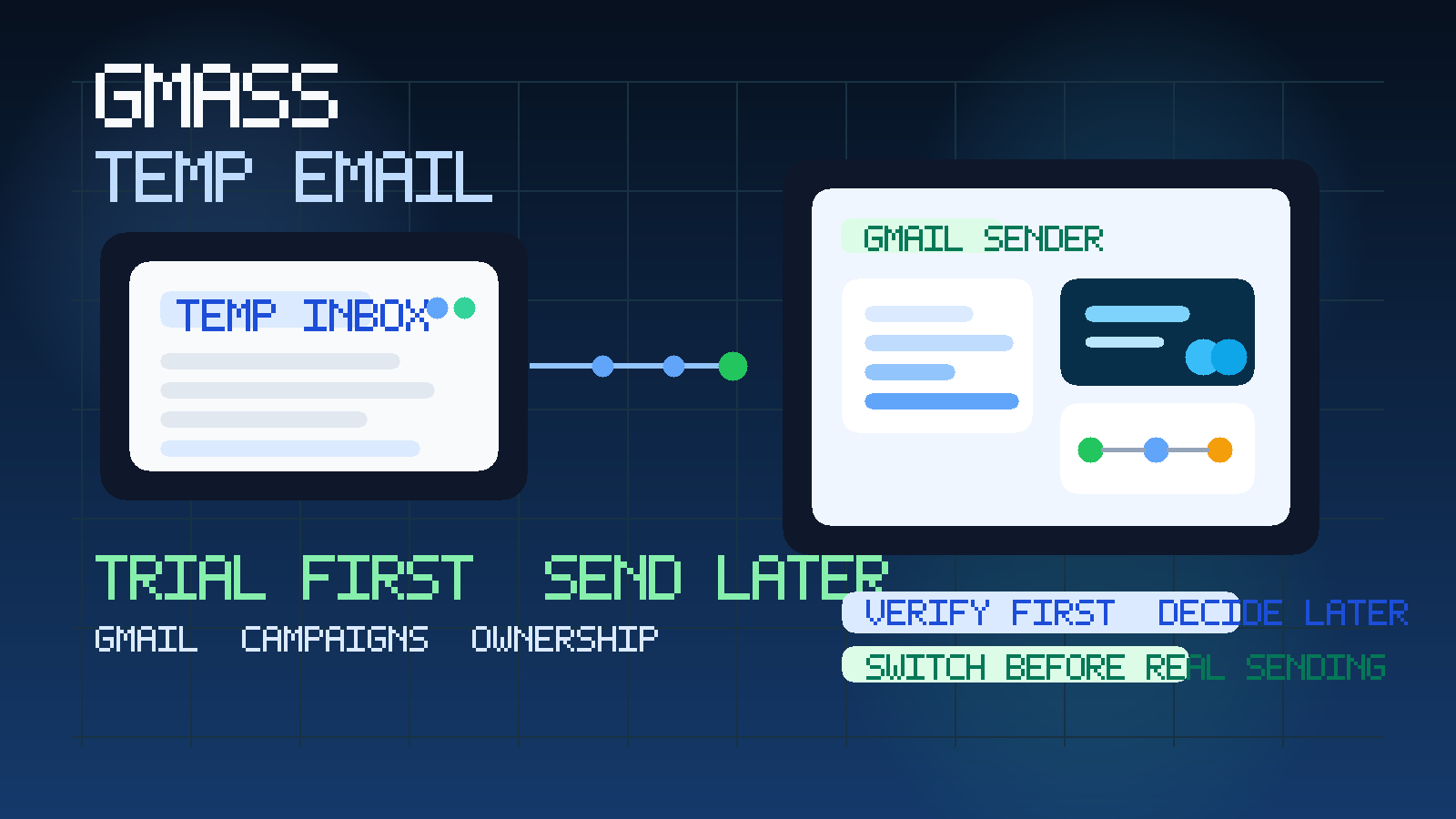
That is the practical answer. GMass sits in a category where curiosity turns into real operational risk faster than people expect. On the surface, it can feel like a lightweight cold-email or mail-merge tool you can test casually. In reality, once you begin relying on a sending identity, draft flows, contact lists, campaign configuration, or follow-up logic, the account stops being disposable even if the original signup address was.
That is why the smartest approach is stage-based. Use a temporary inbox for the first step if your goal is simply to get in, inspect the interface, and avoid sending yet another permanent address into a sales funnel. But switch to an inbox you control long term before the account becomes part of real outreach work. If you want that first layer of separation, a tool like Anonibox is useful because it keeps exploratory signups from spilling straight into the inbox you depend on every day.
Why people want a temp email for GMass in the first place
There is a simple reason this search intent exists: software trials create follow-up. A single signup can trigger welcome emails, onboarding sequences, trial reminders, upgrade prompts, webinar invites, and sales outreach. If you compare multiple outbound tools in the same week, your normal inbox can get noisy very quickly.
GMass is also the kind of product people often evaluate side by side with other cold-email or sales-engagement tools. Someone comparing it against pages the site already covers — such as Mailshake, Lemlist, Instantly.ai, Saleshandy, or broader sales engagement software free trials — may not want every vendor treating their main inbox as a high-intent buying signal on day one.
A temporary inbox solves that early-stage problem neatly. It lets you receive the verification email, inspect the first-run experience, and judge whether the product feels promising before the vendor relationship becomes permanent.
When a temporary inbox is a reasonable choice
A temp email for GMass is usually reasonable when your goal is narrow, short-term, and exploratory.
You only want to test signup and the first-run experience
If your real question is “Can I get in quickly?” or “Does this feel worth deeper testing?” then a disposable inbox can be perfectly sensible. You verify the account, look around, and decide whether the tool deserves more of your time.
You are comparing several outbound tools at once
That is one of the best use cases. If GMass is only one option in a crowded comparison, a separate inbox helps keep your evaluation organized without filling your primary work inbox with multiple nurture sequences. The point is not secrecy for its own sake. It is keeping early research clean and reversible.
You want privacy before the relationship becomes real
Early product evaluation is often casual. You may not want your normal work address tied to every trial, especially if you are a solo operator, consultant, founder, or revenue lead testing a lot of tools. A temp inbox creates a buffer between curiosity and commitment.
You are not yet connecting a meaningful sending workflow
There is a major difference between viewing a product and depending on it. If you are still just exploring, the stakes are low. That is the window where temporary email can be genuinely useful.
Where a temp email stops being a good idea
The trouble starts the moment the account begins to matter.
A real Gmail sending setup is involved
GMass is closely tied to Gmail-based sending behavior. Once your evaluation moves beyond a surface-level look and starts touching a real sender identity, campaign activity, or an inbox that matters to your business, the account should not be anchored to an address you may abandon.
Campaign history and drafts become valuable
It is easy to think, “I am only testing,” and then discover you have built something worth keeping. Maybe you created campaign drafts, refined copy, saved list segments, or compared sending approaches. Once the account holds useful work, a throwaway login becomes fragile technical debt.
Replies, deliverability learning, or inbox continuity matter
Any workflow tied to sending reputation, replies, or ongoing optimization benefits from stable ownership. Temporary email is fine for screening. It is not a strong foundation for serious email operations.
Another person may need the account later
If a teammate, founder, or client eventually needs visibility or ownership, a disposable starting point creates unnecessary friction. Long-term account control is much easier when the login sits on an address someone actually intends to keep.
GMass-specific risks people underestimate
This keyword is different from a generic “temp email for any SaaS trial” question because GMass touches a real sending environment much faster than many other tools do.
The login choice can outlive the trial
People often assume they will switch later. Sometimes they do. Often they do not. They sign up quickly, the product looks useful, the week gets busy, and suddenly the temporary setup has become the real account by inertia. That is exactly the trap to avoid.
Password recovery matters more than people expect
Even short evaluations can require resets, confirmations, or follow-up notices. A temporary inbox is only safe if you are truly comfortable losing access later. Most users are less comfortable with that once a trial becomes interesting.
Cold-email tools become operational surprisingly fast
A CRM trial can stay passive for a while. Cold-email tooling often does not. Once you begin thinking about campaigns, inbox health, sending cadence, message quality, reply handling, or list quality, you are already in a more serious zone than a disposable login deserves.
Ownership confusion becomes expensive later
If the account graduates from experiment to real contender, moving ownership after the fact can be annoying. It is safer to treat the temporary inbox as a first-look tool only, then switch before the account accumulates anything important.
How to use a temp email for GMass without creating a mess
If you want the privacy benefit, the goal is to keep the scope tight and intentional.
1. Create the inbox before you sign up
Open the temporary inbox first so all verification and first-touch messages land in one place. That keeps the evaluation separate from your daily inbox from minute one.
2. Limit the temp inbox to first-pass evaluation
Use it to verify the account, browse the interface, and decide whether GMass deserves deeper testing. If the answer is no, great — your main inbox stayed clean. If the answer is yes, move to a better-controlled address before the account becomes real.
3. Keep useful notes outside the inbox
Your disposable inbox should not be the system of record. Save pricing notes, trial observations, feature comparisons, and shortlist decisions somewhere durable so the temporary mailbox stays a filter rather than a dependency.
4. Switch early if the product survives the shortlist
The right moment to move is earlier than most people think. If you are saying things like “this might actually work for us” or “I should test this with a real sender next,” that is already the signal to move off temporary email.
5. Use a durable address before real sending or shared ownership begins
Once you are evaluating the tool seriously, use an inbox that supports recovery, continuity, and accountability. That does not have to be your most important address. A dedicated evaluation alias or stable team mailbox is often better than either your primary inbox or a fully disposable one.
A better middle ground than temp forever
The smartest workflow is usually not “temp email forever” and not “use your main inbox for every trial.” A better pattern looks like this:
- Temporary inbox for the first look: account verification, first login, basic product feel.
- Dedicated evaluation inbox for the shortlist stage: stable enough for follow-up, still separate from your everyday inbox.
- Durable business address for real ownership: the right move once sending identity, campaign work, or team continuity actually matters.
That layered approach protects your privacy without turning a throwaway login into a long-term weakness.
Quick checklist before you sign up
- Am I only inspecting the product, or do I expect to keep useful setup work inside it?
- Would losing access later be harmless, or genuinely annoying?
- Am I comparing several outbound tools at once and trying to reduce inbox clutter?
- Is this trial about casual evaluation, or is it already moving toward real sending decisions?
- Would a stable evaluation alias be safer than a fully disposable inbox at this stage?
If the trial is still narrow and replaceable, temporary email is fine. If the account is starting to hold anything important, switch early.
Final answer
A temp email for GMass is a smart short-term move for early signup, inbox verification, and first-pass product evaluation. It is a bad long-term home for an account tied to real Gmail sending, campaign work, useful setup, or any workflow you may need to recover later.
Use temporary email during the screening stage, keep your important notes outside the inbox, and move to a durable address as soon as GMass becomes more than a casual test. That gives you the privacy benefit without creating avoidable ownership and continuity problems later.